Yunnan Coffee Charts a Path to Higher Value Through Specialty Coffee
Source: InKunming | 2026-07-02 | Editor:Evan
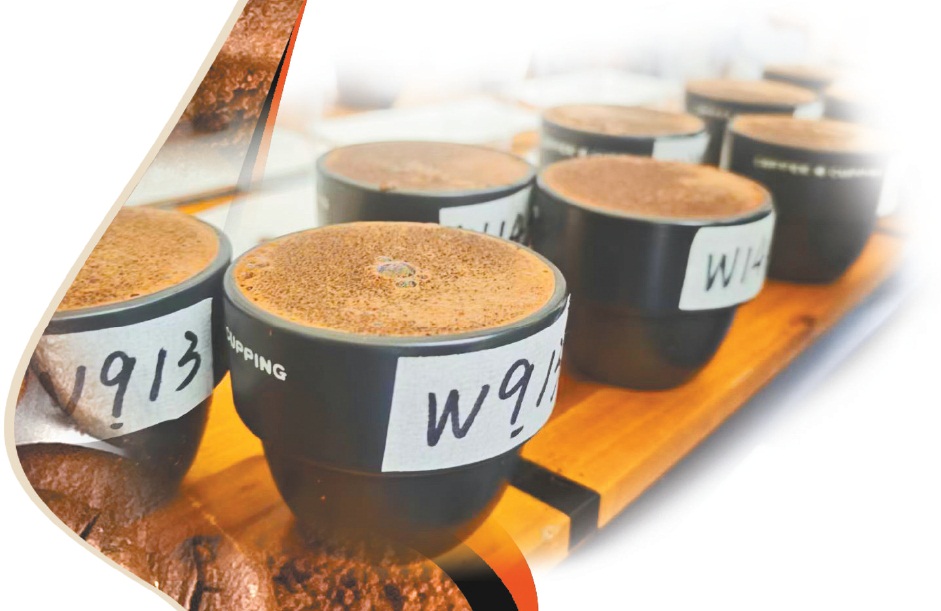
The Cup of Excellence coffee competition in progress. Photo provided by the competition organizing committee.
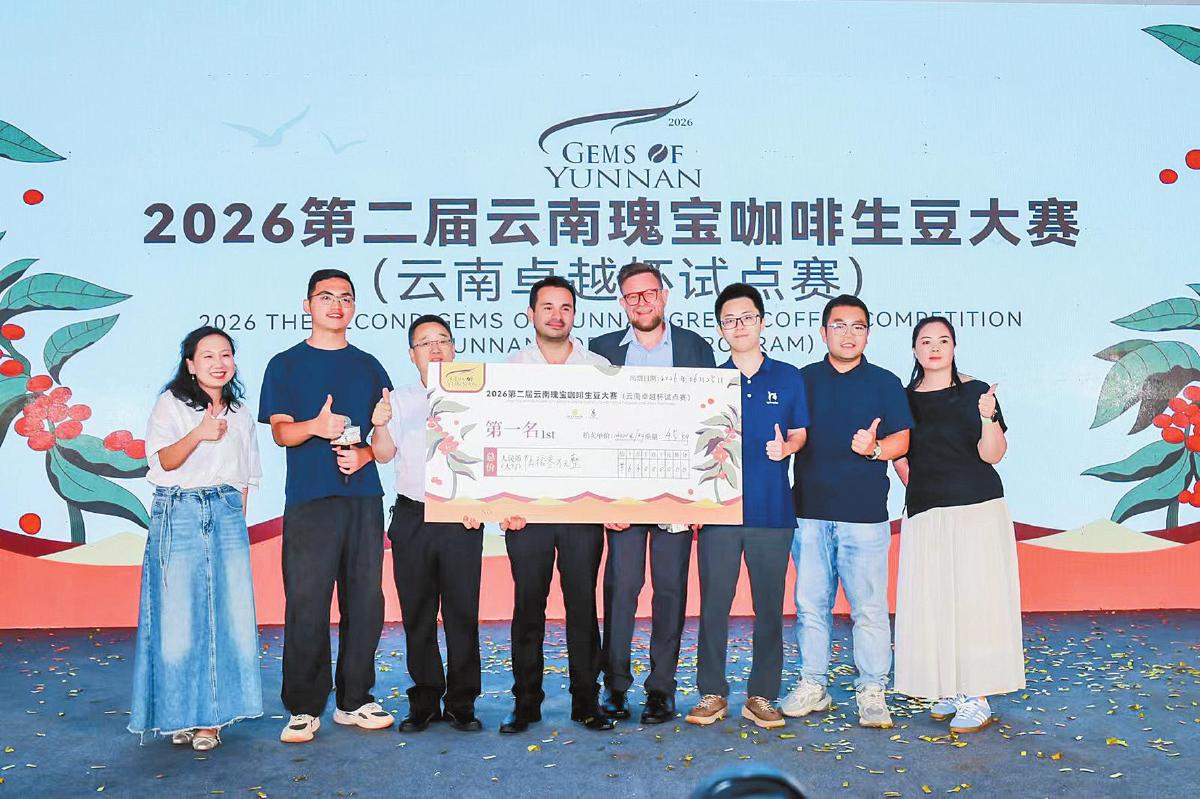
2026 the Second Gem of Yunnan Green Coffee Competition (Yunnan CoE Pilot Program) was held in Kunming. Photo provided by the competition organizing committee.
On June 25, 2026 the Second Gem of Yunnan Green Coffee Competition (Yunnan CoE Pilot Program) concluded on the shores of Dianchi Lake. Traditionally washed Geisha green coffee beans from Gengxia Estate in Lincang claimed the championship with a score of 91.78, setting a new record for Yunnan coffee competitions. The result marked a standout achievement at the event, widely regarded as the "Olympics of the green coffee bean world."
Under the rigorous scoring system of the Cup of Excellence, a score of 90 or above is widely regarded as the threshold for "excellence" and a gateway to the world's finest coffees. At this year's competition, three lots of Yunnan green coffee scored above 90 points in blind tastings conducted by an international panel of judges, while all of the top 20 entries received scores of 87 or higher. These results reflect the long journey of Yunnan's coffee industry out of a prolonged downturn and onto the global stage, marking a significant leap forward in the quality, value, and international influence of Yunnan coffee.
From Slump to Comeback
Yunnan Coffee Finds the Right Track
"The news that three lots of Yunnan coffee scored above 90 points has thrilled distributors selling Yunnan coffee overseas. It shows that the distinctive flavors of Yunnan coffee are gaining recognition among an increasing number of consumers," said a representative of the organizing committee for 2026 the Second Gem of Yunnan Green Coffee Competition (Yunnan CoE Pilot Program).
Kiers, a German judge on the international judging panel, said, "This is my first trip back to Yunnan in 15 years, and I've been amazed by the remarkable improvement in the quality of Yunnan coffee. During the competition, I could clearly appreciate the complexity and flavor profile of Yunnan coffee. Among its fruit notes, I detected lemon and mango, while its floral notes included jasmine. The competition also provides an excellent opportunity to showcase Yunnan coffee's cultivation and processing methods to judges and audiences from around the world." The competition put Yunnan coffee in the international spotlight, earning it growing recognition around the world.
Although coffee has been cultivated in Yunnan for more than 130 years, Yunnan beans were once little more than an anonymous component in blends produced by international coffee companies, exported by the ton as commodity coffee. With cultivation dominated by the disease-resistant, high-yielding Catimor variety, and pricing largely dictated by the New York coffee futures market and the purchasing departments of multinational companies, Yunnan coffee farmers remained at the bottom of the value chain.
In 2019, a bumper coffee harvest in Brazil sent international coffee futures prices plunging, driving down the purchase price of green coffee beans in Yunnan to below production costs. "Selling coffee meant losing money, so we simply stopped harvesting it. Some farmers even cut down their coffee trees and switched to growing tea or corn," recalled Liao Xiugui, a first-generation coffee farmer from Pu'er. His recollection captures the sense of despair felt across the industry at the time. Caught in this vicious cycle, Yunnan's coffee industry found itself at a crossroads.
Painful as it was, the downturn spurred a determination to reinvent the industry. The turnaround began with a strategic shift at the policy level. In 2022, Yunnan introduced the "Six Measures for Coffee," officially pivoting the industry's focus from commodity coffee to specialty coffee.
As the government's visible hand began to steer the transformation, the market's invisible hand also provided a powerful tailwind.
Over the past five years, China's coffee consumption has surged. The rapid expansion of brands such as Luckin Coffee and Manner has created strong demand for a stable supply of coffee beans, fundamentally reshaping the market's pricing dynamics. As a result, Yunnan coffee is no longer as dependent on exports. The market has undergone a dramatic shift, with the share of exports falling from about 90% six or seven years ago to just 10% today, while domestic sales now account for roughly 90%. Driven by robust domestic demand, Yunnan coffee has gained pricing power at home for the first time. Prices have tripled over the past three years, freeing growers from having their incomes dictated solely by fluctuations in the international market.
Yunnan enjoys the ideal conditions for growing specialty coffee, including a low latitude, high altitude, and wide diurnal temperature variation—natural advantages shared by many of the world's leading coffee-producing regions. Yet despite the favorable market conditions, Yunnan has taken a clear-eyed view of its challenges, recognizing that its real shortcomings lie in coffee varieties selection, cultivation practices, and processing techniques.
The turning point came through reflection after a painful downturn, setting in motion an industry-wide transformation led from the top. Centered on the "Six Measures for Coffee" policy, Yunnan's strategy directly targeted the industry's key challenges. In cultivation, the province designated 1.05 million mu (about 70,000 hectares) of land suitable for specialty coffee production, phased out lower-quality varieties, and promoted premium cultivars such as Geisha and Dere 132. In processing, government subsidies supported the construction of environmentally friendly coffee cherry processing centers and the adoption of water-efficient processing technologies. On the market front, Yunnan has worked to build a strong regional coffee brand while promoting the integration of coffee and tourism.
The figures speak for themselves. The share of specialty coffee in Yunnan increased from 8% in 2021 to 41.7% in 2025, while the proportion of coffee receiving advanced processing rose from 20% to 85%. In Xinzhai Village in Baoshan, the adoption of selective harvesting of fully ripe coffee cherries and integrated water and fertilizer management has boosted villagers' per capita disposable income to more than 40,000 yuan. Coffee beans are no longer simply agricultural products—they have become the result of scientific innovation and skilled craftsmanship.
The Strongest Backing
Staying the Course Toward Specialty Coffee
The market has continued to test Yunnan's commitment to the specialty coffee path every step of the way.
On May 1, 2026, China's policy granting zero-tariff treatment on 100% of tariff lines for products imported from 53 African countries with diplomatic ties to China officially came into effect. Specialty agricultural products from Africa, including coffee from Kenya and Ethiopia, began entering the Chinese market under the preferential tariff policy. The development quickly sparked discussion across the industry, with many asking: "With African coffee beans entering China duty-free, what does the future hold for Yunnan coffee?"
Industry insiders acknowledge that had the clock been turned back five or six years, the prospect of large volumes of African coffee beans entering the Chinese market would indeed have been a major cause for concern for Yunnan's coffee industry. Today, however, the shift toward specialty coffee has become its strongest safeguard. In 2025, the agricultural output value of Yunnan's coffee industry reached 8.39 billion yuan, up more than 70% year on year. The transition from "selling by the ton" to "selling by the cup" reflects a fundamental transformation of the industry—not the simple export low-value raw materials, but value creation through branding and specialty coffee. In this sense, Yunnan's move toward specialty coffee had already prepared the industry to compete long before the zero-tariff policy came into effect.
For the second consecutive year, the Cup of Excellence has held a pilot competition in Yunnan, bringing internationally recognized specialty coffee standards directly to the producing regions and providing Yunnan coffee with a globally recognized benchmark for quality.
Truly exceptional coffee never fears competition. Its strength lies in its irreplaceable terroir, distinctive flavor profiles, and the painstaking efforts invested in the pursuit of specialty coffee. At this year's competition, coffees from every producing region in Yunnan earned places among the finalists, highlighting the province's growing strength in diversity.
Hu Faguang, a researcher at the Institute of Tropical and Subtropical Cash Crops of the Yunnan Academy of Agricultural Sciences and director of the Yunnan Key Laboratory of Coffee, said, "This competition demonstrates that Yunnan's specialty coffee has earned international recognition. Three coffees scoring above 90 points stand as compelling evidence of the industry's commitment to the specialty coffee path."
Objectively speaking, Yunnan's coffee industry's transformation is far from complete. It still faces challenges, including limited brand recognition and the lack of a unified regional brand identity. Yunnan has proved to the world that it can produce exceptional coffee. The next challenge, however, is to make the distinctive character of Yunnan coffee a cultural symbol recognized around the world—an even more compelling chapter in its journey toward specialty coffee.
Click here to view Chinese report
(Editors: Doe, Evan)
You May Like
-
Yunnan: A Many-Splendored Life: A Vivid, Multidimensional Po...
From April 23 to May 2, nearly 50 representatives from Chinese-language media outlets in 23 countries across five continents gathered in Yunnan for the Global C...
InKunming 2026-05-19 -
"Experience economy" brews new vitality for Yunnan coffee
In the lush mountains of Pu'er in southwest China's Yunnan Province, Liu Xiaodong, head of a coffee estate, runs a "field classroom" in his coffee plantation.
InKunming 2026-05-08 -
A Horseback Can Become a Bridge: Woman from Kunming Awarded ...
Recently in Astana, the capital of Kazakhstan, Tao Mingxiu, a post-90s woman from Yunnan Province, received the Second-Class Friendship Medal from Aida Balayeva...
InKunming 2026-05-02 -
Five new colors enhance rapeseed flower appeal
A Chinese research team has cultivated 80 colors of rapeseed flowers, creating new varieties aimed at boosting the integration of rapeseed tourism with rural de...
InKunming 2026-04-22 -
Yunnan taps native fungi to refine coffee flavors
For Yunnan coffee, this could be especially significant.
InKunming 2026-04-22 -
Lancang-Mekong Cooperation: A Decade of Shared Home and Deep...
This year marks the 10th anniversary of the first Lancang-Mekong Cooperation Leaders’ Meeting.
InKunming 2026-04-08 -
Kunming’s Slow Living Guide: If You’re Tired, It’s Okay t...
Kunming, we believe that life is not a sprint, but a stroll with beautiful scenery along the way. So if you are tired too, welcome to Kunming.
InKunming 2026-03-26 -
Follow "Shuilong Yin" to Kunming: Step into the Xianxia Scen...
The 16-episode web series Shuilong Yin has captivated audiences on iQiyi, with its mist-shrouded "Xianxia landscapes" capturing the imagination of viewers.
InKunming 2026-03-24 -
Brewing success from the bean
Follow the rich aroma of coffee in Yunnan province. It drifts through ancient town alleys, mingles with mist under waterfalls, lingers at the foot of snowcapped...
InKunming 2026-03-23 -
Blending coffee, charity produces potent brew
Coffee beans grown in the mist-shrouded Gaoligong Mountains of Yunnan province had already been named among the world's best — winning gold at an international...
InKunming 2026-03-20