Brewing success from the bean
Source: China Daily | 2026-03-23 | Editor:Doe
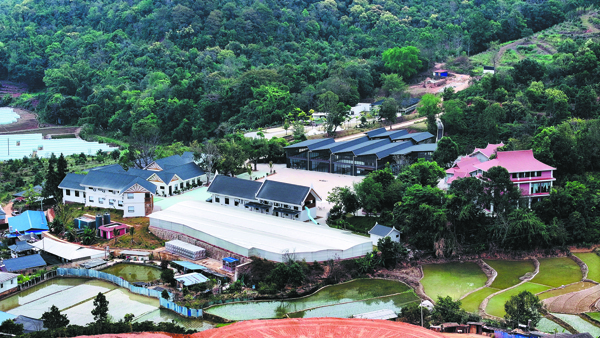
In 2025, a coffee community was established in Mangzhang village, with a coffeehouse, lodgings and public space. [Photo provided to China Daily]
Follow the rich aroma of coffee in Yunnan province. It drifts through ancient town alleys, mingles with mist under waterfalls, lingers at the foot of snowcapped mountains, and weaves through food markets and ancient architecture, where specialty coffeehouses have become ubiquitous.
Today, Yunnan's coffee industry has evolved from producing commodity beans to building its own specialty coffee brands, thanks to years of collaboration among local government, growers, entrepreneurs and research institutions.
With a planting history of over 130 years, Yunnan coffee is also gaining popularity in the global market. Official data showed that in 2025, Yunnan coffee was exported to 43 countries and regions, with new markets like Kyrgyzstan and Slovenia.
Last year, the province's coffee planting area reached 97,533 hectares, up 15.4 percent year-on-year, green bean output hit 138,900 metric tons, up 16.9 percent, and agricultural output value surged 77.8 percent to 8.66 billion yuan ($1.26 billion). All three metrics ranked first in China.
"Yunnan coffee, cultivated early and with exceptional quality, carries a distinct historical charm … Over the years, we have established a high-standard industrial chain system," says Wang Ning, secretary of the Communist Party of China Yunnan Provincial Committee and a deputy to the 14th National People's Congress, China's top legislature.
Yunnan has independently selected and bred 22 coffee varieties, including disease-resistant and high-yielding homegrown varieties with excellent flavors.
He notes that as Yunnan's coffee varieties have been continuously upgraded, the quality of its beans has been steadily rising. The premium rate of coffee beans in the province jumped from 8 percent in 2021 to 41.7 percent last year.
"We've gone all in on coffee processing and now offer a whole range of coffee products, such as roasted beans, liquid concentrate, freeze-dried powder and coffee soap. The province's deep processing rate of coffee beans has leaped from 20 percent five years ago to 85 percent today," he says.
"On the market front, we have developed a regional brand, collaborating with industry leaders such as Luckin and Starbucks, while also nurturing local brands like Cat Four and Sinloy."
He adds that the ultimate aim of the province's coffee industry development is to boost local incomes, particularly for coffee growers, and enhance living standards. "Five years ago, coffee farmers in Yunnan earned just over 10,000 yuan per household on average. Now, their incomes have multiplied several times over."
Since the provincial government introduced supportive policies for the coffee industry in 2022, a growing number of young entrepreneurs have flocked to Yunnan, contributing to the coffee industry.
In 2012, coffee expert Chen Danqi went to Menglian Dai, Lahu and Va autonomous county in Pu'er city from Shanghai, as part of a coffee-focused public welfare project. There, he got to know the local beans and taught farmers growing techniques hands-on. In 2020, he established a cooperative for coffee farmers in Menglian and neighboring areas, helping them through education and sustainable practices while promoting Yunnan coffee beans across the country.
"Over the years, one of the biggest changes has been the mindset of coffee growers in Menglian," he says.
Instead of just letting nature take its course, Menglian's coffee growers are now farming with both intention and science: choosing higher altitudes, embracing ecological practices, and managing fertilization more precisely.
"They're thinking about building their own coffee brands. They once worked in isolation, and now they're joining forces — attending exhibitions together and promoting local coffee collectively," he says.
His team runs the daily operations of a government-supported "village coffee community" established last year in Mangzhang village — with a coffeehouse, lodging and public space that provides affordable living and dining, attracting "digital nomads" from across the country.
"It's a way to attract more talent to the county. We can help these digital nomads connect with local job opportunities that match their skills. For example, local coffee businesses need designers for branding and e-commerce specialists," he says.
Mark Respinger, CEO of Manlao River Coffee, a specialty coffee roasting company based in Kunming, recalls that compared with the time when he first visited Yunnan in the 2000s, the coffee industry has undergone a radical transformation. "Chinese domestic consumption has become the primary engine for growth," he says.
"We are seeing second — and third-generation farmers who have grown up with coffee. They possess a deep, personal connection to the land and a passion for the craft. Today, you can visit farms in the remotest parts of Yunnan and be treated to exceptional coffees."
He says that as for coffee varieties, catimor is no longer the sole focus and has been supplemented by typica, bourbon, and geisha. Traditional washed processing has been joined by naturals, honey processes, and sophisticated anaerobic fermentation methods.
Many local producers are now experimenting with alternative fermentations to process Yunnan's emerging small-grain coffee beans, with each lot possessing unique and localized characteristics. "This diversity makes Yunnan an exciting 'new frontier' for roasters looking for distinct flavor profiles," he says.
You May Like
-
China's evolving coffee industry welcomes new "flavor alchem...
The challenge appeared almost impossible. It required distilling into a single cup of coffee the spirit of China's revolutionary struggle, meaning a fusion of t...
InKunming 2025-08-18 -
Brewing success: Kunming steams ahead as China's coffee hub
As activities continue, public interest swells. Kunming is solidifying its role as China’s emerging coffee hub—with its vision of becoming the nation’s "Coff...
InKunming 2025-08-13 -
Eastbank for Leisure, Westbank for Fun! 2025 Dianchi Interna...
From Dianchi comes the wind, laden with coffee scent. At 11:30 a.m. on August 9, by the shimmering water of Dianchi Lake, accompanied by melodious traditional m...
InKunming 2025-08-11 -
Yunnan University's historic success at national life scienc...
InKunming 2025-08-08 -
Breeding program gives plum yews new life
The first batch of artificially bred Gongshan plum yews were reintroduced to the wild at Gaoligong Mountain National Nature Reserve in Southwest China's Yunnan ...
InKunming 2025-08-06 -
Across China: Foreign investment expands southwest China's "...
In the industrial park of Mile City, Honghe Hani and Yi Autonomous Prefecture of southwest China's Yunnan Province, Japanese firm Rexxam Co., Ltd. is nurturin...
InKunming 2025-07-23 -
The Greenway by Dianchi Lake has been Upgraded Again!
This heavenly greenway by Dianchi Lake has been upgraded again! The Dianchi Greenway Three Peninsulas Section is now open for passage.
InKunming 2025-07-03 -
Celebrate Dragon Boat Festival and Children's Day Together
On the fifth day of the fifth lunar month, the aroma of zongzi (rice dumplings) fills the air, and mugwort leaves sway in the breeze. As a tradition that has be...
InKunming 2025-05-31 -
Captive-bred green peafowls naturally reproduce in China
Four green peafowl chicks were recently hatched naturally in a wild training base in southwest China's Yunnan Province, marking the first successful natural b...
InKunming 2025-05-23 -
Kunming has been "overrun" by bougainvillea!
Entering the summer season, Kunming is ablaze with bougainvillea, igniting the entire city in a riot of color. From the century-old meter-gauge railway to moder...
InKunming 2025-05-22