Ming royal tombs in Shanxi shed light on clan system
Source: China Daily | 2026-03-27 | Editor:Flynn
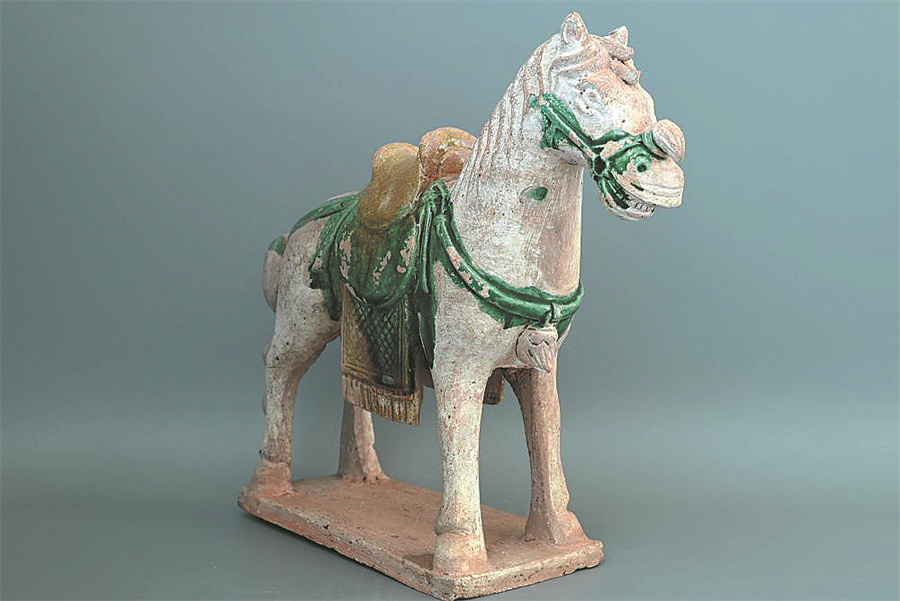
A pottery horse excavated from the tomb.[Photo provided to China Daily]
Archaeologists in North China's Shanxi province have uncovered a family cemetery belonging to a sixth-generation descendant of Zhu Yuanzhang, founding emperor of the Ming Dynasty (1368-1644), providing valuable insight into the royal clan system of that era.
The Shanxi Provincial Institute of Archaeology announced that the cemetery, belonging to Zhu Yinxun and his descendants, was discovered in Qinjiazhuang village, Changzhi city in Shanxi. To facilitate a major provincial construction project, a joint archaeological team excavated seven brick-chambered Ming tombs at the site last year.
Although all the tombs had been looted in the past, nine exquisite stone epitaphs were recovered from five of them, which proved key to identifying the occupants.
According to the epitaphs, the cemetery is the family burial ground of Zhu Yinxun, a descendant of Zhu Mo, who was the 21st son of Zhu Yuanzhang. The five identified tombs belong to Zhu Yinxun and his wife, his second son and wife, his fourth son and wife, one of his grandsons and wife, and another grandson. Archaeologists speculate that the two tombs without epitaphs likely belong to his eldest son and another grandson.
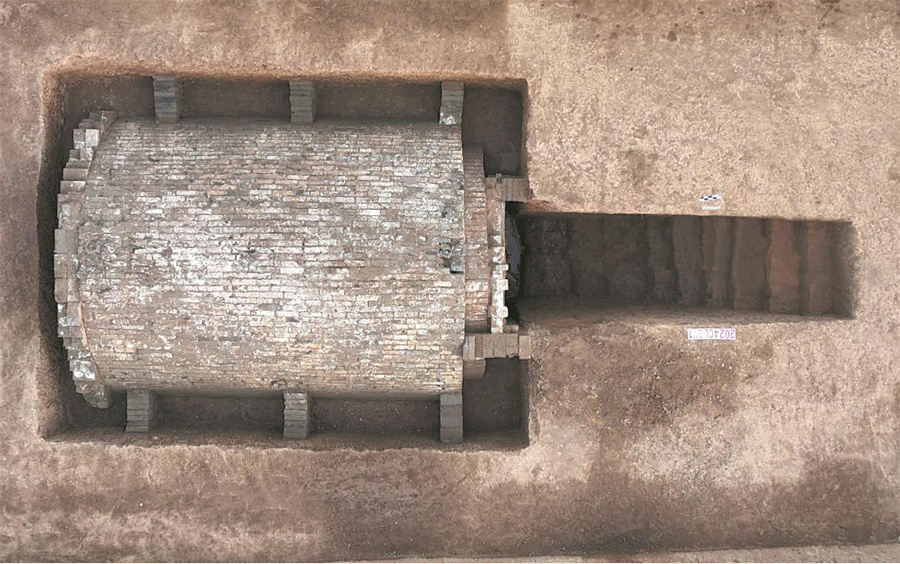
An aerial view of the tomb in Qinjiazhuang village, Changzhi city, Shanxi.[Photo provided to China Daily]
Wang Jingyan, the project leader and a researcher at the provincial archaeology institute, explains that Zhu Yinxun was granted the title defender-general of the state at the age of 15 and died at 65. The unearthed epitaphs contain a wealth of information regarding burial customs, titles, salaries, and marriage practices of the Ming imperial clan."
The inscriptions provide crucial details for studying the imperial clan system," Wang says, adding that the marriages of Zhu Yinxun's sons were carefully arranged, with his eldest son marrying the daughter of an official in the protocol service, his second son the daughter of a vice-minister in the Court of the Imperial Stud, his third son with the daughter of a local scholar, and his youngest son marrying the daughter of a shouguan, an honorary title given to virtuous elders.
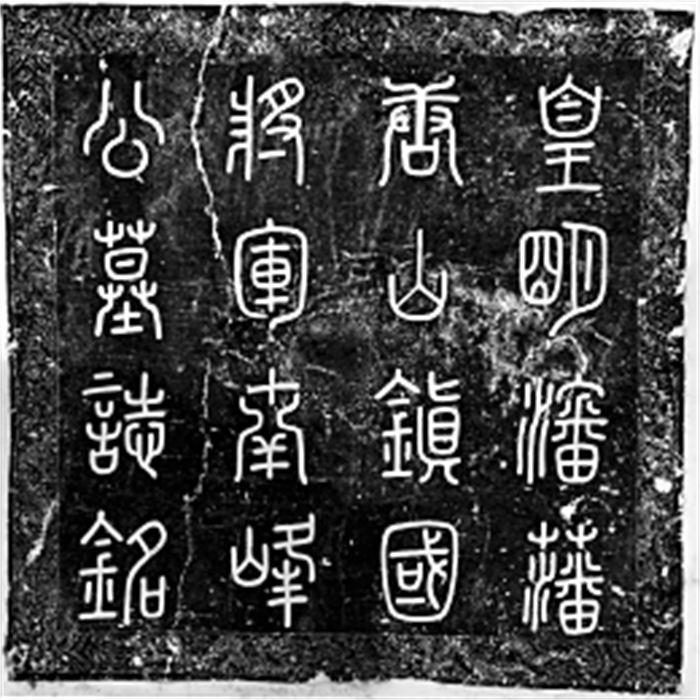
A stone epitaph discovered in the family tomb of Zhu Yinxun, a sixth-generation descendant of Zhu Yuanzhang, the founding emperor of the Ming Dynasty (1368-1644), in Shanxi province.[Photo provided to China Daily]
"The families they married into were either those of officials, acquaintances, or reputable local figures," Wang says.
A total of 722 artifacts were unearthed from the cemetery, including 647 pieces of glazed pottery, 43 pottery items, 14 porcelain pieces, and 18 stone epitaph pieces. The large number of glazed funerary objects, featuring figurines, models of houses, sacrificial vessels, and daily utensils, offers a unique glimpse into the secular life of the Ming imperial family."
This is the first discovery in Shanxi of a Ming imperial clan cemetery that is both well-preserved and clearly documented in terms of lineage," she says.
Wang Qian contributed to this story.
You May Like
-
Stitch by Stitch: Jin Huizhen’s Half-Century Devotion to Tr...
In a quiet home in Chenggong District, sunlight streams through the windows onto the balcony. Seated at a table, Jin Huizhen, a recognized inheritor of Chenggon...
InKunming 2026-01-12 -
Global dialogue as fine as porcelain
Artists of Dehua county receive support in their works going overseas, as they innovate the centuries-old craft known as 'ivory white'.
InKunming 2026-01-09 -
Tomb rekindles Chu history
Lavish burial reveals monarchy's splendor, vulnerability and struggles on the eve of imperial unification.
InKunming 2026-01-09 -
Across China: Chinese couple turns 100,000 photos of Great W...
For most visitors, the Great Wall is something to walk along once and leave behind, but for Gao Wandong and Chen Jing, it was something they could not stop re...
InKunming 2026-01-08 -
China Focus: China sees record number of enterprises in ice ...
InKunming 2026-01-06 -
Breathing life into hanfu
The three different kinds of hanfu — traditional attire of the Han ethnic people — below were designed by the Hanfu Research Institute, Xi'an Polytechnic Univ...
InKunming 2026-01-04 -
Light festival kicks off in Horqin Right Wing Front Banner, ...
InKunming 2025-12-23 -
From Yunnan Opera to Coffee, from Flowers to Seagulls: Kunmi...
Kunming is fast emerging as a new hotspot for inbound tourism to China. According to latest data, Kunming welcomed 952,100 foreign visitors in the first three q...
InKunming 2025-11-04 -
Relics chronicle the evolution of the Yangtze River civiliza...
Exquisite Ceramics. These sections systematically trace the development of civilization in the Yangtze River basin from the Neolithic Age through the Ming and Q...
InKunming 2025-10-28 -
Kunming Promotes Autumn Visits to Dianchi Lake’s Eastern Sh...
Kunming is promoting visits to the eastern shore of Dianchi Lake during the autumn season, highlighting a 108‑kilometer (67‑mile) greenway that links a chain ...
InKunming 2025-10-28