Tomb rekindles Chu history
Source: China Daily | 2026-01-09 | Editor:Doe
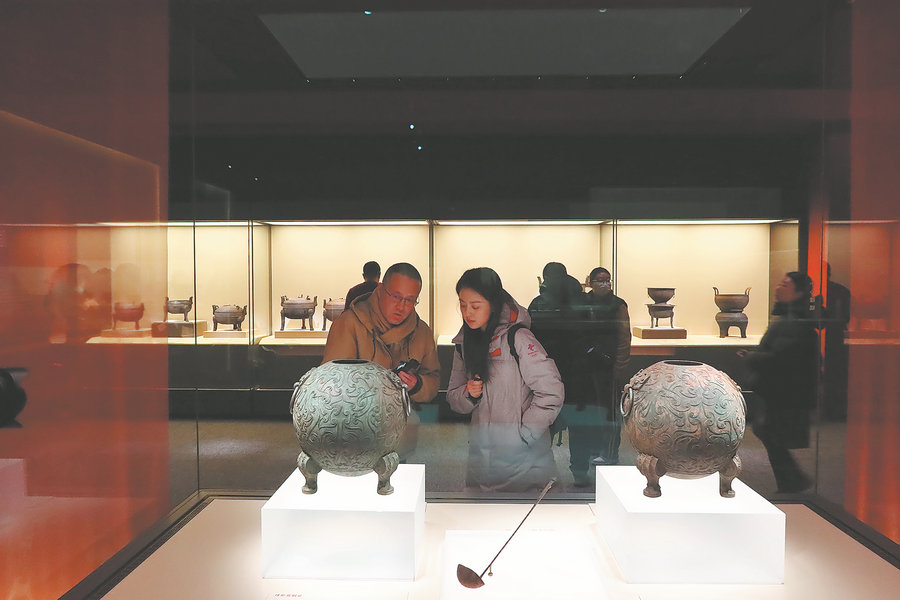
Bronzes of superb workmanship are among the unearthed objects from the Wuwangdun Tomb No 1 on show, including globe-shaped weng (pictured) wares for soup and tripod sheng ding cauldrons for meat. [Photo by Jiang Dong/China Daily]
In 238 BC, Xiong Yuan — known to history as King Kaolie of the Chu state — died as the power he ruled slipped into decline under the mounting pressure of its formidable rival, the Qin state.
He had inherited from his father a regional sovereignty whose origins could be traced back to the Zhou Dynasty (c. 11th century-256 BC). Rising in what is today Hubei province, the Chu state expanded northward and eastward, flourishing as one of the seven powerful vassal states during the Warring States Period (475-221 BC).
King Kaolie presided over Chu during a time of flux and uncertainty, witnessing both its endurance and its erosion. Through careful diplomacy, he attempted to guide the state through shifting alliances, territorial concessions and military threats. Yet, his industrious efforts ultimately failed to reverse Chu's historical trajectory.
About 15 years after his death, Chu was conquered by Qin armies, clearing the way for the founding of the Qin Dynasty (221-206 BC), the first imperial dynasty of a unified China. As centuries passed, King Kaolie's prominence as a key figure of his era faded into the margins of historical memory.
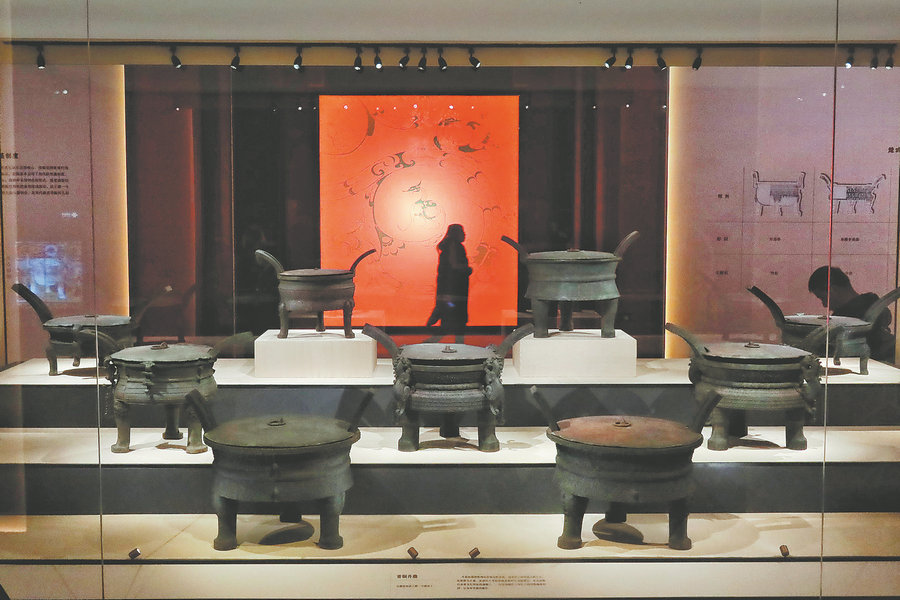
Bronzes of superb workmanship are among the unearthed objects from the Wuwangdun Tomb No 1 on show, including globe-shaped weng wares for soup and tripod sheng ding cauldrons (pictured) for meat. [Photo by Jiang Dong/China Daily]
More than 2,200 years later, however, the glories and vulnerabilities of Chu have resurfaced with remarkable clarity following the identification, excavation and study of King Kaolie's burial site.
Bronze vessels, jade and gold ornaments, wooden figurines and painted lacquerware — all interred to sustain a lavish afterlife befitting royalty — are now on display at the National Museum of China in Beijing. The objects were excavated from Huainan in Anhui province, believed to be the site of Shouchun, the ancient capital of Chu, where King Kaolie's cemetery was discovered.
More than 200 artifacts are featured in the exhibition Echoes of King Kaolie: Archaeological Discoveries from the Wuwangdun Tomb No 1, which opened on Dec 26 and runs for four months. The exhibition documents excavation work that has been underway since 2020.
Gu Zhiyang, curator of the exhibition, says the findings indicate that Kaolie was buried in "the largest and highest-ranking royal cemetery of the Chu state discovered to date, and its layout, consisting of nine chambers, looks more complicated than other Chu royal tombs" found so far.
He says more than 10,000 objects have been unearthed at the site through a joint effort involving archaeologists from Anhui, the National Cultural Heritage Administration, Xiamen University and Shandong University.
"From complete sets of bronze chime bells, stone percussion instruments, and exquisite jade discs, to a lacquered table painted with dragons and phoenixes, these invaluable objects reflect the affluence of Chu's material life and rank-based burial customs," he adds.
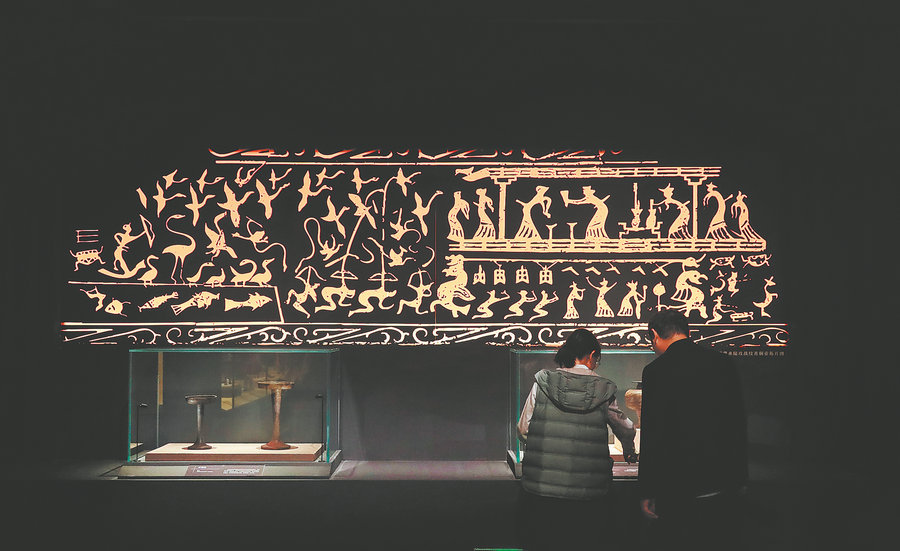
A projection of scenes of banquets and combat depicted on the outer surface of a Warring States Period (475-221 BC) bronze container found in Sichuan province, which exhibition curators believe provides the big picture of the exchanges among different regional powers at the time. [Photo by Jiang Dong/China Daily]
More broadly, he says, they testify to the state's royal funerary system, hierarchical etiquette and cultural exchanges during the Warring States Period — shedding light on the transitional era between the Zhou and Western Han (206 BC-AD 24) dynasties.
The excavation, though, had not been planned.
Shortly after the founding of the People's Republic of China in 1949, people identified an area to the east of the relic site of Shouchun as a burial ground of Chu's high society. One tomb, later designated Wuwangdun Tomb No 1, was believed to be exceptionally large.
Between 2015 and 2018, the site was looted three times. Authorities recovered 76 stolen artifacts, prompting the approval and launch of a full-scale archaeological excavation by the National Cultural Heritage Administration.
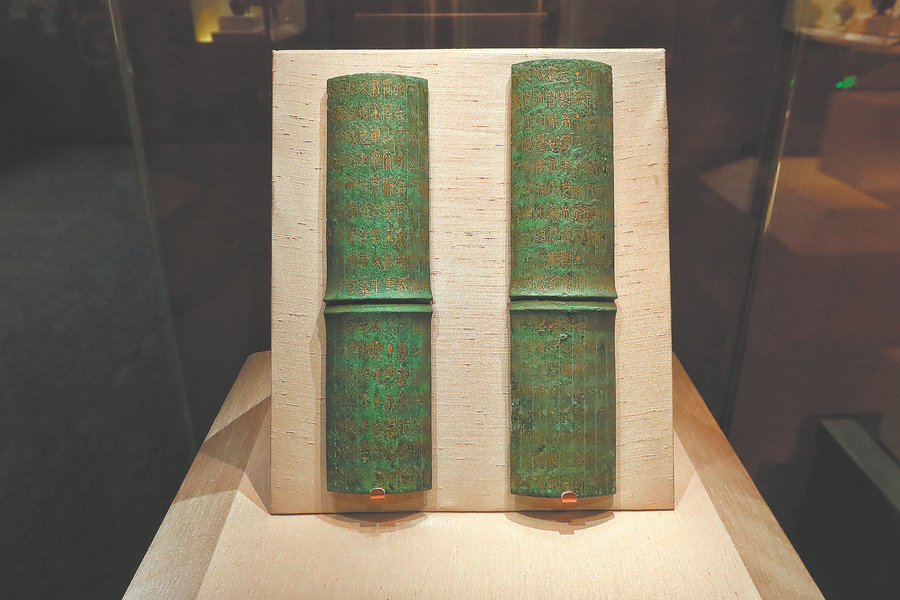
A bronze jiezhi pass inscribed with transportation regulations. [Photo by Jiang Dong/China Daily]
The site of Wuwangdun sits by Shungeng Mountain, now a national forest park, to the north, opens to an expansive field to the south and is adjacent to a lake to the west.
On-site work unveiled the face of Wuwangdun Tomb No 1 — a vertical earth-pit, chambered-coffin tomb that covers about 12,000 square meters, and inside there are 21 stairs leading to the chambers.
The layered structure — a central main chamber surrounded by eight sub-chambers in four directions — suggested the occupant was a senior member of Chu's ruling house.
The diversity and richness of grave goods reinforced that conclusion.
Archaeologists uncovered ceremonial stone and jade objects, metal fittings for horses, wooden coffin boards inscribed with hundreds of ink characters, and tortoise shells used for divination.
Among the most striking discoveries were massive bronze vessels that clarified the tomb's royal identity.
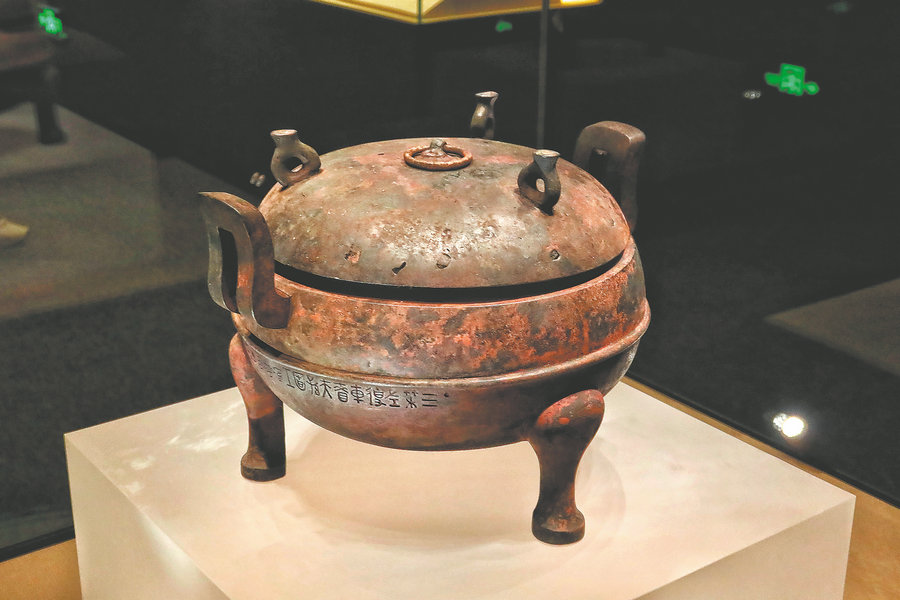
A tripod ding vessel carved with characters. [Photo by Jiang Dong/China Daily]
One highlight of the exhibition is a colossal three-legged huo ding vessel used for royal banquets and sacrificial ceremonies. Nearly 1 meter tall with an 88-centimeter rim, it is the largest Chu-era ding vessel ever excavated.
Another bronze fu vessel bears a 12-character inscription stating it was commissioned by King Xiong Yuan himself.
Cross-disciplinary analysis involving anthropology and paleopathology of human remains suggests the occupant of the tomb died at 50 or older, stood about 164 centimeters tall, and likely had a mother from the northern region, consistent with historical records of King Kaolie.
Therefore, the drama of King Kaolie's life journey has been vividly unveiled.
Although hailing from an influential family, he grew up in the ever-changing cauldron of the Warring States Period during which the crucial players, including his home state, annexed small powers, formed alliances or became military rivals. As a youth, he was one of the so-called "hostage princes" sent to enemy courts — a common diplomatic practice of the time.
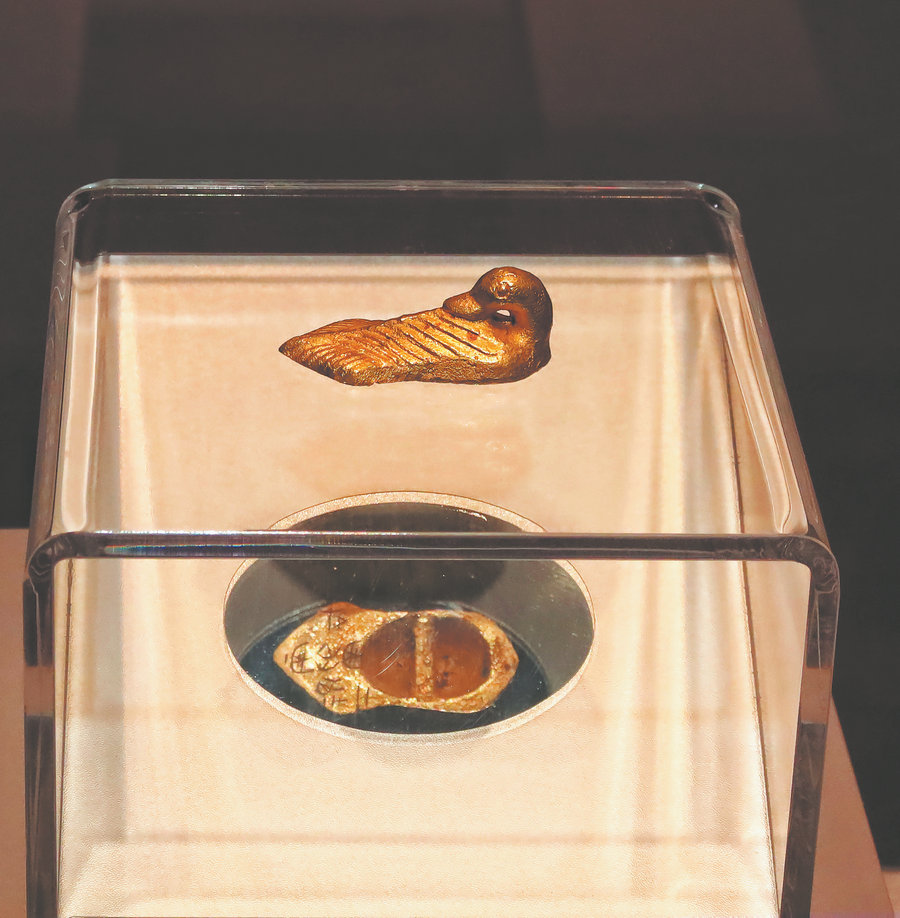
A gold duck ornament are the highlights of the exhibition. [Photo by Jiang Dong/China Daily]
After ascending the throne, he ceded territory to Qin in hopes of easing tensions. In 241 BC, he organized a military alliance against Qin, but the campaign failed. He later moved Chu's capital to Shouchun.
Though Chu never regained its former strength under his reign, the material richness of his tomb reflects the cultural abundance accumulated over generations.
Lacquerware, in particular, reveals the state's artistic sophistication.
According to Gong Xicheng, a veteran archaeologist who heads the excavation work at Wuwangdun, Chu lacquerware is distinguished by dark backgrounds and vivid motifs — dragons, phoenixes and swirling clouds rendered primarily in red.
"The patterns and sheen of these lacquer works are well-preserved to convey composure and dignity, exemplifying the fine craftsmanship and aesthetics of the Chu state, and also providing a glimpse of its social developments," he says.
He says the construction of the tomb along with its burial assets, in the big picture, points to a pivotal moment in history, at the dawn of transitioning from complex, constant rivalries to a unified country.
King Kaolie died with unfulfilled ambitions to defeat his biggest rival and restore glory to the Chu state.
More than two millennia later, excavations at the site of his tomb were enlisted among China's top 10 archaeological discoveries of 2024, inarguably one of the highest honors for China's archaeologists.
Plans are underway to develop a cultural park at the site, bringing renewed attention to the legacy of Chu and the diversity of China's past.
You May Like
-
In pics: historic open-air market in China's Tianjin
People visit an open-air market in Ninghe District of north China's Tianjin Municipality, Jan. 7, 2025. With a history of about 350 years, the market is one of ...
InKunming 2025-01-08 -
A glimpse of Xi'an where tradition and modernity mingle
Xi'an, also known as Chang'an in ancient times, has a history stretching back over 3,100 years. Boasting world-famous sites such as the Terracotta Warriors, Xi'...
InKunming 2024-12-25 -
Yao needlework crafts a revival
Pan Haiyan demonstrates needlework technique to an apprentice, talks with embroiderers and carries a bundle of fabrics (below left) at her embroidery workshop i...
InKunming 2024-12-23 -
Culture&Life | Traditional art of Cangxian lion dance well p...
Cangxian Lion Dance is a unique folk art with a long history, which was inscribed into the national intangible cultural heritage list in 2008. Thanks to the pol...
InKunming 2024-12-23 -
Sharing the Silk Road's treasures
Artists with a passion for history make perfect copies of ancient murals, so everyone can enjoy their beauty.
InKunming 2024-10-22 -
Inheritor of Gupa tea-making skills in China's Guangxi
Tea cultivation is a tradition of Xiangzhou that has lasted over 1,300 years, while Gupa tea, named after its place of origin, Gupa Village, has a history spann...
InKunming 2024-10-17 -
Young people swell demand for creative cultural items
Museums produce rare, beautiful, fun goods based on relics, art, history
InKunming 2024-09-25 -
Pic story: inheritor of Wuyuan wood carving in E China
The "Three Carvings in Wuyuan" include carvings on stones, bricks and wood, with wood carving being the most representative. Boasting a history of over 1,000 ye...
InKunming 2024-09-24 -
Lantern fair opens in Beijing Garden Expo Park
The Beijing Mid-Autumn and National Day Lantern Festival has been held grandly in Beijing Garden Expo Park on September 14th, 2024. As the largest-scale lantern...
InKunming 2024-09-20 -
Bronzes from central China illuminate Hong Kong with ancient...
More than 150 sets of cultural relics from 15 institutions in eight cities in central China's Henan province have been transported southward to Hong Kong and ar...
InKunming 2024-04-29