Global dialogue as fine as porcelain
Source: China Daily | 2026-01-09 | Editor:Doe
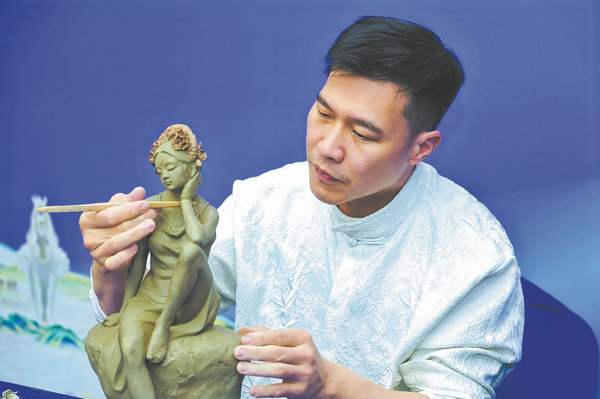
Li Jinfeng sculpts a clay figurine at the ceremony. [Photo provided to China Daily]
On a chilly December afternoon in Beijing, the air in the Yellow River hall of the Ministry of Culture and Tourism is warmed by intense focus.
Li Jinfeng, a porcelain artist from Dehua county of Quanzhou in eastern Fujian province, leans over his worktable, holding a bamboo tool as fine as a strand of hair.
He is sculpting the detail of a Xunpu village woman from the province's southern region into a piece of creamy, luminous white clay.
The woman's head is slightly tilted, her fingers seemingly brushing against the flowers that adorn her hair. Most mesmerizing is the layered, delicate floral crown — each petal taking form under Li's expertise.
Guests from Jordan, Turkiye, and Italy gather around Li's table, forming a quiet circle as they witness the centuries-old craft freeze a cultural moment into a work of art.
"The texture of Dehua white porcelain, what we call 'ivory white', is perfect for capturing such fine detail," Li explains to the crowd who attends the launch ceremony for Beauty in Diversity, Porcelain as a Bridge, the 2026 Blanc de Chine Dehua porcelain international cultural exchange activity hosted by the Quanzhou culture, radio, television and tourism bureau and the Dehua government.
"It can convey the softness of petals and the fineness of hair," says the artist.
Known in the West as Blanc de Chine, this porcelain from Dehua county is celebrated for its unique white hue and jade-like translucency, a quality derived from local high-purity kaolin clay, with a history stretching back to the Song (960-1279) and Ming (1368-1644) dynasties.
For centuries, Dehua's Buddhist statues, tea sets, and scholarly objects were exported worldwide. However, by the late Qing Dynasty (1644-1911), its international visibility declined slightly due to geopolitical disruptions, including wars and maritime restrictions.
But production soon resumed, and Dehua porcelain regained international recognition through exhibitions, diplomatic gifts, exports, and cultural exchange efforts in the 20th and 21st centuries.
Li has devoted nearly three decades to the art of porcelain. Some of his representative works, like the Beauty in Books series, which blends classical female figures with books, and the solemn Ksitigarbha Bodhisattva statue, have found homes in galleries and private collections in France and the United Kingdom.
"The fact that my works are taken overseas is closely tied to Dehua's systematic efforts to go global," he says.
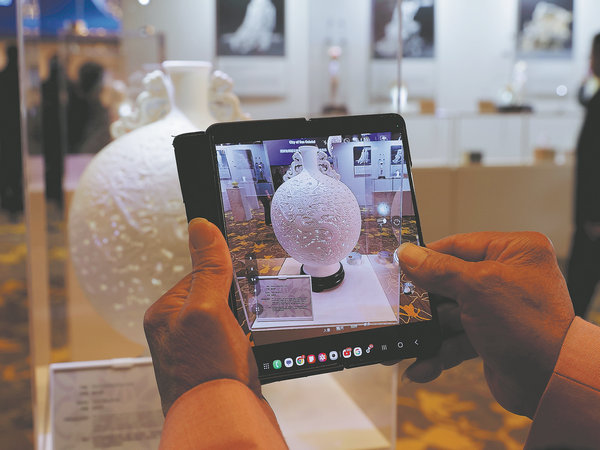
A visitor takes a photo of a Dehua porcelain vase in an exhibition in Los Angeles. [Photo provided to China Daily]
Art on tour
Li feels the source of this "systematic" wave can be traced to the 2023 strategic blueprint for promoting Dehua porcelain abroad by local authorities.
Over the past few years, Dehua porcelain exhibitions have traveled to 26 countries and regions, according to local authorities.
"The touring exhibitions significantly raised Dehua's profile," says Fang Junqin, the county's Party secretary.
Fang notes that government endorsement has also been crucial, as local officials promoted Dehua porcelain at multiple sessions of the Canton Fair in Guangzhou, Guangdong province.
"This shows global buyers our commitment and credibility, leading to a substantial increase in orders," he says.
The output value has grown by over 10 percent for several consecutive years, reaching nearly 80 billion yuan ($11.46 billion) in 2025.
"Our goal is to reach 100 billion yuan by 2027," Fang says.
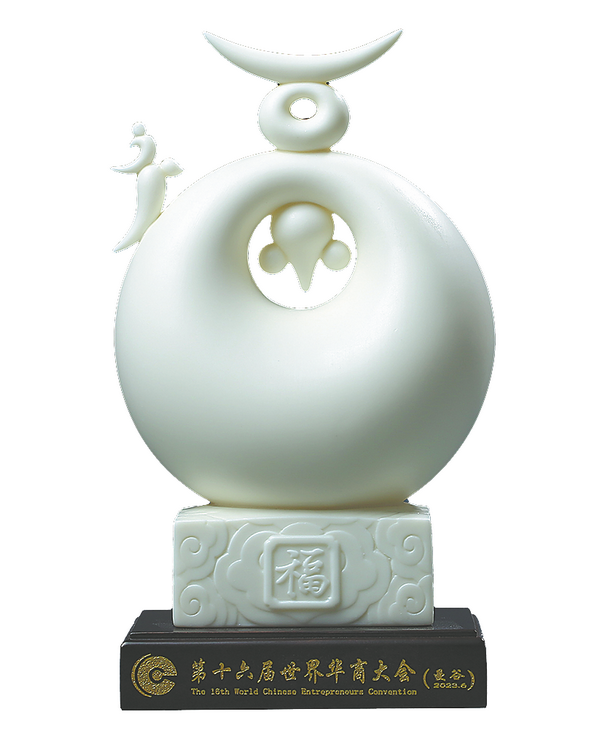
The two shapes of a reconstructed Chinese character fu (fortune or blessing) by Peng Chengxiong. [Photo provided to China Daily]
Contemporary dialogue
The drive to promote Dehua's artistic profile globally has spurred many local porcelain artists to innovate.
With almost three decades of experience in creating porcelain sculptures, Peng Chengxiong has chosen to converse with the world using the most fundamental Chinese cultural symbol — Chinese characters.
His signature work is a reconstructed fu (fortune or blessing), a character traditionally displayed in Chinese homes during Chinese New Year, which he reimagined by using punctuation marks and parentheses to form its shape.
"I wanted to explore its artistic possibilities beyond calligraphy and seal carving," Peng says.
It thrills him to see that this porcelain fu has become a cherished emblem of identity and connection for Chinese communities overseas.
In 2023, more than 3,000 pieces were presented at the World Chinese Entrepreneurs Convention in Thailand.
His latest creation, Maritime Silk Road Fu, incorporates the three iconic commodities of the ancient trade route — tea, silk, and porcelain — into the character's form.
"I hope it can continue its journey around the world, acting as a bridge for exchange," Peng says.
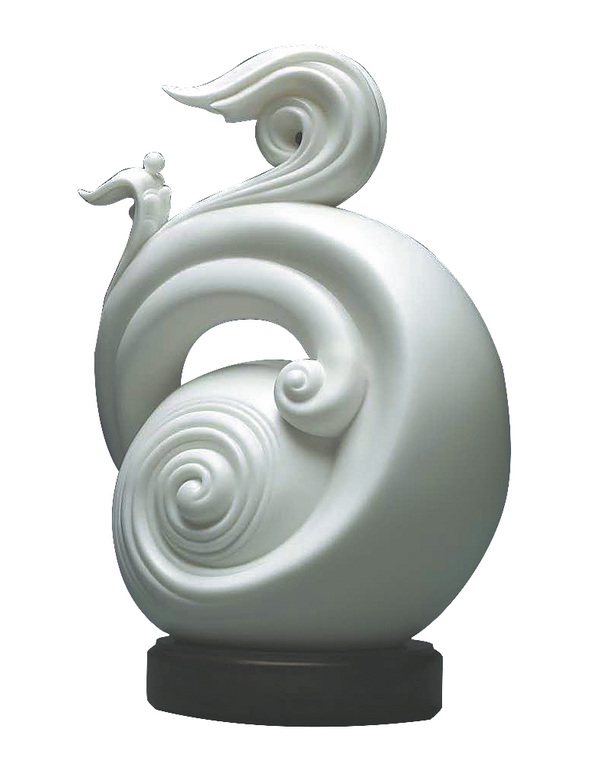
The two shapes of a reconstructed Chinese character fu (fortune or blessing) by Peng Chengxiong. [Photo provided to China Daily]
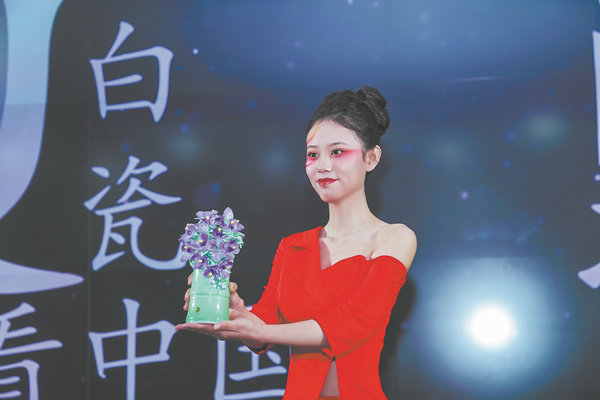
A flower-themed piece on show at the recent launch ceremony for a Dehua porcelain international cultural exchange in Beijing. [Photo provided to China Daily]
Charting the future
Building on current achievements, Dehua has charted a more ambitious course for 2026.
A new international touring exhibition will set sail for London, Geneva, Belgrade, and Lisbon, officials revealed at the launch ceremony in Beijing.
Zodiac-themed porcelain works for the Year of the Horse will be highlighted to connect Chinese people worldwide.
Furthermore, a comprehensive support ecosystem is being built, including an international ceramic culture week in the autumn to gather global porcelain enthusiasts and an international competition to spark creativity.
Meanwhile, a multilingual media matrix will tell the millennia-old story of Dehua porcelain.
The ongoing global initiative also seeks to integrate global supply chains and e-commerce networks, ensuring that Dehua porcelain will reach global consumers efficiently.
Zhang Weiguo, director-general of the China Center of International Cultural Exchange and Tourism Promotion, notes that ceramics have long served as an enduring medium through which Chinese civilization engages in dialogue with the world.
"Dehua white porcelain was exported overseas as early as the Song and Yuan (1271-1368) dynasties and gained fame during the Ming Dynasty as Blanc de Chine," Zhang says.
"Today, as a symbol of cultural exchange among BRICS countries and beyond, it continues to play a vivid role in cross-cultural communication," he observes.
For Li Jinfeng, the rising international recognition not only better showcases his works abroad but has reshaped his creative philosophy.
Initially, as his pieces began reaching international audiences, he began to think about how his art could bridge cultural divides.
Yet, the answer revealed itself through personal connections with international guests.
For instance, he met a Russian violinist who visited his studio and was deeply moved by his traditional Chinese figurative sculptures.
"His genuine, instinctive appreciation was a revelation," Li recalls.
"It showed me that our cultural essence, when rendered with authenticity and mastery, carries a universal language. It doesn't require dilution or adaptation for foreign tastes."
He believes the key lies in balancing tradition and modernity.
"Tradition is our root; we employ classic techniques in our craft while infusing contemporary sensibilities into the creation process," he explains.
"This allows the work to resonate with modern audiences and meet the demands of today's market, all while staying true to its cultural essence."
You May Like
-
China Focus: Global mayors inspired by transformation of Chi...
In an era defined by industrial speed and digital efficiency, Jingdezhen, China's "porcelain capital," is charting a different path: attracting the world thro...
InKunming 2025-10-20 -
Global mayors discuss cultural governance in NW China's Dunh...
A forum bringing together mayors or their representatives, diplomats and scholars from 10 countries opened on Monday in Dunhuang, a city along the ancient Sil...
InKunming 2025-10-14 -
Traditional Chinese medicine bridges cultures, generations
TCM is undergoing a quiet transformation. Rooted in tradition yet adapting to the times, it is honoring its origins while connecting with a global and younger a...
InKunming 2025-08-08 -
Across China: New wave of Chinese tea culture hits global sh...
In a bustling exhibition hall in Chengdu, southwest China's Sichuan Province, Gregory Cattin, a French beverage industry veteran, savored a cup of osmanthus-sce...
InKunming 2025-04-10 -
Update: "Ne Zha 2" makes history as first non-Hollywood film...
Chinese animated blockbuster "Ne Zha 2" has become the first non-Hollywood film to exceed 2 billion U.S. dollars in global earnings, including presales, accordi...
InKunming 2025-03-04 -
Traveling along the Nezha trail
The Chinese animated blockbuster Ne Zha 2, which has shattered multiple box office records and generated discussions among the global Chinese community, has tra...
InKunming 2025-02-25 -
How Chinese animated film "Ne Zha 2" becomes global box offi...
"Ne Zha 2," the animated blockbuster that has dominated China's box office, is igniting a global frenzy with its seamless fusion of traditional Chinese mythol...
InKunming 2025-02-18 -
Shandong town's Chinese knots weave a path to global recogni...
As Chinese New Year draws near, villagers in a town in Shandong province are busy making traditional Chinese knot ornaments to meet the rising demand for the up...
InKunming 2025-01-23 -
Jade's royal seal of approval
When Emperor Qianlong (1711-99) ascended the throne in 1735, he inherited a court of wealth and a dynasty reaching its apex. Perhaps that partially explains why...
InKunming 2025-01-10 -
An enduring enchantment with Peking Opera
The global success of the Chinese video game Black Myth: Wukong has helped introduce the tale of Sun Wukong, or the Monkey King, to people around the world. But...
InKunming 2024-12-30