Relics chronicle the evolution of the Yangtze River civilization
Source: China Daily | 2025-10-28 | Editor:Alice
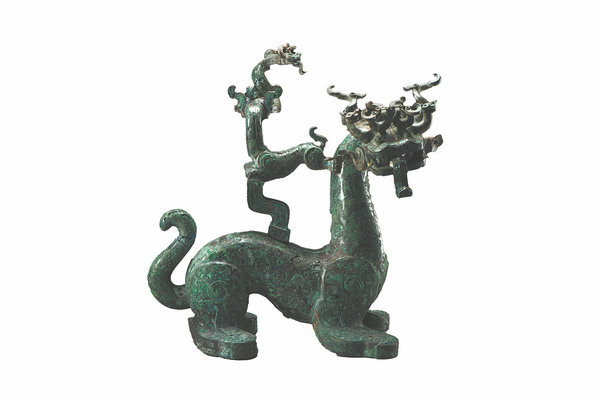
A bronze ornament dating to the Spring and Autumn Period (770-476 BC) on show. [Photo provided to China Daily]
Step into a world where history breathes through the delicate curve of a jade pendant, the gleam of a gold crown and the fierce charm of a bronze beast — each artifact a silent storyteller of the Yangtze River's timeless saga.
In a spectacular gathering of 160 treasures spanning 8,000 years of civilization, The Everlasting Yangtze: Treasures of Ancient Civilizations, an exhibition at the Panlongcheng Site Museum in Wuhan, Hubei province, until Jan 4, doesn't just display relics, but also resurrects the vibrant soul of ancient cultures, where myth and reality dance together in lacquer, bronze, gold and clay.
The exhibition showcasing 160 cultural relics from the Yangtze River region brings together prized artifacts from 37 museums and cultural institutions across the river's vast basin, including the Hunan Museum, Hubei Provincial Museum and Zhejiang Provincial Museum.
Through a diverse collection of jade, lacquerware, bronze ware, gold and silver items, and ceramics, the exhibition delves into the social life, cultural exchanges and religious beliefs that flourished along the Yangtze throughout different historical periods.
Visitors can admire jade artifacts from the Liangzhu culture, Han Dynasty (206 BC-AD 220) lacquerware, and a Ming Dynasty (1368-1644) gold crown inlaid with rubies. Highlights include a bronze mythical beast from the Chu state, unearthed in Henan, alongside bronze bells from the Zeng state discovered in Hubei province.

A Ming Dynasty (1368-1644) gold crown. [Photo provided to China Daily]
The exhibition is organized into five thematic sections based on material: Crystal Jade Splendor, Radiant Lacquerware, Elaborate Bronze, Shiny Gold and Silver, and Exquisite Ceramics. These sections systematically trace the development of civilization in the Yangtze River basin from the Neolithic Age through the Ming and Qing (1368-1911) dynasties, highlighting distinctive craftsmanship and artistic achievements.
According to the show's curator Shen Meichen, each section features between 20 and 40 carefully selected artifacts. "We chose the most representative, visually appealing and widely recognized pieces to illustrate the developmental journey of the Yangtze civilization," she explains.
Shen emphasizes that all five categories of artifacts — jade, lacquer, bronze, ceramics, and gold and silver — share a common pattern: they each have an origin phase, experience continuous development, and exert lasting influence on later cultures.
"This continuity reflects the long and profound history of Yangtze culture and underscores its prominent role in the evolution of traditional Chinese culture," Shen says.
She talks about the deep interconnections among civilizations across the upper, middle and lower reaches of the Yangtze. Citing lacquerware as an example, she says that the earliest known lacquer artifact, dating back about 8,000 years, was found at the lower reaches, Jingtoushan in Yuyao, Zhejiang province. Lacquerware flourished during the Chu culture of the middle and lower reaches in the Spring and Autumn (770-476 BC) and Warring States (475-221 BC) periods. However, research indicates that while most lacquer items were produced in the upper reaches, they were widely used in the Chu state downstream.
"This demonstrates a coherent development of lacquer art across the entire Yangtze basin, indicating active exchanges between different regions," Shen adds.
A standout piece in the lacquerware section is a Warring States Period pig-shaped box for wine vessels from the Jingzhou Museum in Hubei province. The oval container, which holds drinking vessels, features symmetrical ends shaped like pigs' snouts and is exquisitely decorated. Its surface is adorned with vivid life scenes such as hunting, chariot driving, and sword dancing. These detailed illustrations offer a lively glimpse into the daily lives of the Chu people more than 2,000 years ago.
Shen compares the two cradles of Chinese civilization — the Yangtze and the Yellow River — noting their distinct characteristics. While Yellow River artifacts often convey solemnity, those from the Yangtze region tend to be more dynamic and imaginative.
A prime example in the bronze section is a Spring and Autumn Period mythical bronze beast from the Chu state, housed at the Henan Provincial Institute of Cultural Relics and Archaeology. This piece represents a pinnacle of bronze casting, with a fantastical design combining a dragon's head, a tiger's body and turtle-like feet. The dragon's head is adorned with six small mythical creatures, each unique, and it has a snake in its mouth, while another small beast perches on its back.
Yang Wensheng, deputy director of the institute, explains that each part of the beast is detachable — a remarkable feat of engineering.
"We attempted to replicate this piece using modern technology but couldn't capture the original's mythical allure. Its imaginative and lively form reveals the romantic spirit of the Chu people," Yang says.
To enhance the visitor experience, the exhibition includes interactive elements in each section. Attendees can try their hand at reassembling relic puzzles, making rubbings of bronze patterns, or applying different glaze colors to pottery jars to experience the art of ceramics.
"We expect that visitors will not only look at the artifacts but also engage with them to better understand the history behind them," she says.
You May Like
-
China Focus: 3rd Liangzhu Forum champions cultural diversity...
The 3rd Liangzhu Forum opened in Hangzhou, capital city of east China's Zhejiang Province on Saturday, with the theme "Revitalization of Civilization: Cultura...
InKunming 2025-10-20 -
China's outdoor boom turns trails into green gold
Ranging from the hiking trails of the Qinghai-Tibet Plateau in western China to coastal camping sites, and from family-friendly forest adventures to recreationa...
InKunming 2025-10-17 -
Global mayors discuss cultural governance in NW China's Dunh...
A forum bringing together mayors or their representatives, diplomats and scholars from 10 countries opened on Monday in Dunhuang, a city along the ancient Sil...
InKunming 2025-10-14 -
Lively, chic and open: Palace Museum marks 100 years of livi...
This year marks the 100th anniversary of the founding of the Palace Museum. In recent years, the museum has digitally documented more than 1 million artifacts a...
InKunming 2025-10-11 -
Coffee, tea, or free? Beverage market this year has been an ...
Amid the growing popularity of food delivery platforms, China's coffee and tea market this year has been an amalgamation of fire and ice.
InKunming 2025-10-09 -
Across China: World's tallest bridge brings local tourism to...
During China's eight-day National Day and Mid-Autumn Festival holiday ending on Wednesday, the newly opened Huajiang Grand Canyon Bridge, soaring 625 meters abo...
InKunming 2025-10-09 -
China Focus: Million-year-old skull from central China rewri...
A new study of a 1-million-year-old human skull found in central China revealed a previously unknown branch of the human family tree, dramatically pushing back ...
InKunming 2025-09-30 -
Exhibition held to mark 100th anniversary of founding of Pal...
This year marks the 100th anniversary of the founding of the Palace Museum. On Monday, the opening ceremony of the exhibition "A Century of Stewardship: From th...
InKunming 2025-09-30 -
Census to help protect cultural relics
The fourth national cultural relics census has ignited nationwide efforts to safeguard the country's rich cultural heritage, with cultural relic protection forc...
InKunming 2024-09-25 -
Young people swell demand for creative cultural items
Museums produce rare, beautiful, fun goods based on relics, art, history
InKunming 2024-09-25