China brings archaeological sites closer to the public
Source: Xinhua | 2026-10-26 | Editor:Doe

People visit the Dahecun site museum in Zhengzhou, central China's Henan Province, June 14, 2025.(Xinhua/Hao Yuan)
At the Dahecun National Archaeological Site Park in Zhengzhou, central China's Henan Province, reeds sway in the autumn breeze and deer can be heard calling across the nearly 2,400-mu (160-hectare) landscape. The new Dahecun Site Museum within the park is built largely underground, with a sloping entrance leading visitors into the history of a Neolithic settlement dating back about 7,000 years.
"This is the country's first thematic museum to present the Yangshao Culture in a panoramic form," said Wang Xiaoya, a guide at the museum. "Its rectangular roof is level with the ground, allowing the building to blend into the landscape like an archaeological site emerging from the soil."
Inside, more than 1,500 cultural relics illustrate the Yangshao Culture and shed light on the history of the Dahecun site. Outside, the core protection zone displays the remains of a large Yangshao-period settlement. Offering an important window into a Neolithic culture that lasted about 2,000 years, Dahecun is one of China's major archaeological sites, where protection and public presentation are making the traces of ancient life more accessible to the public.
Known in Chinese as "dayizhi," these archaeological sites include the remains of major ancient settlements, cities, palaces and tombs, as well as related groups of sites and cultural landscapes. They carry historical and cultural information across different stages of ancient Chinese history, and are distinguished by their scale, historical and cultural significance, and far-reaching influence.
The category includes sites such as Liangzhu in east China's Zhejiang Province, the Yin Ruins in Henan, Sanxingdui in the southwestern province of Sichuan, the Old Summer Palace ruins in Beijing, the Xixia Imperial Tombs and the Great Wall. These sites attest to China's million-year human history, 10,000-year cultural history and more than 5,000-year-old civilization.
China now has 150 such archaeological sites. A total of 65 national archaeological site parks have been established based on some of these sites, incorporating the surrounding areas.
Luoyang, a city in Henan with 4,000 years of urban history and more than 1,500 years as a capital, is home to several major archaeological sites that are closely woven into the modern cityscape.
"Several major archaeological sites lie within an east-west stretch of less than 50 kilometers along the Luo River, including Erlitou, the Yanshi Shang Dynasty Capital Ruins, the Han-Wei Luoyang Ancient City site, the Sui-Tang Luoyang City site and the Mangshan tombs," said Zhao Xiaojun, head of the Luoyang municipal cultural heritage bureau. "The density, scale, time span and richness of historical content are rare in the world."
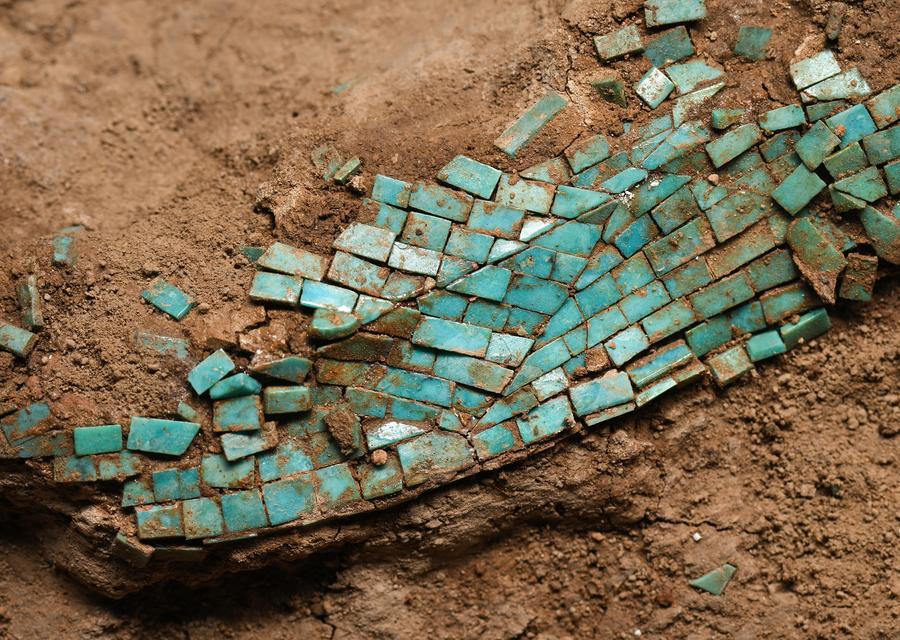
This photo taken on Jan. 29, 2024 shows the details of a turquoise dragon-form artifact at Chinese Archaeological Museum in Beijing, capital of China. (Xinhua/Li He)
As early as the 1950s, Luoyang developed a new urban area away from the old city and required archaeological excavations before construction began. Authorities have adopted site-specific regulations to protect these archaeological sites. The Sui-Tang Luoyang City site, the Han-Wei Luoyang Ancient City site and Erlitou have all become national archaeological site parks and cultural landmarks woven into city life.
Nationwide, more people are visiting such places. According to statistics, visits to China's national archaeological site parks rose from 20.97 million in 2021 to 97.74 million in 2025, bringing the five-year total to 303 million.
Their benefits also extend beyond archaeological research and museum exhibitions. In Zhejiang, efforts to link Liangzhu Culture with rural revitalization have supported local economic development. The operating income of village collectives in 14 villages within the site area rose 19 percent year on year in 2025. At the Liulihe site in Beijing, a China-U.S. international field archaeology summer school offers young people from around the world a platform to learn about Chinese civilization.
China's 15th Five-Year Plan (2026-2030) for the development of national cultural heritage calls for systematic protection and utilization of such sites.
A recent national conference on work related to major archaeological sites stressed the need for high-level archaeological research, sustainable protection and efficient management, while also calling for high-quality presentation.
For sites in city centers, small-scale exhibition spaces will be integrated into the urban fabric, while sites in suburban and rural areas can explore models that combine rural revitalization with educational field trips and study programs. Efforts will also be made to improve the cultural services provided by these sites, better realize the value of cultural heritage and meet public needs.
For visitors, these sites offer a more direct encounter with the past. Standing among the reeds at Dahecun, they may wonder whether the people who lived here 7,000 years ago saw the same landscape.
You May Like
-
Bamboo takes root as China's plastic alternative
In the processing plants of Huaihua, Hunan province, one of China's major bamboo-growing regions, strips of the canes are fed into automated production lines.
InKunming 2026-10-08 -
Carving a future in a traditional art
The clink-clink starts before the sun clears the ridge — short, high-pitched metallic taps, the sound of chisels fine-lining scriptures into stone. Namkha Kyid...
InKunming 2026-10-08 -
Explore Yunnan Through Sport: A 147-Kilometer Route Around D...
On the western shore of Dianchi Lake, the final event marking the close of the three-year Jiuhu League cycle and the 6th Xishan Hiking Festival have officially ...
InKunming 2026-10-05 -
Intangible Cultural Heritage Comes Alive, Culture Goes Globa...
From song and dance to intangible cultural heritage, and from live performances to spectacular drone displays, China's diverse cultural traditions are being pre...
InKunming 2026-10-03 -
A Taste of Kunming: From Yunnan Flavors to Southeast Asian C...
From a bowl of small-pot rice noodles to a traditional long-street banquet, to a cup of specialty coffee, Kunming is using the flavors of Yunnan as a bridge to ...
InKunming 2026-10-02 -
A Moonlit Night by Dianchi, A Taste of Yunnan — Over 300 Ev...
From September 25 to October 7, come together in the Spring City, take in the moonlight over Dianchi, and share the warmth of family reunion this festive season...
InKunming 2026-09-30 -
Choreographer bridges Chinese and Vietnamese cultures throug...
For 30-year-old Vietnamese choreographer Vu Minh Anh, China is an important country in her dance career. Her connection with Chinese dance began in childhood. A...
InKunming 2026-09-22 -
Chinese dance drama "Mulan" staged in New York
The dance drama Mulan, presented by China Arts and Entertainment Group, was staged at Lincoln Center in New York on Saturday, attracting more than 2,000 viewers...
InKunming 2026-09-22 -
US returns relics, fossils to China
A century after being stolen from the Tianlongshan Grottoes in Taiyuan, the capital of Shanxi province, and lost overseas, the torso of a Bodhisattva statue is ...
InKunming 2026-09-21 -
Geotourism gains ground as travelers seek more than scenery
At the Zhangye Colorful Danxia Scenic Spot in northwest China, middle school student Xu Yan held up an English textbook and watched as the image on its cover al...
InKunming 2026-09-20