Carving a future in a traditional art
Source: China Daily | 2026-10-08 | Editor:Doe

The clink-clink starts before the sun clears the ridge — short, high-pitched metallic taps, the sound of chisels fine-lining scriptures into stone. Namkha Kyid grew up with that sound in Heri village, Zekog county, southeastern Qinghai province.Both her grandfather and her father were skilled in the craft. Her mother was unable to write her own name, yet she could carve it in stone with ease.At 15, Kyid picked up the fine chisel and small iron hammer herself."My sisters and I would compete to see who learned faster, who was the best," she recalls.Today, at 39, she is a single mother of a son and a daughter."The craft allows me to earn money while taking care of my family," she says, carving scriptures into a slab of stone — one stroke, one chip, the dust falling on her chuba robe.Working from early morning until dusk, she can finish 10 slabs. Two weeks of work earns her nearly 5,000 yuan ($744.8)."Income from carving stone has become the main source of livelihood for most villagers here," says Puwa Dorje, Party secretary of Heri village.He is also the legal representative of Heri Stone Carving Art Co, established in 2009 to pool the village's craft resources and build a diverse product line that includes stone carvings, tea tables, inkstones, and paperweights.Heri village has a population of 1,020, and the stone-carving craft has now helped 560 villagers find work or start their own businesses. Of those, 265 artisans work steadily at the company, whose annual sales have topped 7.56 million yuan, he adds.
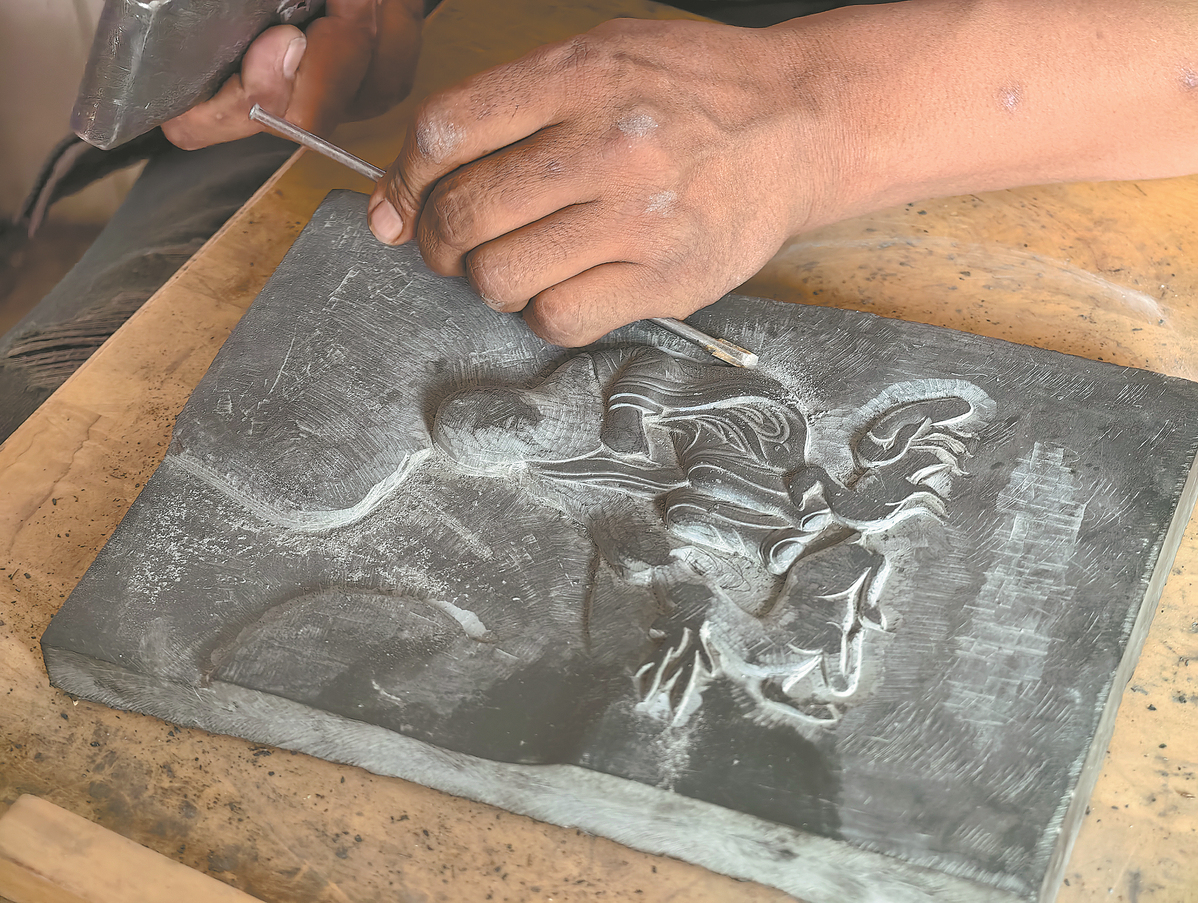
The technique they use dates back to the Qing Dynasty (1644-1911).[Photo provided to China Daily]
The style the villagers specialize in is known as Zekog Heri Monastery stone carving, which dates back to the Qing Dynasty (1644-1911), when the Zekog Heri Monastery and the stone scripture wall on the hillside behind it were built.
The wall is made of more than 100,000 slabs carved with scriptures and images of Buddha, stretching over 200 meters.
It offers invaluable material for Tibetan studies and Tibetan art, as it contains a wealth of content on poetry, art, astronomy, calendrical calculation, medicine, and law. The slabs are also engraved with Buddha figures of various sizes, decorative patterns and illustrations of Buddhist stories.
The craft has been passed down locally ever since, and in 2008 it was added to the national intangible cultural heritage list.
The craft covers two main categories: scripture carving and Buddha carving. It also includes techniques such as line engraving, relief and round carving.
It is known for its exquisite workmanship, delicate patterns, vivid figures, and clear lettering. The finished works are fine and smooth to the touch. The carved scriptures are elegant, neat and powerfully executed. The Buddha figures are full and flowing in form.
Tseten Gyal, who has been carving stone for more than 30 years, is now a representative inheritor of the craft.
"As a stone carver, you first have to love this work and do your best to do it well. Only then can you carry the craft forward and win more people's affection and recognition," he says.
In 2019, he set up a training base in the village, where he runs classes to train apprentices.
His son, Dorje Tseten, once found the idea of spending all day tapping away at stone tedious, but in recent years, he has begun learning the craft in his spare time.
"At first, I was impatient while carving. I kept thinking that once I finished a stone, I could do something else. But my father always found fault with what I produced," says Dorje Tseten.
"When I calmed down and carved with focus, the finished pieces looked much finer. Over time, I grew used to that state of undivided attention — and came to love it."
You May Like
-
Foreign dancers embrace life and culture in China's Nantong
An aerial panoramic photo taken on May 31, 2026 shows foreign staff dancers performing for tourists at the Sendi Resort in Nantong, east China's Jiangsu Provinc...
InKunming 2026-09-03 -
Summer camp brings China closer to Russian teens
Before coming to China, 17-year-old Russian student Ilkhan Fayzullin saw the country as "ancient and distant".
InKunming 2026-09-02 -
Ancient wooden arch bridges get a new lease of life in Fujia...
Pingnan county in Ningde, East China's Fujian province, has stepped up efforts to protect and use its ancient wooden arch bridges, integrating the heritage site...
InKunming 2026-09-01 -
Tourists flock to Huangling Village in east China to view tr...
InKunming 2026-08-27 -
90 years after Edgar Snow, a journey through China's revolut...
At the entrance to the Red Army's western expedition memorial hall in Tongxin County, in northwest China's Ningxia Hui Autonomous Region, a bronze sculpture o...
InKunming 2026-07-09 -
Feature: How Chinese clay shapes world's porcelain standards
For centuries, the word kaolin has been closely connected to porcelain worldwide. For Dutch ceramic collector Marc van Hevel, however, it's more than just a t...
InKunming 2026-07-06 -
Across China: Hungarian cultural delegation explores ancient...
A total of 23 artists, art educators, students and cultural professionals from Hungary wrapped up their discovery tour of the ancient architectural heritages in...
InKunming 2026-06-29 -
Exhibition of intangible cultural heritage opens to visitors...
Exhibition of intangible cultural heritage opens to visitors during Summer Davos in China's Dalian
InKunming 2026-06-24 -
Chinese lifestyle lifts consumption
There is a popular saying, for overseas people, if you drink hot water, wear slippers at home, and shopping at Asian markets, you may be Chinese.
InKunming 2026-06-23 -
Posters: How the Chinese observe traditional solar term of X...
Xiazhi, or the Summer Solstice, is the tenth solar term of a year on the traditional Chinese lunar calendar. It marks the longest daytime in the Northern Hemisp...
InKunming 2026-06-21