Chinese aerospace leaders engage industrial thrust
Source: China Daily | 2026-06-03 | Editor:Flynn
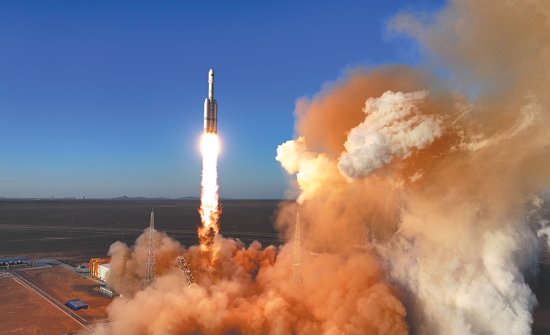
A Lijian-2 Y1 carrier rocket with three satellites onboard blasts off from the Dongfeng commercial space innovation pilot zone in northwestern China on March 30. WANG JIANGBO/FOR CHINA DAILY
Driven by an increase in orbital filings and successful launches, China's commercial aerospace sector is steadily transitioning from a phase of technical verification to large-scale deployment of its achievements.
Advancements in satellite mass production, in-orbit services and reusable rocket technologies are fueling this expansion. As satellite services integrate into consumer markets and various industries, China is also propelling its position in the competitive domain of low-Earth orbit.
This progress is reflected in recent industry figures. According to the China National Space Administration, the sector conducted 50 commercial launches in 2025, accounting for 54 percent of the country's total space launches for the year.
Meanwhile, 311 commercial satellites were placed into orbit, representing 84 percent of the national total. The newly operational Hainan Commercial Space Launch Site facilitated nine of these missions, demonstrating a turnaround capability of "seven days for launch, and seven days for recovery" at its primary pad.
Alongside physical deployment, China submitted filings to the International Telecommunication Union in late December for up to 203,000 additional satellites. However, the practical execution of this strategy relies heavily on a maturing domestic supply chain.

Lihong-1 Y1, China's commercial recoverable spacecraft designed for space tourism, successfully completes its suborbital flight test mission on Jan 12. CHINA DAILY
Fresh focus
Key industry leaders note that the focus has shifted toward mass production and the urgent development of heavy-lift launch capabilities.
Lin Guangrong, a constellation communication system architect at Galaxy-Space, said his company has successfully transitioned from a "custom workshop" model to a "digital factory" approach.
Recognized as China's first unicorn company in the commercial aerospace and satellite internet sector, GalaxySpace has established a complete manufacturing chain for satellites weighing 100 to 2,000 kilograms. The company's annual production capacity for medium-sized satellites has stabilized between 100 and 150 units, with the manufacturing cycle shortened by 80 percent compared with traditional models. This efficiency is driven by a "smart brain", where algorithms continuously optimize industrial processes based on data from front-line engineers.
Industrialization extends to launch vehicles, with the aim of turning aerospace equipment into standard industrial products. For example, the Lijian-2 Y1 carrier rocket, which recently had a successful launch, shares an almost identical design for the core stage and two boosters.
Lian Jie, deputy chief designer of the Lijian-2, said this "universal booster core" configuration allows major components to be mass-produced.
Making rockets is becoming akin to assembling building blocks; simplifying the manufacturing process and enabling rapid replacement of parts can support high-frequency, airline-style launch schedules, Lian said.
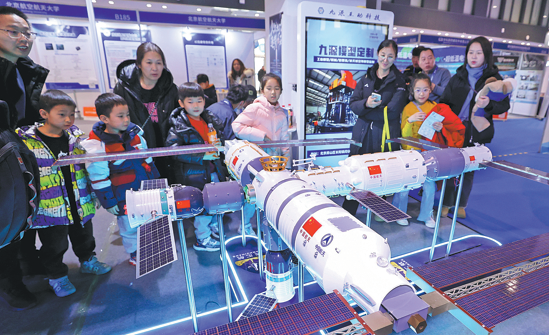
Visitors observe a model of China's space station at a commercial space exhibition in Beijing on Jan 24. CHEN XIAOGEN/FOR CHINA DAILY
Space 'gas station'
Chinese commercial space enterprises are also pushing the boundaries of in-orbit capabilities.
A prime example is the Yuxing-3 06 satellite, recently launched from the Jiuquan Satellite Launch Center in Northwest China. It carried out a series of complex in-orbit operations hundreds of kilometers above the Earth, including simulated propellant refueling tasks using a robotic arm.
Developed by Suzhou Sanyuan Aerospace Technology Co, a subsidiary of Beijing Aerospace Yuxing Technology, the satellite is intended to serve as a "space gas station".
Equipped with a flexible robotic arm, it is China's first commercial experimental satellite designed to perform high-difficulty in-orbit operations.
Chen Jing, chief technology officer of Sustain Space, said the satellite utilizes three control modes for refueling: autonomous path planning, remote manual control, and visual servo-guided docking.
Cao Meng, vice-president of Beijing Aerospace Yuxing Technology, envisions a future where satellites swiftly locate targets, perform precise docking, and refuel them. "We hope to build the future 'Space 4S shop' to provide one-stop maintenance and repair solutions for space assets," Cao said.
Meanwhile, computing power is also heading to the stars.
In a low-Earth orbit approximately 500 km above the ground, 12 computing satellites are operating to form a space computing network. Spearheaded by the Zhijiang Lab, this "Three-Body Computing Constellation" aims to bring artificial intelligence directly to space.
Wang Jian, an academician of the Chinese Academy of Engineering and director of the Zhijiang Lab, said nearly 90 percent of satellite data is currently discarded before reaching the ground due to limited onboard processing. By deploying AI models in orbit, the constellation can process data locally.
The team has already successfully deployed 10 AI models in orbit, including an 8-billion-parameter space-based remote sensing model 80, and a 150-million parameter Fuxi weather model 1.5, ensuring data timeliness for critical applications like disaster relief and urban governance.
Technological innovation is also driving the efficiency of communication payloads.
Lin, from GalaxySpace, highlighted the development of payloads using the Q/V band, which combines the Q and V bands to cover frequencies from 47 to 52 gigahertz, more than doubling the bandwidth of current satellite systems.
Lin compared traditional frequency bands to congested city streets and the Q/V band to a new, wider superhighway essential for high-speed satellite internet.
GalaxySpace has developed its fourth-generation Q/V antenna, reducing its weight from over 7 kg to just 3.2 kg, allowing engineers to stack more satellites inside a single rocket fairing, or protective shell. In September, the company also launched the world's first satellite equipped with large flexible solar wings.
These breakthroughs are being tested in the Little Spider Web, China's first low-Earth-orbit broadband trial constellation. The network has verified the ability to provide continuous broadband communications for 30 minutes at a time. It has successfully conducted tests in diverse environments, from verifying power grid connectivity in Yunnan province to enabling maritime emergency communications. Through satellite internet, drones have successfully conducted firefighting missions, and humanoid robots have achieved "remote perception" via synchronized visual data transmission.
Tian Feng, deputy director of the technology research and development center at the Innovation Academy for Microsatellites of the Chinese Academy of Sciences, said low-Earth orbit satellites act as a space-based information highway, eliminating "information silos" in deserts and oceans.
Li Xiayu, chief engineer at the China Academy of Information and Communications Technology, said satellite communications are accelerating their expansion into consumer fields like smartphones and smart vehicles, opening new consumer markets.
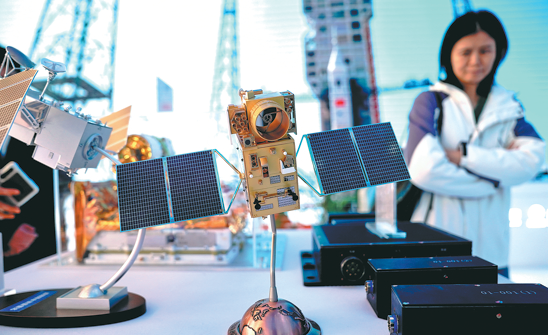
A visitor explores a commercial space exhibition in Shanghai on March 12. ZHANG JIANSONG/XINHUA
Consumer integration
While GalaxySpace focuses on infrastructure, other industry players are concentrating on the downstream ecosystem.
Wang Hui, general manager of BeiDou Satellite Communication Co, a subsidiary of China North Industries Group (Norinco Group), has emphasized that applications are being rapidly integrated into consumer life.
Pan Ying, deputy chief engineer of the company, highlighted the integration of the BeiDou short message service into mass-market consumer devices. Unlike standard GPS, BeiDou allows users to send their location and status without ground-based mobile signals.
By forming joint ventures to develop new chips, the company has integrated this capability into standard smartphones. Since 2022, hundreds of millions of such phones have been shipped. Beyond phones, the company is collaborating with outdoor apparel brands like Bosideng and Phoenix to embed satellite communication modules directly into outdoor gear.
Pan believes Chinese companies are carving out a unique market position. While Western competitors like SpaceX employ a "vertical integration" model, controlling everything from chips to rockets, the Chinese system is defined by specialization — a "letting a hundred flowers bloom" approach.
Rocket manufacturers focus on launch vehicles, and satellite makers focus on spacecraft. Pan said this model concentrates resources to achieve high-quality system completion in a short time frame.
This specialized approach has been heavily supported by local governments, with the building of comprehensive industrial clusters.
In Beijing, a dedicated satellite town and Rocket Avenue are under construction. In Haiyang, Shandong province, the Oriental Aerospace Port connects manufacturing facilities directly to launch craft.
A standout example of this local empowerment is the Xixian New Area in Northwest China's Shaanxi province. The recent successful launch of the Xiguang-1 06 satellite, developed by the Xi'an Zhongke Xiguang Aerospace Technology Group, underscores the robust support provided by the local government.
As China's first and only in-orbit commercial hyper-spectral remote-sensing satellite with full-spectrum coverage of the 400-2,500 nanometers band, it ushers in a new era of "full-spectrum precise perception". Covering 26 independent spectral bands, the satellite functions like a CT scanner for the planet.
"It doesn't just look at surface morphology, but can analyze material composition, monitor crop health and predict ecological hidden dangers," said Kou Yimin, chief engineer at Zhongke Xiguang Aerospace.
The satellite is already monitoring the growth of tea and traditional Chinese medicine herbs in Sichuan and Yunnan provinces, and providing early warnings for landslides in northwestern China's mining areas.
Behind this success is a complete commercial aerospace ecosystem cultivated in the Xixian New Area. Hosting 34 enterprises in the aerospace industry chain, the area achieved an output value of 5.69 billion yuan ($835.29 million) in 2025.
"The success of this satellite sets another benchmark for the new area to cultivate a more modernized industrial system with new quality productive forces," a spokesperson for the Xixian New Area said, adding that they aim to contribute the "Xixian experience" to China's high-quality manufacturing development.
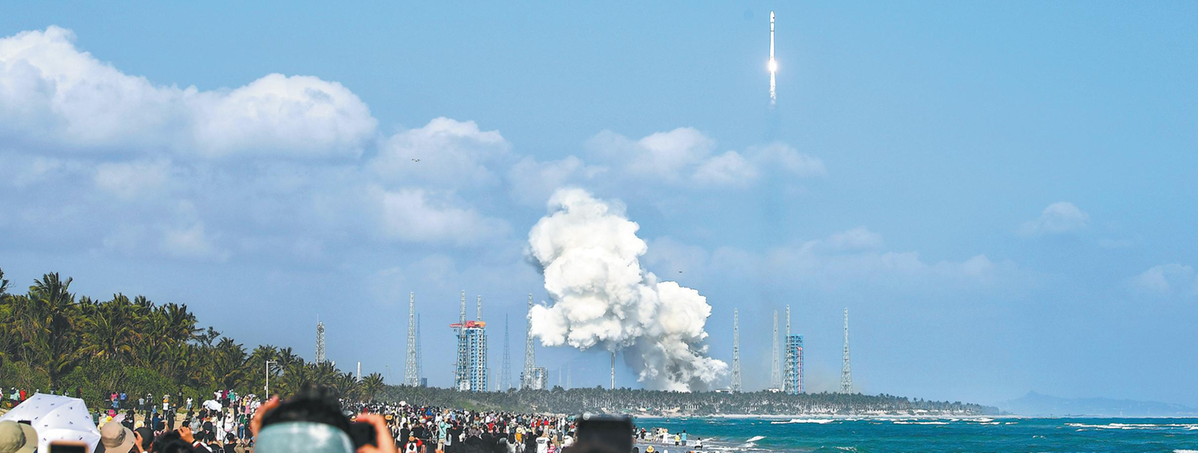
A Long March-12 rocket carrying the 19th group of low-orbit internet satellites blasts off from the Hainan Commercial Space Launch Site in Hainan province on Jan 19. YANG GUANYU/XINHUA
'Use it, or lose it'
The realization of these vast commercial ambitions, however, depends heavily on the physical capacity to launch hardware into space.
The International Telecommunication Union's "first come, first served" regulatory principle comes with strict "use it or lose it" deadlines. Once filed, an applicant must launch the first satellite within seven years and deploy 10 percent of the constellation within nine years.
This regulatory clock places immense pressure on China to increase launch capacity and reduce costs.
The industry is aggressively pursuing reusable rocket technology. In 2025, the Zhuque-3 reusable rocket completed its maiden flight, successfully placing its second stage into orbit and verifying core technologies for first-stage reentry and return.
Furthermore, the "Gravity-2" (Yinli-2) carrier rocket is undergoing intensive hot-fire tests for its "Force-110" liquid oxygen kerosene engine, with a maiden flight and recovery technology verification expected in the second half of the year. The "Blue Flame" 220-ton liquid oxygen methane full-flow staged combustion cycle engine has also completed full-system long-duration test runs.
The Tianlong-3 rocket, designed for large-scale constellation deployment with a "one rocket, 36 satellites" configuration, is preparing for upcoming missions. Experts estimate that reusable technology could slash total launch costs by 40 to 60 percent.
As domestic capabilities mature, Chinese companies are also looking abroad. GalaxySpace is expanding its footprint in Southeast Asia, partnering with local operators in Thailand to build ground stations and test satellite internet applications, marking the first time low-Earth-orbit broadband has been utilized there. Similar agreements have been signed in Hong Kong to explore applications in the Middle East and Africa.
Pan, from Norinco, stressed the importance of international compliance, calling for clearer government guidance to help companies navigate the complex legal landscapes of international operations. Services like the BeiDou short message could find widespread use in global search and rescue, Pan said.
renqi@chinadaily.com.cn
You May Like
-
Using AI to protect mental health
As the world marks International Children's Day on June 1, it's a time for joy and anticipation for children across the country.
InKunming 2026-06-01 -
Interview: Tajikistan, China eye closer cooperation in water...
Tajikistan and China are steadily expanding cooperation in ecology and water resources through joint projects on water conservation, glacier preservation and gr...
InKunming 2026-06-01 -
Xi encourages children to carry forward revolutionary tradit...
Xi Jinping, general secretary of the Communist Party of China (CPC) Central Committee, has called for inheriting revolutionary traditions in a reply letter to s...
InKunming 2026-06-01 -
AI-driven innovation opens new possibilities for smart livin...
Similar AI-powered applications are already making their way into classrooms.
InKunming 2026-06-01 -
Group of Friends of Global Governance forges consensus on 5 ...
Chinese Foreign Minister Wang Yi said Thursday that the Group of Friends of Global Governance (GFGG) has reached consensus on five key points regarding global...
InKunming 2026-05-29 -
Senior CPC official meets delegation of British MPs
Wang Huning, a senior official of the Communist Party of China (CPC), on Thursday met with a British delegation of cross-party members of parliament (MPs), wh...
InKunming 2026-05-29 -
Interview: Serbia-China ironclad friendship unbreakable: Ser...
In an exclusive interview with Xinhua in Beijing on Tuesday, Serbian President Aleksandar Vucic fondly spoke about Chinese President Xi Jinping awarding him t...
InKunming 2026-05-29 -
Weixin Pay, PayPal tie up on payments
Tencent said on Wednesday that United States users of PayPal will be able to pay at tens of millions of Weixin Pay merchants across China by scanning QR codes, ...
InKunming 2026-05-29 -
Young voyagers encouraged to continue quest
Twelve days of living and learning together in China added a new item to the bucket lists of both Sun Linlin and Adrian Castillo — to explore more of each othe...
InKunming 2026-05-29 -
Hyper-focused founder hails Suzhou support
Dong Zhen, 32, has a closet full of awards. A Forbes 30 Under 30 award, a Suzhou Young Scientist award and more. But ask him about these honors, and he shrugs.
InKunming 2026-05-28