An ancient game that transcends borders and generations
Source: China Daily | 2026-04-28 | Editor:Evan
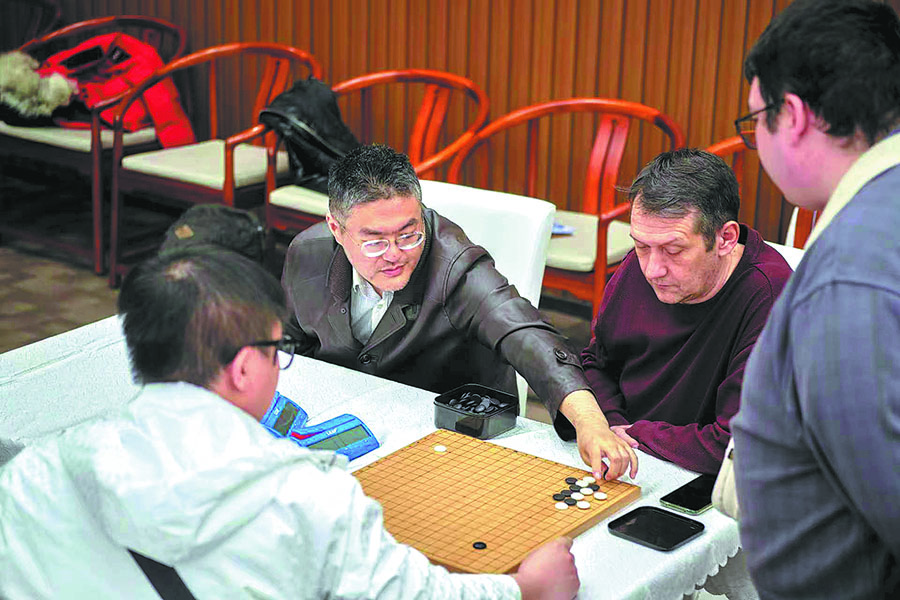
The 2026 Serbian Spring Go Open was held recently at the China Cultural Center in Belgrade. [PHOTO/XINHUA]
At the China Cultural Center in Belgrade, the quiet click of black and white stones carried more than the rhythm of competition. Over two days at the 2026 Serbian Spring Go Open, 36 players from across Europe and Asia gathered not only to contest a title, but to explore a shared language that transcends borders.
"Go originated in China, but it belongs to the world," said Zhang Aimin, director of the cultural center, during the opening ceremony. His words framed the tournament less as a sporting contest and more as a cultural dialogue. Between the intersecting lines and alternating stones, he suggested, lies "a profound Eastern philosophy", one now being interpreted by a new generation of international players. For Zhang, even the youngest participants were "paving the way toward an even brighter future for China-Serbia friendship".
For Serbian national team member Dragan Dubakovic, that philosophy has been a lifelong companion. Introduced to the game by his father, he has spent nearly four decades navigating its deceptively simple rules and near-infinite complexity. "It has grown with me and has long been an indispensable part of my life," he says.
Dubakovic speaks of Go not just as a game of strategy, but as a canvas for imagination. Each match, he explains, allows players to test creativity within a structured system, where mastery demands patience and long-term dedication. His hope is that such depth will draw wider attention across Europe, a goal he continues to pursue through promotional efforts in Serbia and beyond.
That sense of discovery resonates with younger players like Zhou Guanwen, who first encountered the game at the age of 10. What captivated him then still holds true today: "Go is full of variations.
"Solving problems on the board through thought and calculation is like continuously making breakthroughs in a puzzle game," he says.
But for Zhou, the appeal extends beyond intellectual challenge. The rituals surrounding play — handshakes before a match, the quiet placement of stones, the etiquette of mutual respect — create an environment that feels both competitive and deeply human. "This humble and friendly atmosphere helps bridge the distance between people," he notes, describing Go as an effective medium for sharing traditional culture.
From the perspective of Li Ang, who has served as head coach of Serbia's national team since 2024, the tournament reflects a broader evolution. He has witnessed firsthand the enthusiasm of players from different regions and the subtle ways their styles express cultural diversity. On the board, communication often happens without words.
At the same time, Li points to the influence of modern technology. The rise of artificial intelligence in Go, particularly in human-computer matches, has reshaped training methods and global interest in the game. These developments, he says, bring new opportunities for education, even as they redefine how players approach strategy.
Yet amid these changes, Li emphasizes the enduring essence of Go. "The beauty of Go lies in the brilliance of clever plays, the macroscopic vision of the opening layout, the delicate handling of the endgame, and the unique expression of a player's personality on the board," he says.
You May Like
-
Culture helps strengthen exchanges
During a visit to the Palace Museum in Beijing in January, veteran guide Wang Xiaoxin had the opportunity to give visiting Finnish Prime Minister Petteri Orpo a...
InKunming 2026-03-19 -
World Insights: Ancient Chinese academies foster cross-cultu...
As the world seeks ways to engage in dialogue across different civilizations while preserving distinct identities, "shuyuan," or ancient Chinese academies, have...
InKunming 2026-03-17 -
Storytellers in sand and stone
In the hushed halls of the Junsheng Sandstone Paintings Creative Space, the walls do not shimmer with oil paint or float in washes of ink. Touch the vividly col...
InKunming 2026-03-16 -
InPics | Spring greets China with blooming nature
As spring gradually unfolds across China, buds emerge on branches and flowers bloom, attracting people to step outdoors and embrace the nature.
InKunming 2026-03-13 -
Sino-Thai youth deepen ties through study tour
Standing inside the reconstructed caves at Geological Museum of Guizhou, Pongkhun Adulyatham found himself surrounded by towering stalactites and centuries of g...
InKunming 2026-03-11 -
Renowned brand presents centuries-old art collection in exhi...
Shanghai Duoyunxuan, a renowned cultural and time-honored brand, is presenting its most valued art collection for the first time in a free exhibition at the Chi...
InKunming 2026-03-06 -
Guardians of woodblock art carry it forward
The air in the west wing gallery of Beijing's Prince Kung's Palace Museum carries a scent mixed with aged pear wood, nutty vegetable oil and earthy ink.
InKunming 2026-03-05 -
Bonds of friendship and art redefined
From a memorable ascent of Huangshan Mountain to exhibitions at home and abroad, the ties among three masters helped propel Chinese painting onto the internatio...
InKunming 2026-02-24 -
Sacred beasts of ancient Yinxu
Complete skeletons of tigers, leopards, wolves, wild boars, deer, swans and other species were buried in sacrificial pits within the royal mausoleum area.
InKunming 2026-02-24 -
Traditional culture shines as festive travel surges during S...
More than halfway through China's nine-day Spring Festival holiday, which began on Feb. 15, travel enthusiasm shows no signs of slowing.
InKunming 2026-02-24