Sacred beasts of ancient Yinxu
Source: China Daily | 2026-02-24 | Editor:Flynn
Excavations uncover ritual patterns, highlighting the importance of zooarchaeology in studying Shang society, Wang Ru reports.
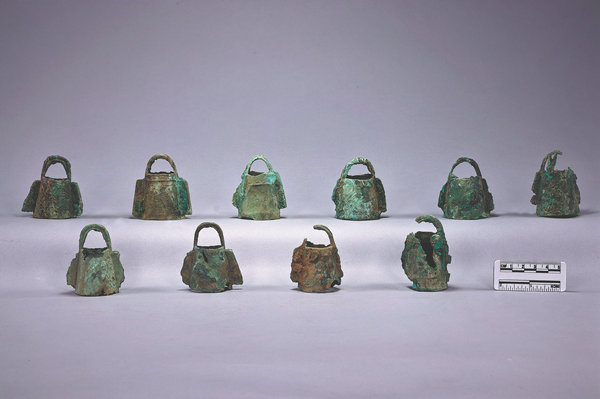
Bronze bells discovered in the sacrificial pits of Yinxu Ruins' royal mausoleum area in Anyang, Henan province. They may have been attached to track animals' movements. [Photo provided to China Daily]
While modern people marvel at wild animals in zoos, their ancestors in the Shang Dynasty (c. 16th century-11th century BC) may have done something similar.
Archaeologists working at the Yinxu Ruins in Anyang, Henan province — the late Shang capital famed for inscribed oracle bones bearing jiaguwen, the earliest-known established form of the Chinese writing system — have uncovered the remains of a remarkable menagerie. Complete skeletons of tigers, leopards, wolves, wild boars, deer, swans and other species were buried in sacrificial pits within the royal mausoleum area.
The discovery isn't just a random cache of wild prey, but is considered the earliest evidence of a Chinese royal family raising and managing wild animals, turning the Shang kings into the first-known "zoo owners" in Chinese history.
During excavations in 2023 and 2024 at the fifth locus of the mausoleum zone — between two encircling ditches that surround graves and sacrificial pits — archaeologists cleared 59 pits. They recovered dozens of wild species, including short-horned water buffalo (already extinct), wolves, tigers, leopards, foxes, serows, porcupines, and wild birds such as swans, alongside many domesticated horses. The findings were recently published in the Chinese journal, Archaeology.
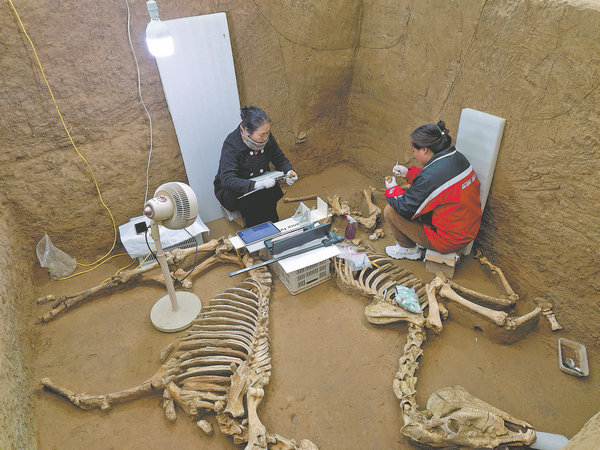
Technicians check horse bones in a pit at the Yinxu Ruins. [Photo provided to China Daily]
Archaeologists classified the pits into two major types: large-scale and medium — or small-scale. Most wild animals were found in the smaller pits, while larger pits contained horses — often two to eight — as well as elephants and human remains.
"The Shang people seemed to have dug pits based on the size and number of animals each pit needed to hold," says Li Zhipeng, a researcher at the Institute of Archaeology at the Chinese Academy of Social Sciences, who leads the zooarchaeological analysis. "Large pits suited multiple horses. One or two wild animals required smaller spaces."
The combinations of species likely carried specific ritual meanings, though further study is needed to clarify them, says Li.
"Zooarchaeological analyses show many of the animals were wild, but since 29 bronze bells have been unearthed from the pits, many found near the necks of wild animals, we believe they were raised by the Shang royal family, rather than captured shortly before sacrifice," says Li Xiaomeng, a member of the archaeological team at Yinxu.
Li Zhipeng says the bells are a sign of animal management, probably attached to track animals' movements.
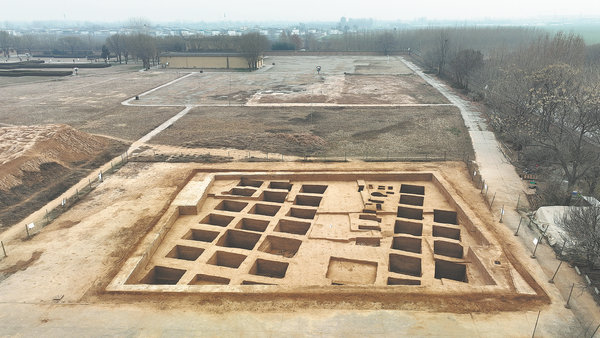
A bird's-eye view of the excavation area of the fifth locus in the royal mausoleum zone of the Yinxu Ruins. [Photo provided to China Daily]
Carbon-14 dating places the bones between 1220 and 1000 BC, spanning roughly from the reign of King Wuding, about the 12th century BC, to the end of the Shang Dynasty, says Niu Shishan, the lead archaeologist at the Yinxu Ruins. Wuding's rule marked one of the dynasty's most prosperous eras; nearly half of the inscribed oracle bones recovered at Yinxu date to his time.
Li Zhipeng says oracle inscriptions record frequent ancestral worship ceremonies. Many of the newly excavated pits belong to Wuding's period, suggesting the animals were possibly used by the king in royal sacrifices before burial.
He says the scale is striking. Within the mausoleum area alone, nearly 3,000 tombs and sacrificial pits have been identified. If 59 pits yielded so many managed wild animals, researchers believe many more once existed.
"Oracle bones tell us that sacrificial ceremonies were very common during the late Shang period," says Li Zhipeng. "If wild animals were rare, they would not have used so many. The court had to balance sustaining them with ritual use."
"So many wild animals appear together, and are all processed in a standardized manner. This indicates that the Shang people had already developed a sophisticated system for acquiring, rearing, and managing wild fauna," says Niu.
Li Zhipeng says multidisciplinary research is still underway to gain more in-depth information on how the Shang people obtained, raised, and managed such wild animals.
The latest animal discovery is part of researchers' continuous studies on the northern bank of the Huanhe River since 2021.
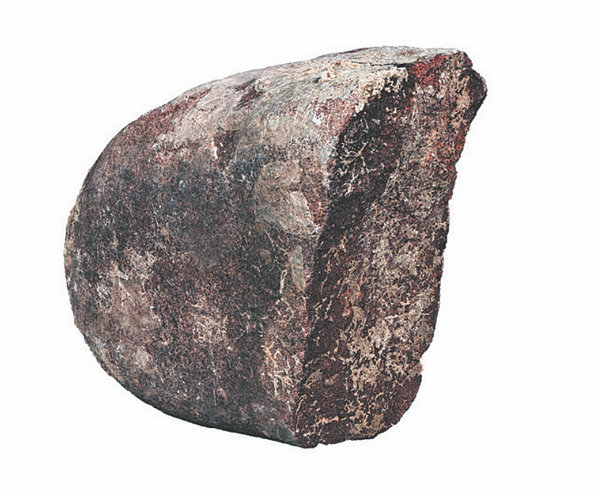
A stone discovered from one of the pits, the function of which is waiting to be unveiled. [Photo provided to China Daily]
Spread across the north and south banks of the Huanhe River in the suburbs of Anyang, Yinxu covers about 30 square kilometers. Since it was excavated in the 1920s, Chinese archaeologists have studied the site for nearly a century, making it a sacred place for archaeological studies in the country. In 2006, Yinxu was listed as a UNESCO World Heritage site.
In the past, archaeological work was largely carried out in the south bank area. Therefore, the team has turned its attention to the north bank since 2021, especially around the royal mausoleum area, leading to a series of new discoveries.
For example, they found two encircling ditches in the royal mausoleum area, believed to be part of a moat system designed to protect the mausoleums. This was listed as one of China's top 10 archaeological discoveries in 2022.
Continued study of the ditches led archaeologists to identify the fifth locus within the royal mausoleum area. There, they found that the western ditch had deliberately curved around some sacrificial pits, suggesting a relative chronological sequence between the two.
The team excavated the area to better understand the western ditch and its relationship with the nearby pits — work that ultimately resulted in the latest animal discoveries, says Li Xiaomeng.
Li Zhipeng says zooarchaeological research forms part of the "Yinxu traditions" that highlight multidisciplinary research in archaeological studies. As one of the earliest large-scale, systematic excavations undertaken by Chinese archaeologists, work at Yinxu helped establish the core paradigms, methods and academic foundations of modern Chinese archaeology.
"At the very beginning of the Yinxu excavations, visionary scholars like Li Ji, Liang Siyong and Shi Zhangru paid close attention to collecting animal materials and sent them to paleontologists for research," says Li Zhipeng. "That laid a solid foundation for subsequent research on animal materials at Yinxu."
Over the years, zooarchaeologists working at the Yinxu Ruins have developed a detailed understanding of how people in the late Shang Dynasty used animals. Evidence shows that pigs, dogs, cattle, sheep, and horses had already been domesticated, and that Shang society employed them in diverse and sophisticated ways.
Li Zhipeng also notes that archaeological findings do not entirely align with later historical texts. Written records suggest that during the Western Zhou period (c. 11th century–771 BC), people commonly placed animals' forelegs in tombs as funerary offerings, while Shang rituals were believed to favor rear legs — reflecting differences between Shang and Zhou ceremonial systems.
However, his research indicates that when the Shang people selected limbs from domesticated animals for burial purposes, they overwhelmingly chose the left foreleg. This pattern suggests that the use of the left foreleg was likely a standardized ritual convention. Because Zhou burials also show a preference for forelegs, the evidence points to continuity, rather than rupture, in ritual practice between the two dynasties.
"Animals were a vital resource for ancient people," says Li Zhipeng. "In life, they provided wool, milk and labor. In death, they supplied meat as food and bones as raw materials for crafting artifacts and tools."
Given the many roles animals played, research on faunal remains offers a distinctive window into Shang society, he adds.
"Even the birth of jiaguwen was closely tied to people's use of animals, as the inscribed oracle bones were often made of cow's shoulder blades and tortoise shells," he notes.
You May Like
-
Bamboo slips tell stories of ancient eras
The Jingzhou Cultural Relics Protection Center has developed core technologies to tackle the challenges in restoring waterlogged bamboo and wooden slips, and un...
InKunming 2026-01-15 -
China unveils major archaeological findings
Cutting-edge technologies and research approaches have empowered Chinese archaeologists to unlock new findings, six of which were unveiled to the public on We...
InKunming 2026-01-15 -
Global dialogue as fine as porcelain
Artists of Dehua county receive support in their works going overseas, as they innovate the centuries-old craft known as 'ivory white'.
InKunming 2026-01-09 -
China Focus: Heartbeat chronicles: travels that left their m...
An immersive odyssey into the boundless world of Taoist philosophy, few experiences are more soul-soothing than a ticket to the live show at Mount Longhu, or Dr...
InKunming 2026-01-09 -
Tomb rekindles Chu history
Lavish burial reveals monarchy's splendor, vulnerability and struggles on the eve of imperial unification.
InKunming 2026-01-09 -
Across China: Chinese couple turns 100,000 photos of Great W...
For most visitors, the Great Wall is something to walk along once and leave behind, but for Gao Wandong and Chen Jing, it was something they could not stop re...
InKunming 2026-01-08 -
Tang Dynasty tomb with exquisite artifacts unearthed in Xi'a...
Archaeologists in northwest China's Shaanxi Province have discovered a tomb dating back to the Tang Dynasty (618-907), unearthing a collection of ceramics, br...
InKunming 2026-01-07 -
Dong New Year traditions are a major attraction
To the rhythm of lusheng woodwind pipes and the scent of sticky rice cakes, a village in southwest China's Guizhou province celebrated its annual Dong Ethnic Ne...
InKunming 2025-12-31 -
Ancient painting "Lady Guoguo's Spring Outing" to be display...
The painting, attributed to Tang Dynasty (618-907 AD) court painter Zhang Xuan, is one of the figure painting masterpieces depicting aristocratic women.
InKunming 2025-12-30 -
From Hanfu to heritage, immersive travel grips global touris...
Dressed in an elegant Qipao and holding a delicate round fan, German traveler Lea Hoffmann strolled through a centuries-old water town in Suzhou in east China's...
InKunming 2025-12-18