Bonds of friendship and art redefined
Source: China Daily | 2026-02-24 | Editor:Flynn
From a memorable ascent of Huangshan Mountain to exhibitions at home and abroad, the ties among three masters helped propel Chinese painting onto the international stage, Lin Qi reports.
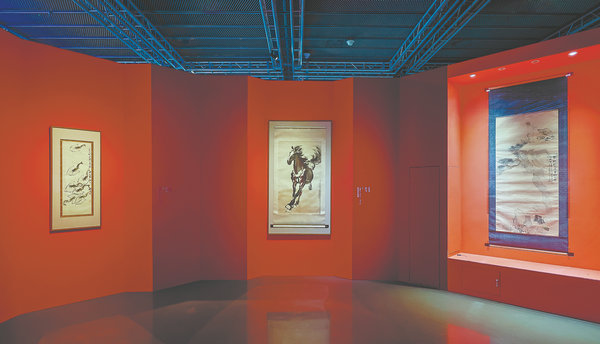
(From left) Shrimps of Qi Baishi, Galloping Horse of Xu Beihong, and Red Cliffs of Zhang Daqian on display at the exhibition. [Photo provided to China Daily]
One's fondest memories are often those spent with like-minded people.
Xu Beihong (1895-1953), a pioneer of 20th-century Chinese art, would tell stories from time to time of a trip he took to Huangshan Mountain, in Anhui province, in April 1936. While there, he unexpectedly met two artist friends, Zhang Daqian (1899-1983) and Xie Zhiliu (1910-97). Together, they climbed the mountain, which is famous for its views of the clouds and oddly shaped rocks and pine trees. In memory of the trip, Zhang later created and engraved a seal with Chinese characters declaring, "Three incredible men atop Huangshan Mountain".
Zhang is today regarded as a giant of 20th-century art and someone with international prominence. When talking about his accomplishments, people often quote Xu, who said that Zhang was "a man once in 500 years" — meaning he was a gifted man comparable to the great artists in history.
The friendship between Xu and Zhang is preserved in the photos of their Huangshan trip and the paintings on which they collaborated throughout the years. These works are now on show at Between the Thousand Years, an ongoing exhibition at Beijing's Guardian Art Center.
The show, running through March 10, gathers paintings, calligraphic scrolls, manuscripts and documents, primarily from the collection of Xu Beihong Memorial Museum in the capital city, which houses a great number of Xu's works and his assembly of ancient art and selected works by his friends, including Zhang.
The exhibition also marks the close association between Xu and Qi Baishi (1864-1957), which is still talked about today. Despite an age gap of 30 years, Xu was one of the key figures who, in the late 1920s, introduced Qi, a humble carpenter-turned-painter, to the art scene of Beijing. Xu, who was a famed artist returning from Europe when they first met, helped launch Qi's career by enthusiastically promoting his works at home and abroad.
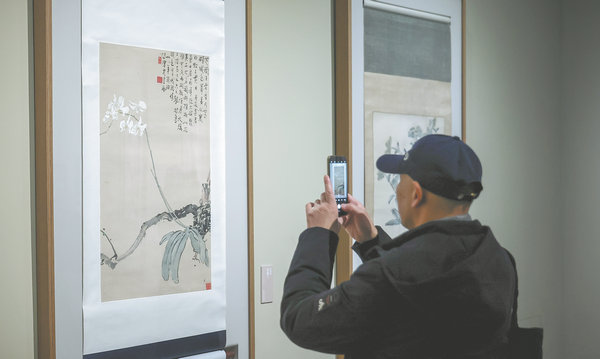
Flowers, by Xu Beihong. [Photo provided to China Daily]
The exhibition is the odyssey of three legendary artists who etched a colorful mark in the 20th century by championing the reform of Chinese ink art. Kou Qin, general manager of the Guardian Art Center, says this rare gathering of three great artists illuminates "their respect and understanding for each other, motivated by a shared goal in art".
The exhibition title in Chinese, Wanglai Qianzai, is borrowed from the inscriptions on a tailor-made square seal that Xu commissioned from engravers. The title implies that many of the things that people pursue are fleeting, whereas art and culture are timeless. He used the seal on his most favored paintings that he created or collected.
The three men differed in backgrounds and developed different approaches to the reinvention of Chinese ink painting, but, says Xu Ji, director of the collection department at Xu Beihong Memorial Museum,"they shared a belief in the renewed vitality of the ink tradition. The close bonds among them were grounded in full respect for the Chinese cultural spirit, which was delivered in their forceful ink strokes".
Born in Jiangsu province in East China, Xu Beihong studied in Paris and traveled throughout Europe in the 1920s. Meanwhile, Qi struggled for decades as a rural artist in his native Hunan province in Central China, before he secured a foothold in Beijing's art community.
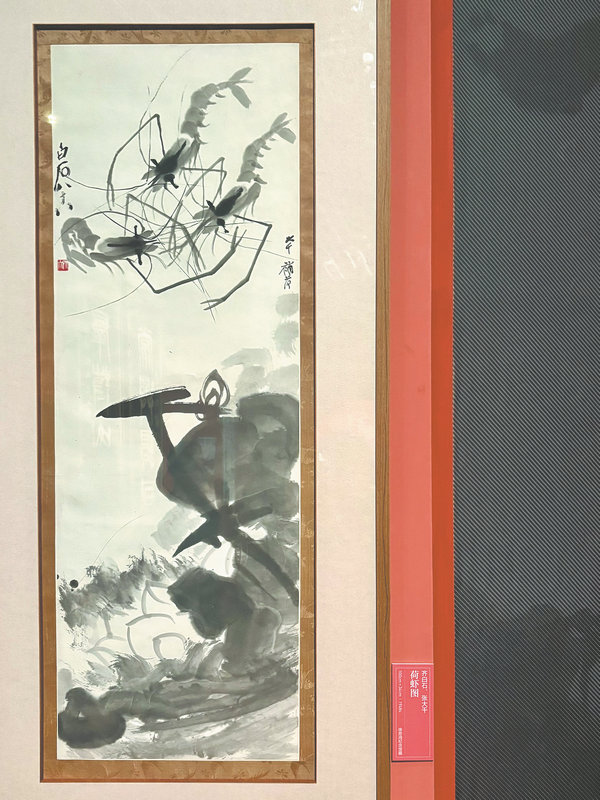
Lotus and Shrimps, a collaborative painting by Qi Baishi and Zhang Daqian. [Photo provided to China Daily]
Xu became the headmaster of Beiping Fine Art School, now the Central Academy of Fine Arts in Beijing, at age 33. Shortly after, he paid three visits to the home of Qi, whose artistic excellence he admired, and persuaded him to accept a professor's job at the school.
Zhang hailed from a well-to-do family of scholars in southwestern Sichuan province. He was taught to read and paint by his mother and older siblings, and once studied textile design in Japan. From the 1950s, he lived and divided his time mainly between the Americas and Europe, before moving to Taipei where he eventually died.
While in Paris in 1933, he was introduced to a European audience at the Modern Chinese Paintings Exhibition, which was promoted by Xu Beihong, who exhibited works by Chinese artists including himself, Zhang and Qi. The exhibition was a success and went on to tour other European cities.
"Besides painting and managing art schools, Xu Beihong was committed to campaigning for Chinese art and artists," Xu Ji says. "For example, Xu placed his own works, which sold at a much higher price, beside Qi's pieces at exhibitions to help raise Qi's profile."
He says the current exhibition offers a rare view of a 22-leaf album of paintings that includes Qi's best-known motifs, including flowers, plants, fruits, vegetables and small animals, in which he celebrated the vigor of small living things. He says the album was commissioned by Xu Beihong, who told Qi to paint whatever he wished, and that he would pay for them at a fair price.
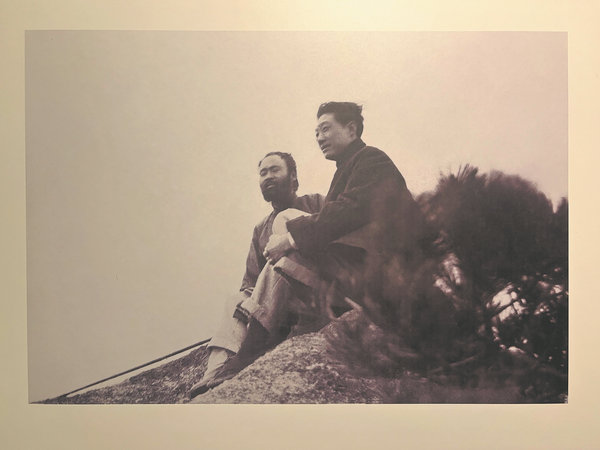
A photo from 1936 shows Zhang Daqian (left) and Xu Beihong on Huangshan Mountain, Anhui province. [Photo provided to China Daily]
Xu Ji says the three were open-minded about new developments and embraced change. The experiences of traveling abroad allowed Xu Beihong, who studied oil painting while in Paris, and Zhang to employ techniques taken from foreign artistic traditions in their own work.
He says, "The exhibition has Xu's The Himalayas No 1 on display, a monochromatic ink work in which he applied a contrast between highlights and shadows, with oil techniques to accentuate illusions of depth."
Zhang developed an iconic abstract, highly expressive pocai (splashing colors) style in which one can feel the Western influence. Qi even learned to sketch.
Above all, though, their experimental explorations invigorated Chinese art and culture — the roots that nourished them throughout their lifetimes, says Xu Ji.
In October 1947, the three held a group exhibition at a hotel in Tianjin. Zhang later left the Chinese mainland permanently and lived a globe-trotting life to exhibit and promote his art. After the founding of the People's Republic of China in 1949, Xu Beihong continued to head the Central Academy of Fine Arts where Qi was an honored guest professor. In September 1953, they both attended a national conference on art and culture, and three days later, Xu succumbed to a cerebral hemorrhage.
Xu Qingping, son of Xu Beihong and director of the Xu Beihong Memorial Museum, says, "My father loved a particular verse of Du Fu, the Tang Dynasty (618-907) poet: 'A feather in the eternal sky'."
He says these artworks are like feathers flying eternally in the sky of history, bearing witness to the wisdom of humankind and continuously inspiring creativity.
You May Like
-
Come to Kunming to Chase a Breathtaking Sunset!
Dusk bled into Dianchi Lake like liquid amber, its golden hue dissolving across the water. The last daylight caressed the silhouette of Xishan Mountain, the Sle...
InKunming 2025-04-16 -
Update: "Ne Zha 2" makes history as first non-Hollywood film...
Chinese animated blockbuster "Ne Zha 2" has become the first non-Hollywood film to exceed 2 billion U.S. dollars in global earnings, including presales, accordi...
InKunming 2025-03-04 -
How Chinese animated film "Ne Zha 2" becomes global box offi...
"Ne Zha 2," the animated blockbuster that has dominated China's box office, is igniting a global frenzy with its seamless fusion of traditional Chinese mythol...
InKunming 2025-02-18 -
Ne Zha 2 set to resonate with Hollywood
Over the weekend, the Hollywood premiere of Ne Zha 2 — a milestone film that has become the sole Asian film listed in the world's top 30 highest-grossing films...
InKunming 2025-02-11 -
Explore the 'ASEAN elements' in Nanning
Nanning, a dynamic city and the capital of Guangxi Zhuang autonomous region, serves as a vital gateway for China's collaboration with ASEAN nations. Embracing A...
InKunming 2025-01-16 -
Documenting a giant of literature
At the age of 102, Yang Yi, a distinguished translator known for her work on English author Emily Bronte's classic Wuthering Heights, reminisces about the begin...
InKunming 2025-01-06 -
An enduring enchantment with Peking Opera
The global success of the Chinese video game Black Myth: Wukong has helped introduce the tale of Sun Wukong, or the Monkey King, to people around the world. But...
InKunming 2024-12-30 -
Shanghai Cooperation Organization Children's New Year Concer...
The Shanghai Cooperation Organization (SCO) Children's New Year Concert premiered last night at the Zhongshan Concert Hall in Beijing.
InKunming 2024-12-26 -
"Western Monkey King" takes Peking Opera to the world
The global success of China's acclaimed game "Black Myth: Wukong" has introduced the enchanting tale of Sun Wukong, or the Monkey King, to audiences worldwide.
InKunming 2024-12-25 -
GLOBALink | "Panda ambassadors" win hearts worldwide
Giant pandas have been playing the role of "ambassadors," fostering bridges of friendship between China and other countries.
InKunming 2024-12-24