Renowned brand presents centuries-old art collection in exhibition
Source: China Daily | 2026-03-06 | Editor:Doe
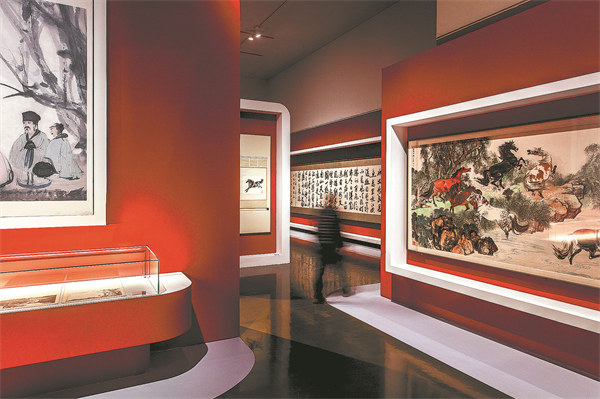
The ongoing exhibition at Shanghai Art Museum, Treasures of a Millennium, features 105 pieces (sets) of Chinese paintings, calligraphy, stone carvings and ancient books from the collection of the time-honored art institution Duoyunxuan Group. [Photo provided to China Daily]
Shanghai Duoyunxuan, a renowned cultural and time-honored brand, is presenting its most valued art collection for the first time in a free exhibition at the China Art Museum, Shanghai, also known as the Shanghai Art Museum.
The ongoing exhibition Treasures of a Millennium features 105 pieces/sets of Chinese paintings, calligraphy, stone carvings, ancient books, and more, spanning the 7th to early 20th century.
Among the most precious paintings and calligraphy works is an album of ink paintings by seven masters, including Ma Lin from the Southern Song Dynasty (1127-1279). The works are presented alongside some of the more familiar artists of the 19th-20th century, such as Zhang Daqian, Wu Changshuo and Ren Bonian.
One highlight is an ink painting by contemporary artist Liu Danzhai. The large piece, spreading 3.67-meter wide and 1.41-meter tall, depicts eight horses staying by a willow-lined pond, drinking, bathing, and playing with the water, while some neigh and leap high, creating a joyous atmosphere.
Visitors will also find a series of epigraphy and antiques that were once significant in China's literati lifestyle, such as seals carved on precious stones that combine poetry, calligraphy and painting.
As an event celebrating the Year of the Horse, the exhibition is arranged in four chapters, each introduced by a horse-themed painting by Xu Beihong, an influential Chinese artist and educator who played a significant role in the reformation of Chinese art, which integrated the Western art training system. His horse-themed ink wash paintings have received high acclaim in China.
While the first three are original ink paintings, the fourth piece is a reproduction of Xu's painting made from a woodblock waterprint, a unique technique of overprinting and color-block printing dating back to the Tang Dynasty (618-907).
Since its founding in 1900, Shanghai Duoyunxuan has been dedicated to inheriting and developing the traditional art of woodblock printing. In 2008, Duoyunxuan's woodblock water-print technique was listed in the first batch of national intangible cultural heritage.
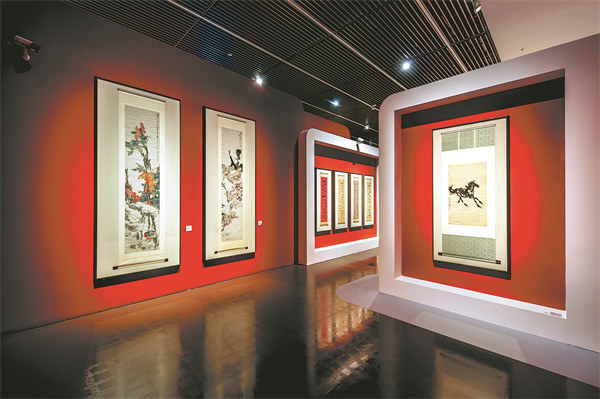
The ongoing exhibition at Shanghai Art Museum, Treasures of a Millennium, features 105 pieces (sets) of Chinese paintings, calligraphy, stone carvings and ancient books from the collection of the time-honored art institution Duoyunxuan Group. [Photo provided to China Daily]
Now, Duoyunxuan Group is a comprehensive institution dedicated to purchasing, distributing, publishing, and collecting fine art.
Zhu Qi, general manager of Duoyunxuan Group, says at the exhibition opening: "We hope this exhibition bridges the gap between art and daily life, allowing the public to experience the charm of artistic masterpieces firsthand."
Every day of the Chinese New Year holiday, the curatorial team arranged guided tours of the exhibition, and invited art scholars to give lectures about traditional Chinese art.
Since opening on Jan 31, the exhibition has received more than 100,000 visitors.
Some art lovers have returned to the exhibition for a second and third view. Zheng Mingchuan, the group's deputy general manager and the exhibition's curator, even encountered two elderly visitors who had returned five or six times. "They smile and say, 'Look, we are back again,'" Zheng says, touched by their enthusiasm.
Wang Yichuan, executive director of the Shanghai Art Museum, emphasizes that the collaboration between cultural enterprises and art institutions is a vivid practice in urban cultural construction.
The exhibition, jointly hosted by Duoyunxuan Group and the Shanghai Art Museum, will run until March 18.
You May Like
-
China, UK museums to co-host exhibition on European art in S...
Museums from China and the United Kingdom have agreed to jointly host an exhibition on European art in Shanghai in 2027, showcasing works spanning nearly seven ...
InKunming 2026-02-02 -
Chinese artists paint in westerly ways
Western painting techniques have evolved in medium from tempera to oil and acrylic, on wood and on canvas, to bear rich presentations
InKunming 2026-01-29 -
Where to See Plum Blossoms in Kunming This Winter
While snow still blankets northern lands, the branches of Kunming, known as the “Spring City,” are already in bloom. In a city where flowers can be found year...
InKunming 2026-01-27 -
Fair featuring intangible cultural heritage, Chinese New Yea...
A citizen views paper-cutting works during a fair featuring intangible cultural heritage and Chinese New Year goods in Hangzhou, east China's Zhejiang Province,...
InKunming 2026-01-26 -
History on the plate
Why do Chinese people eat dumplings during the winter solstice? Was egg-fried rice once considered a dish reserved for emperors?The answers to these questions c...
InKunming 2026-01-23 -
China discovers earliest known texts on horses from Warring ...
Chinese researchers have found the earliest known literature on horses via bamboo slips dating back over 2,000 years to the Warring States Period (475 BC-221 BC...
InKunming 2026-01-21 -
China Focus: Southeast Asian tourists flock north, fueling C...
Despite the biting minus 20 degrees Celsius cold on the century-old Central Street in Harbin, northeast China's Heilongjiang Province, Thai tourist Nattapong ...
InKunming 2026-01-20 -
Bamboo slips tell stories of ancient eras
The Jingzhou Cultural Relics Protection Center has developed core technologies to tackle the challenges in restoring waterlogged bamboo and wooden slips, and un...
InKunming 2026-01-15 -
China unveils major archaeological findings
Cutting-edge technologies and research approaches have empowered Chinese archaeologists to unlock new findings, six of which were unveiled to the public on We...
InKunming 2026-01-15 -
Ice dragon boat race aims to bolster Sino-UK bond
The frozen Songhua River in Harbin, Heilongjiang province, came alive with the sound of drums and the rhythmic clanging of ice picks, as nearly 200 members of i...
InKunming 2026-01-13