At China-Vietnam border hospital, care remains universal but moves between languages
Source: Xinhua | 2026-08-27 | Editor:Jennifer
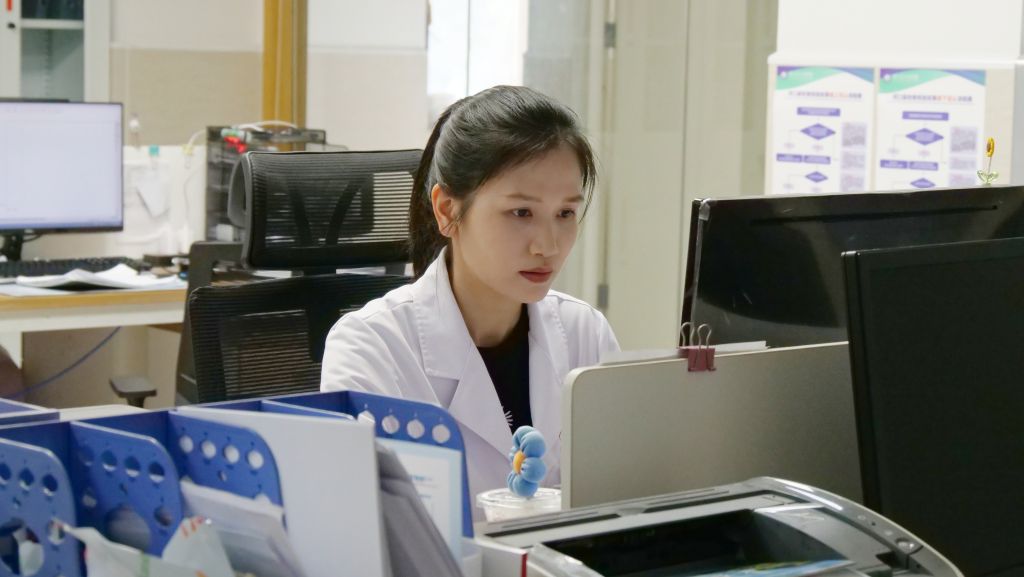
Tran Thi Oanh works at the People's Hospital of Hekou Yao Autonomous County in southwest China's Yunnan Province, Aug. 18, 2026. (Xinhua)
At 8 a.m., the neurology ward at the People's Hospital of Hekou Yao Autonomous County was already busy. Chinese and Vietnamese patients lay in neighboring beds, separated by a blue curtain.
Tran Thi Oanh moved from one to the next, asking questions in Chinese at one bedside and Vietnamese at another.
For Tran, a Vietnamese neurologist working in southwest China's Yunnan Province, changing languages is simply part of practicing medicine. She uses both to ask about symptoms and medical histories, and to stay in touch with some patients after they return home.
Two years ago, a Vietnamese patient suffered a cerebral infarction at customs and was unable to move. Tran rushed to the emergency department, spoke with the patient in Vietnamese to learn about the condition, and assisted the attending physician in providing timely treatment.
For many Vietnamese patients, having a doctor who speaks their language offers an added measure of reassurance.
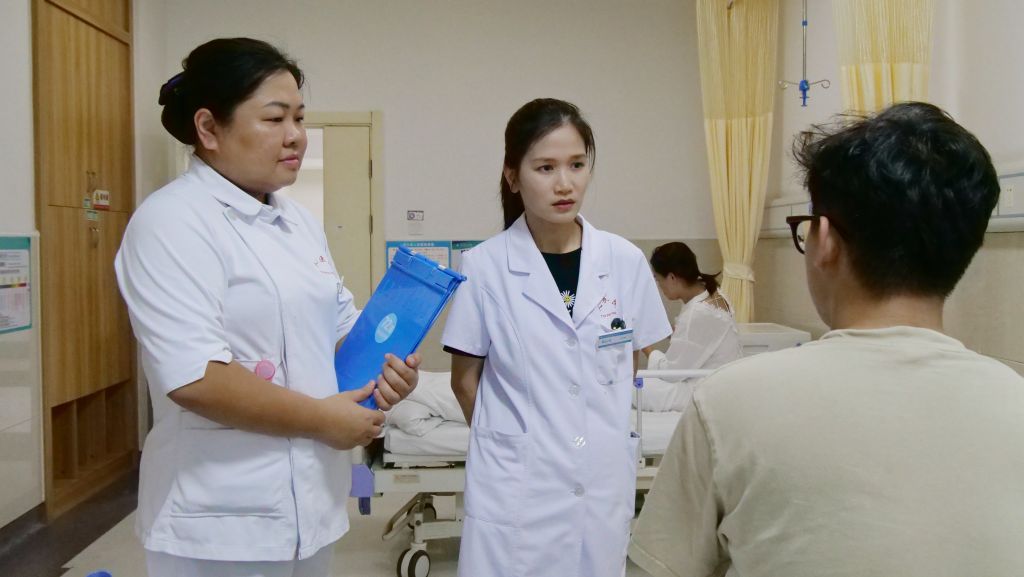
Tran Thi Oanh (C) inquires about the patient's condition in a ward at the People's Hospital of Hekou Yao Autonomous County in southwest China's Yunnan Province, Aug. 18, 2026. (Xinhua)
And the relationship often does not end at discharge.
Tran has the contact information of more than 100 Vietnamese patients on her phone. Among them is a woman in her 60s from Lao Cai Province, Vietnam, who had struggled with recurrent limb convulsions for more than three years. Treatment at home had brought little improvement. After someone recommended Tran, she traveled to Hekou.
Three months after starting a standardized medication regimen, her condition had improved significantly. She returned to Vietnam, but her daughter kept messaging Tran with updates about her mother's medication.
"Treatment doesn't end when a patient leaves the hospital," Tran said. "Follow-ups and medication adjustment are also important."
It is a role that Tran could hardly have imagined when she first arrived in China in 2010.
Born and raised in Vietnam, she came to Kunming Medical University in 2010 to study clinical medicine with almost no Chinese. Six years later, after graduating, she joined the People's Hospital of Hekou Yao Autonomous County, roughly two kilometers from the China-Vietnam border crossing.
At first, not every patient trusted her. Some wondered whether a foreigner could really master medicine taught in Chinese. Others asked for a different doctor.
Tran kept working on her Chinese and later trained at Ruijin Hospital, affiliated with Shanghai Jiao Tong University School of Medicine. Over the years, she became a key member of the county hospital's neurology department.
She still remembers a Chinese stroke patient brought in late one night with complete paralysis on the right side of the body. Tran and her colleagues quickly administered thrombolytic therapy. The patient later stood on his own.
"That moment gave me a real sense of achievement," she recalled.
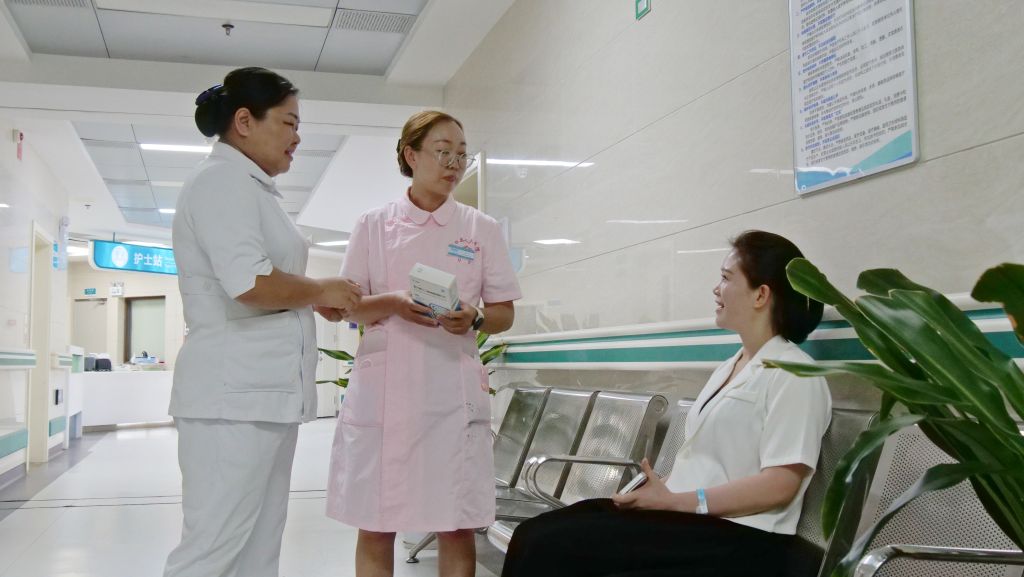
Medical workers of the international medical department communicate with a patient (R) at the People's Hospital of Hekou Yao Autonomous County in southwest China's Yunnan Province, Aug. 18, 2026. (Xinhua)
When Tran arrived at the hospital a decade ago, much of the communication with Vietnamese patients rested on her own ability to move between two languages.
That is no longer the case.
The People's Hospital of Hekou Yao Autonomous County, the largest and best-equipped border hospital along the Yunnan section of the China-Vietnam frontier, logged more than 13,000 visits by foreign patients in 2025. Its reach now extends to patients from Vietnam's Lao Cai, Ha Giang and Lai Chau provinces.
The hospital has opened an international medical department and hired two full-time Vietnamese interpreters who provide assistance around the clock. Signs appear in Chinese, English and Vietnamese. Foreign patients needing emergency treatment can use a fast-track entry channel.
Last month, nine Vietnamese nursing interns arrived for training, taking up posts at the reception desk, in cardiology and elsewhere in the hospital.
Tran has watched this all happen around her. What once relied heavily on one doctor's bilingual skills is now part of the hospital's everyday operation.
Aug. 19 marks the annual Chinese Doctors' Day. Tran spent it at work.
There was no special celebration on her schedule. She made her rounds as usual, moving down the ward, from one bed to the next, from one language to another.
Some patients still know her as the doctor who came from Vietnam.
Others simply call her Doctor Tran.
You May Like
-
Wild mushroom season in Yunnan has visitors heading for the ...
For Romanian teacher Simona Abagiu, the flavors of Yunnan's rainy season arrived in a steaming pot of wild mushroom soup. As the clear broth arrived at the tabl...
InKunming 2026-07-30 -
View of Fengqing County in SW China's Yunnan
Fengqing County, which boasts a long history of tea cultivation and tea production, has about 300,000 mu (about 20,000 hectares) of tea plantations, and is home...
InKunming 2026-07-30 -
Forum on international communication being held in SW China'...
The 5th Yunnan International Communication Forum kicked off on Thursday in Xishuangbanna Dai Autonomous Prefecture of southwest China's Yunnan Province, gathe...
InKunming 2026-07-17 -
Irish travel blogger explores Jingmai Mountain and experienc...
Chinese tea is always popular. Have you ever wondered how to make tea? Join Irish travel blogger Luke Wayne and discover the process!
InKunming 2026-07-09 -
Summer scenery of Lugu Lake in SW China
Summer scenery of Lugu Lake in Yunnan, China
InKunming 2026-07-08 -
Scenery along China's Yunnan-Xizang Highway, 50 years after ...
Scenery along China's Yunnan-Xizang Highway, 50 years after its opening
InKunming 2026-07-07 -
When mushrooms become wearable art
In rainy seasons, southwest China's Yunnan abounds with mushrooms.
InKunming 2026-07-06 -
FPV drone tour of Jiulong Waterfalls in China's Yunnan
What if you could fly straight over the edge of a waterfall?
InKunming 2026-07-06 -
Yunnan Coffee Charts a Path to Higher Value Through Specialt...
On June 25, 2026 the Second Gem of Yunnan Green Coffee Competition (Yunnan CoE Pilot Program) concluded on the shores of Dianchi Lake.
InKunming 2026-07-02 -
Global experts gather in Yunnan to advance tropical biodiver...
Experts from China and abroad gathered on Sunday in Xishuangbanna Dai autonomous prefecture, Yunnan province, to exchange insights on advancing tropical biodive...
InKunming 2026-07-02