Living alongside Asian elephants
Source: China Daily | 2026-08-12 | Editor:Jennifer

A herd of Asian elephants is seen in the Nangunhe National Nature Reserve in Lincang city, Yunnan province. CHINA DAILY
In China, Asian elephants have become symbols of both disruption and media fascination, often simultaneously.
While they typically reside within nature reserves, herds of these majestic creatures often venture into human settlements.
In Yunnan province, wild elephants frequently wander into villages, checkpoints, and suburbs in search of food. While individual strays are common, the province captured global attention in 2020 when a herd of about 14 elephants embarked on an epic journey, trekking over 500 kilometers toward Kunming, the provincial capital.
This surge in media coverage has inadvertently put the spotlight on regions like Xishuangbanna and Pu'er, associating them with the presence of Asian elephants.
However, nestled between these well-known areas, the city of Lincang in Yunnan has often been left out of elephant-related news. This is despite the presence of a unique population of Asian elephants thriving within the Nangunhe National Nature Reserve, located in Cangyuan and Gengma counties under Lincang's jurisdiction.
"The elephants within our reserve rarely, if ever, clash with the communities living nearby," said Qin Jianchun, deputy director of the reserve's Cangyuan administration.
"This harmonious coexistence is likely why Lincang remains relatively unknown as a home for Asian elephants."

An aerial photo shows a watchtower at the field given by the local government to cultivate food for Asian elephants. CHINA DAILY
Abundant resources
According to Qin, there are two distinct clades of wild Asian elephants distributed across China. Those living in Xishuangbanna and Pu'er, with a population of more than 280, belong to the Alpha clade, and those living within the Nangunhe nature reserve, with a population of only 21, belong to the Beta clade.
The Beta clade is most prominent in Sundaland — tropical rainforest spread across the islands of Sumatra, Borneo and Java, as well as the Malay Peninsula — and is also sporadically found in southern and central India, Sri Lanka, Myanmar, and parts of Thailand.
"In China, Asian elephants from the Beta clade are only found in Nangunhe," Qin said.
Established in 1980 as a nature reserve and upgraded to a national reserve in 1995, Nangunhe covers an area of more than 500 square kilometers. It features nine types of vegetation, including subtropical seasonal rainforest, temperate evergreen broadleaf forest, and coniferous forest.
The reserve is home to a remarkable diversity of seed plant species, accounting for about one-tenth of the nation's total and roughly one-fifth of those found in Yunnan. A survey conducted by the reserve identified over 400 plant species that serve as food sources for Asian elephants.
"This abundance of food allows elephants to easily find food within our reserve," Qin said. "Due to these rich resources, they rarely need to leave the reserve in search of food."
On occasion, elephants may venture near villages surrounding the reserve, particularly those in Banlao and Banhong townships in Cangyuan. However, Qin said, they seldom linger long enough to cause disturbances for the local residents, most of whom belong to the Va ethnic group.
According to the reserve manager, there are 38 villages scattered around the entire nature reserve with a population exceeding 100,000 people. Among these villages, nearly 20,000 people live near areas with distributions of wild Asian elephants.
Despite the proximity, there has only been one reported injury caused by a wild elephant over the past four to five years. The incident occurred when a villager entered the core area of the reserve and unexpectedly encountered a group of elephants, resulting in an injury. "This incident was a result of humans encroaching on the elephants' habitat," Qin said.
The harmonious coexistence between humans and elephants is partly attributed to the Va people's long-standing reverence for the majestic creatures. Each year on April 18, the Va ethnic group celebrates the Gongxiang (Elephant Worship) Festival in Banlao township. Recognized as a provincial intangible cultural heritage in 2022, the festival is a colorful celebration of the Va people's profound connection with nature.
The festival's origins are rooted in the desire to honor and appease the elephants that share their homeland. It features a food offering ritual with sugarcane, corn, and bananas to the elephants believed to be nearby. In addition to these cultural traditions, the reserve manager credits the peaceful relationship to various conservation efforts and protective measures implemented by the reserve and local government over the years.
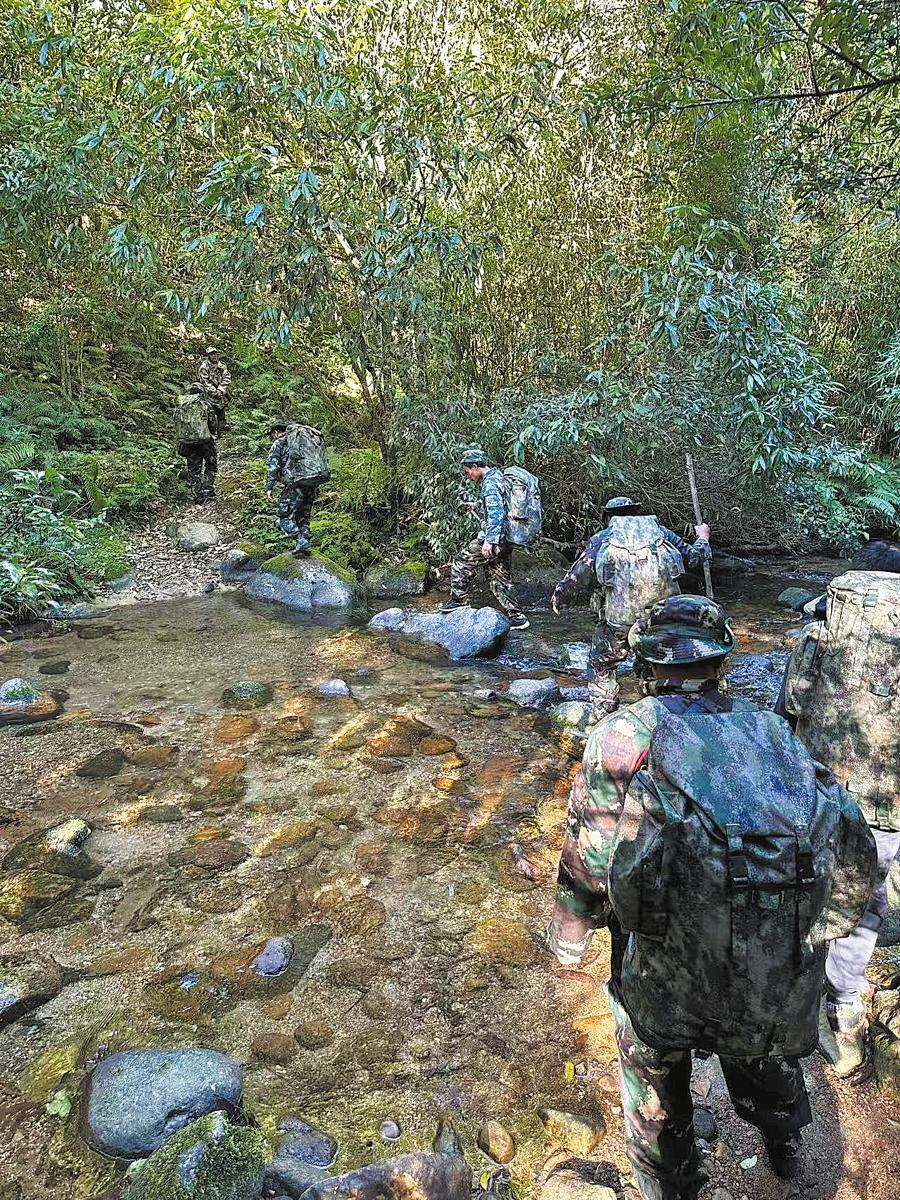
Rangers wade through a stream during their patrol in the reserve. CHINA DAILY
In recent years, significant investments have been made to protect the elephants.
Near the boundary of the reserve, the local government has given a 53-hectare field to the reserve to cultivate favorite food sources for Asian elephants, such as certain species of bamboo and banana. As a result, the elephants can find an alternative source of food in the field during periods of food scarcity. Another field with an area of 67 hectares has been mapped out in another area bordering the reserve and will soon start planting food for elephants, Qin said.
Electric security fences have been installed around the fields to protect them, he said. "We won't allow the elephants access to the fields until the plants are ready for them to eat," he added.
The reserve has also contributed to making the local villagers' tea plantations less appealing to the elephants by encouraging the growth of macadamia nut trees in the plantations. "Elephants don't like eating the nut trees, and they have good memories when it comes to food sources," Qin said.
Living alongside Asian elephants around the reserve requires constant vigilance. The Cangyuan administration continuously enhances monitoring and early warning systems, incorporating the use of drones, infrared cameras and smart terminals, and utilizing an Asian elephant warning app.
In May 2025, the administration hired a drone monitoring team to patrol key areas. Equipped with high-definition cameras and thermal imaging, drones can track elephant movements day and night, even in dense forests. "Unlike similar teams in Xishuangbanna and Pu'er, our team consists of only four members," Qin said.
In Nangunhe, the elephants typically reside in jungles, with only a few exits that can enable them to leave the forests.
"This makes it relatively easy for us to track their movements out of the reserve," Qin said. In addition to drones, the reserve has installed cameras at these key locations and more infrared cameras in the forests. With data from the surveillance team and from the cameras, the administration can send warnings through the app.
Tian Shihua, head of the administration's Banlao protection station, said that a team of 19 patrolmen, including nine part-time members hired from various villages in the township, is actively working for the station. When the team receives a warning from the app, they can communicate with the villagers about the possibility of wild elephants wandering into specific areas. This coordinated effort helps ensure the safety and awareness of the local communities.
Tian and his team are responsible for regularly patrolling five monitoring routes across an area exceeding 2,667 hectares. With information from the warning system, they can choose safe routes for their patrols. "Over the years, I've only had one close encounter with Asian elephants in the wild," said the 48-year-old. "They didn't chase me, but I was frightened. Fortunately, nothing else happened."

Two rangers observe a wild flower during their patrol in the reserve. CHINA DAILY
While the reserve has achieved significant milestones in conservation, the future is not without its challenges.
Agricultural expansion and a growing population have fragmented natural corridors, preventing the elephants from dispersing, said Chen Fei, director of the Asian Elephant Research Center of the National Forestry and Grassland Administration, which is based in Kunming. He said that the forested corridor connecting the reserve to Myanmar, once used by the elephants, has been largely replaced by rubber and tea plantations, isolating the elephant population.
"For me, that's the biggest challenge the Nangunhe population of Asian elephants has encountered," Chen said.
To address the challenges, he said that "we need to introduce new individuals to the population to enhance genetic diversity, balance the sex ratio, and improve the population's ability to withstand external environmental changes" in the future.
At present, Qin said, he still feels positive about the population's health. "The elephant population has grown from 12 in 2018 and five calves have been born since 2019," he said. "That means under our conservation, the population of Asian elephants is still growing in Nangunhe."
You May Like
-
Solutions to an elephantine ecological problem
In January, wildlife workers recorded images of three female Asian elephants and seven calves foraging for food and taking naps in Pu'er, Yunnan province.
InKunming 2023-02-22 -
Conservation efforts increase population of Asian elephants ...
Long Long, a baby Asian elephant, attracted much attention on the Internet weeks ago with a video showing him sliding down a muddy slope.
InKunming 2022-10-14 -
Baby elephant learns to slide down a muddy hill
This little elephant, who goes by the name of Long-Long, was caught on video learning how to slide down a muddy hill on his belly in the Asian Elephant Breeding...
InKunming 2022-10-12 -
Asian elephants in Kunming Zoo have fun at a new playground
The living condition of Asian elephants in Kunming Zoo has been improved recently. In the Asian Elephant Area of Kunming Zoo, you can see the mother and daughte...
InKunming 2022-10-09 -
China's efforts to protect Asian elephants bear fruit
At the Asian Elephant Breeding and Rescue Center in Xishuangbanna, Yunnan Province, staff referred to as "elephant parents" work at least 10 hours a day bathi...
InKunming 2022-08-18 -
40 wild Asian elephants spotted in SW China
A herd of 40 wild Asian elephants has been spotted foraging on a mountain in Mengla County, southwest China's Yunnan Province.
InKunming 2022-07-18 -
Yunnan strengthens efforts to protect Asian elephants
Xishuangbanna Asian Elephant Rescue and Breeding Center is set up to protect endangered species and to rescue Asian elephants as well as their breeding research...
InKunming 2022-07-12 -
China strengthens efforts to protect Asian elephants
Tang Zhengfang, a farmer from Jinning district, Kunming, has been longing for some special friends -- a herd of Asian elephants.
InKunming 2022-06-09 -
A naked-eye 3D video of Asian elephants shown on Yunnan's 8K...
To celebrate Earth Day on April 22, a naked-eye 3D video of Asian elephants was recently displayed on the outdoor 8K screen at the intersection of Beijing Road ...
InKunming 2022-04-22 -
Reserve keeps wandering elephants happy at home
Two years after a herd of wild Asian elephants attracted global attention by leaving its forest habitat in Southwest China, experts are working hard to ensure t...
InKunming 2022-03-23