Caution advised amid mushroom peak
Source: China Daily | 2026-08-05 | Editor:Flynn
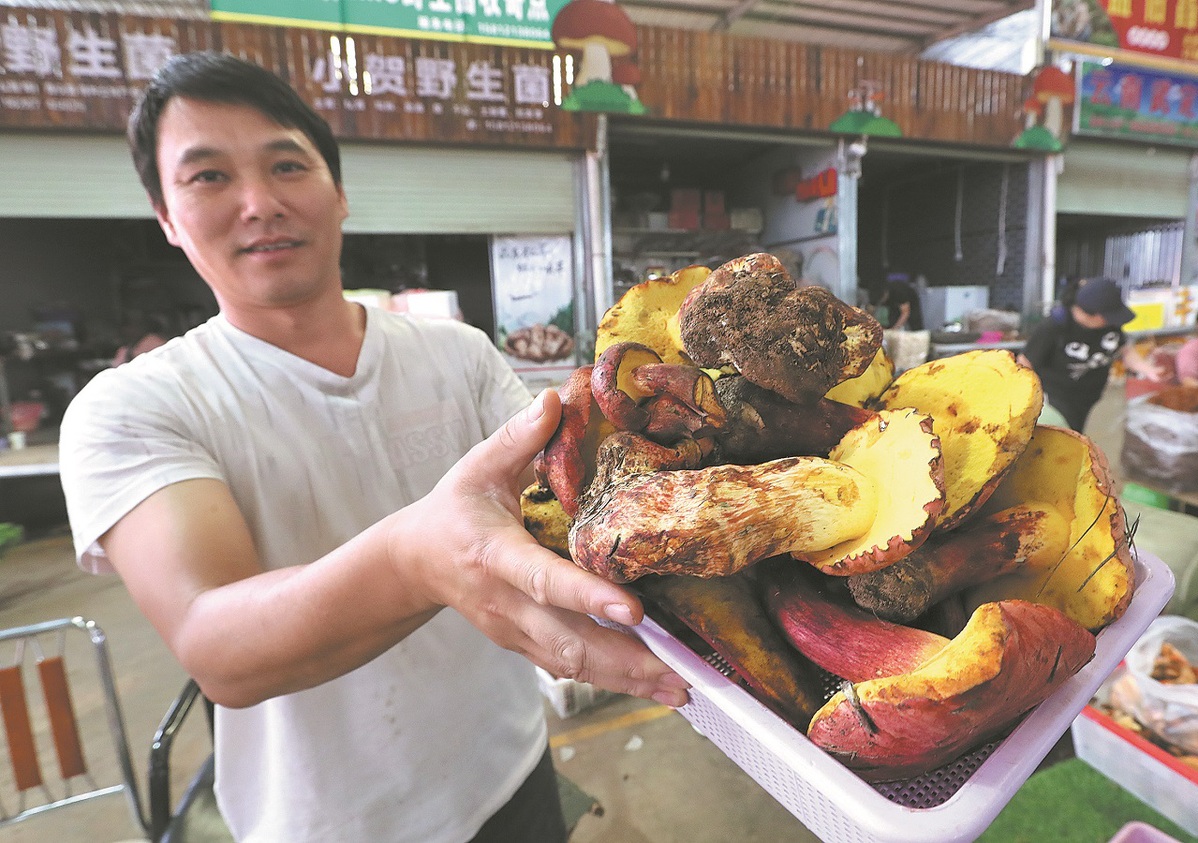
In Yunnan province, summer storms bring more than just water. They also bring mushrooms, money and, occasionally, ambulances.
Just ask the farmers who gather more than 900 mushroom species in the region, the traders who sell them and the doctors who treat people who fall ill after eating the wrong ones.
Liu Zhitao, director of the Nutrition and Food Hygiene Institute at the Yunnan Provincial Center for Disease Control and Prevention, said that more than 200 wild species are known to be toxic — including around 20 that are deadly. Many of the dangerous varieties closely resemble safe ones, making visual identification challenging even for experienced foragers.
With Yunnan experiencing its peak wild mushroom season from June to August, local health authorities have introduced a risk-assessment system to prevent poisoning.
"For high-risk counties, authorities are stepping up prevention efforts, including providing medical training at township health centers, improving intensive care capabilities at county-level hospitals, and streamlining patient-transfer procedures," Liu said.
Xiao Yunqian, director of the emergency department of Yunnan's Pu'er City Central Hospital, said horror stories of mushroom poisoning arise every year. This year, there have been about 100 cases since late May.
"People should seek immediate medical attention if they experience symptoms of wild mushroom poisoning, and should take any leftover mushrooms, as well as samples of vomit or excreta, to the hospital for testing," Xiao said.
Meanwhile, people working in the commercial mushroom trade and culinary fields are focusing on prevention. Their daily work helps to ensure that toxic varieties do not enter the supply chain.
Luo Wei, general manager of a mushroom trading center in Lijiang, Yunnan, said that the center has hired experienced mushroom farmers and provided them with professional training to guide tourists through the foraging process to help them avoid toxic species.
"The center has produced posters of poisonous mushrooms and distributed them to visitors for basic identification," Luo said.
Zhang Jianqiang, executive chef at two Aishangjun mushroom hotpot restaurants near Kunming's old town, said that all mushrooms must be screened by experienced staff members before being cooked, and that they must be cooked thoroughly. Stir-fried varieties require generous amounts of oil and a long cooking time, while boiled mushrooms require at least 25 minutes of heat, Zhang said, adding that plenty of garlic can help reduce bacterial risks.
You May Like
-
Season 2 of “A Letter from Kunming” Officially Kicks Off ...
As the Northern Hemisphere is gradually swept up in waves of summer heat, Kunming, located at 25° north latitude, remains in a springlike embrace of 21°C. Now, ...
InKunming 2026-05-01 -
New business models inject vitality into China's "spring eco...
As temperatures go up across China, spring has arrived in most parts of the country, and seasonal consumption is heating up accordingly, giving rise to a vibran...
InKunming 2026-04-08 -
Tourism enjoys robust growth
As China's visa-free policies continue to deliver dividends, the country's inbound tourism market is warming up this spring, with travelers venturing beyond fir...
InKunming 2026-04-07 -
China-Laos Railway handles over 70 mln passenger trips
The China-Laos Railway has handled over 70 million passenger trips since it began operations on Dec. 3, 2021.
InKunming 2026-04-01 -
Kunming market bursts with edible flowers as spring arrives
Seasonal edible flowers sell briskly at Zhuanxin Wet Market in Kunming.
InKunming 2026-03-24 -
A South African Blogger Finds Opportunity in Yunnan’s Slow ...
“Friends, whatever you do, don’t come to Yunnan—because once you do, you won’t want to leave!” In videos by Liz, a blogger from South Africa, viewers see K...
InKunming 2026-03-18 -
Kunming Welcomes Peak Season for Spring Delicacies as Wild M...
As spring unfolds in March, seasonal delicacies have taken center stage. With temperatures continuing to rise, Kunming has entered its annual peak season for "e...
InKunming 2026-03-18 -
Cherry blossoms in Yunnan reach peak bloom
Spring at its finest! Yunnan's cherry blossoms are in full bloom, with sightseeing boats and trains winding through hills painted pink.
InKunming 2026-03-16 -
A Flower-Made Peacock Spreads Its Feathers at Dianchi Lake
A Flower-Made Peacock Spreads Its Feathers at Dianchi Lake, ushering in Spring Festival Romance in Kunming.
InKunming 2026-02-10 -
Robust traffic on China-Laos Railway strengthens connectivit...
The China-Laos Railway has seen robust growth in both passenger and freight transport since its launch, providing strong support for regional connectivity and e...
InKunming 2026-02-09