Guided by a legacy
Source: China Daily | 2026-06-17 | Editor:Flynn
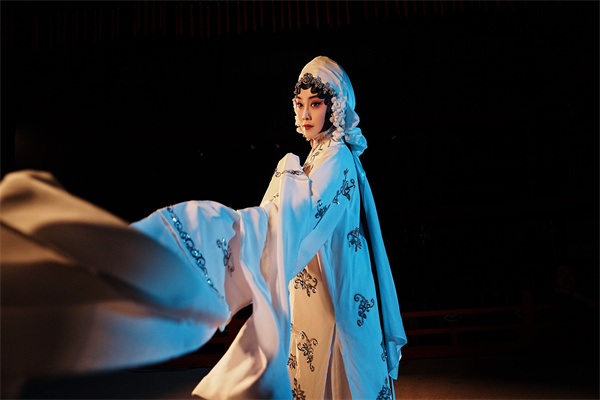
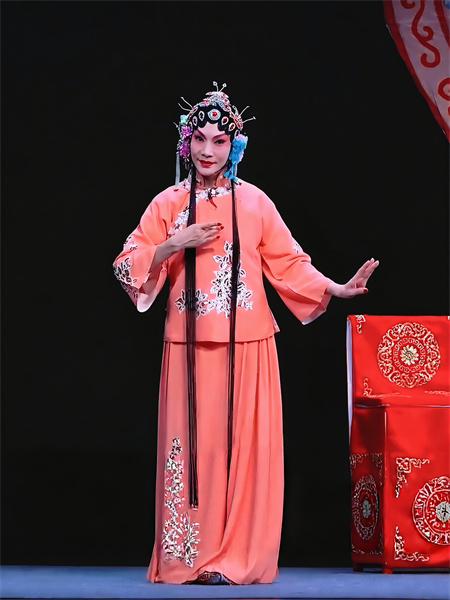
Capturing the timeless grace of Peking Opera, actress Wang Mengting brings classical roles to life in three distinct, expressive poses. CHINA DAILY
During rehearsal, some moments in time seem to bend. A phrase of song is repeated once, then again — never quite the same, yet never entirely different. A gesture shifts by a few centimeters, and suddenly the emotional logic of a scene transforms.
For Peking Opera actress Wang Mengting, who is working on the classic, The Butterfly Dream, these moments often carry an uncanny sensation, as if someone she has never met is quietly guiding her from the side of the stage.
"I often imagine how Tong Zhiling would do it," Wang says. "Not as imitation, but as a conversation across time. I try to allow her logic and inner rhythm to guide me."
It is in this delicate space — between reconstruction and imagination — that a major Peking Opera revival takes shape. The production, The Butterfly Dream, premiering in June 2026 across Tianjin (June 5 and 6), Shanghai (June 13 and 14) and Beijing (dates to be announced), seeks to bring back the legacy of Tong Zhiling (1922-95), one of Peking Opera's most innovative and nuanced performers.
Also known as jingju, Peking Opera dates back over 200 years and was recognized as an Intangible Cultural Heritage of Humanity by UNESCO in 2010. It blends art forms such as singing, dancing, martial arts, and acrobatics.
Born in Tianjin into a family devoted to Peking Opera, Tong Zhiling trained under the legendary "dan" (female role) master Xun Huisheng (1900-68), one of the "four great dan" along with Mei Lanfang (1894-1961), Cheng Yanqiu (1904-58), and Shang Xiaoyun (1900-76). Tong became renowned for hua dan roles — lively young women — admired for her subtle gestures, refined singing, and nuanced character portrayals.
She also studied under Wang Yaoqing (1881-1954) and Mei, absorbing the finest traditions while cultivating her own style. Together with her siblings, she formed the famed "Tong family troupe", dazzling audiences in classics such as The Phoenix Returns Home and Hong Niang from Romance of the Western Chamber. Her artistry extended to film, including the acclaimed 1963 Peking Opera film You Sanjie. She joined the Shanghai Peking Opera Company in 1954.
A master of emotional depth and technical finesse, Tong Zhiling's performances were celebrated for their grace, subtlety and enduring vitality — qualities that continue to inspire performers and audiences alike.
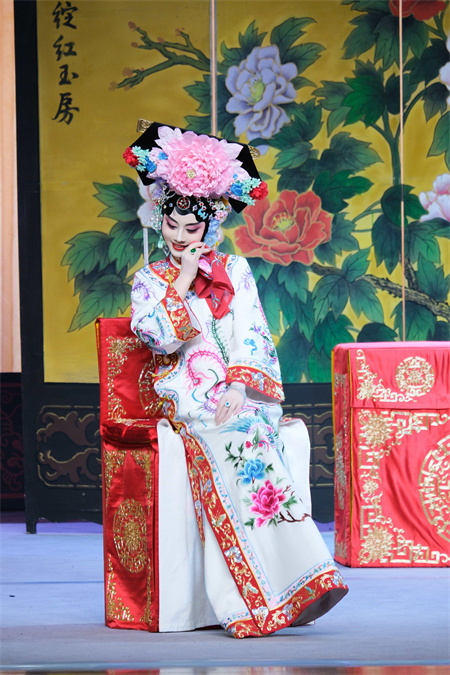
Capturing the timeless grace of Peking Opera, actress Wang Mengting brings classical roles to life in three distinct, expressive poses. CHINA DAILY
Wang Mengting first encountered Tong's work through fragments, including archival clips and occasional broadcasts. At first, they were enchanting but elusive, like glimpses of a distant star. Only after formal training under master Sun Yumin (1940-2023) did those fragments coalesce into a coherent artistic language. What emerged was not a rigid system, but something fluid, intimate and profoundly human.
Tong's artistry, Wang Mengting observes, is built on "instability in precision"; no movement is mechanically repeated. Every gesture, every lift of the hand, every flicker of the eyes arises from the character's immediate emotional state. Even familiar roles shift night to night, responding to the flow of the story, stage atmosphere and interplay with other actors.
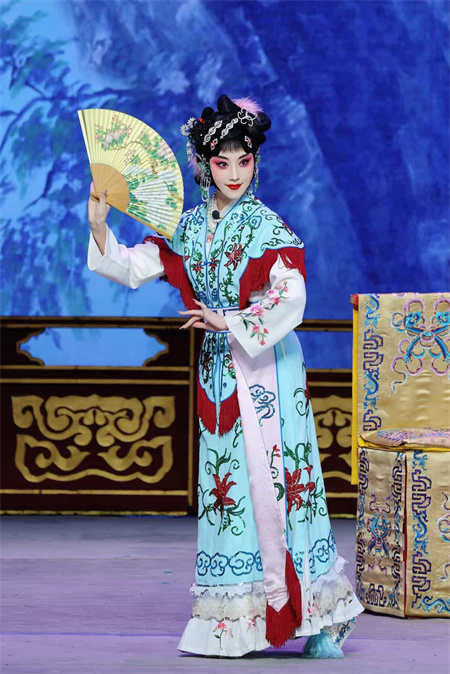
Capturing the timeless grace of Peking Opera, actress Wang Mengting brings classical roles to life in three distinct, expressive poses. CHINA DAILY
"She doesn't perform from templates," Wang Mengting says. "She performs from the given situation. Every gesture grows organically from the moment. That is where her artistry lives."
The tribute program includes The Butterfly Dream, Silang Visits His Mother, excerpts from You Sanjie, Romance of the Dragon and the Phoenix, and Stealing the Soul Bell. Among them, The Butterfly Dream represents the most delicate reconstruction effort. Its performance history is fragmented, with incomplete documentation and stage tradition largely absent from contemporary repertoires.
Wang Mengting describes the process as navigating "without a complete map". Some references exist in overseas recordings, including versions reconstructed by Tong Zhiling's daughter, Tong Xiaoling, in the United States. But much of the staging must be rebuilt through interpretive logic and an understanding of how a character thinks, hesitates, or expresses joy or fear within Tong's artistic system.
Tong Xiaoling, daughter of famous hua dan performer Tong Zhiling idolized by Wang Mengting. CHINA DAILY
The scene in which the emotional reunion of husband and wife after years apart became central. Wang Mengting didn't ask, "How did she move her hand?" She asked,"What emotion produces that movement?
"It's less about copying her," she says, "and more about understanding the inner movement that generates the outer shape."
Wang Mengting, 36, born in Shenyang, Liaoning province, is a leading Peking Opera actress of the younger generation, specializing in the Xun School hua dan roles. Her journey began at age 7 and culminated in her joining the Beijing Peking Opera Company in 2009.
For Tong Xiaoling, Tong Zhiling's daughter, her mother's life was less biography than continuous motion.
"She was always inside Peking Opera," she recalls. "Even at home, she was rehearsing, thinking, and refining. The stage never ended for her."
Immersed in the art from a young age, Tong Xiaoling moved to the United States in the early 1980s. There, she carried forward her mother's legacy, touring Europe and the US, collaborating with composer Tan Dun, and presenting master classes in schools and cultural centers.
In childhood, Peking Opera was a constant presence. While other children read stories from books, Tong Xiaoling absorbed them through sound — arias rehearsed endlessly in the next room, and scenes repeated until they became involuntary memory. By the 1980s, the family home had become an informal creative laboratory where senior artists gathered to test, dissect, and rebuild scenes.
Yet, outside this world of artistic labor, Tong Zhiling remained quietly austere. "She never cared about appearance," her daughter says."Only about whether the role was right."
Even in her later years, Tong Zhiling rarely repeated a role the same way twice. For Wang Mengting, this becomes both a challenge and a method: study deeply, then re-activate rather than reproduce.
"The key," Wang Mengting says,"is not to look like her, but to think like her on stage."
Wang Mengting has also championed digital outreach, introducing Peking Opera to younger audiences through rehearsal videos, interpretive explanations, and livestreamed performances.
"Young audiences are already close to this art," she says. "They just need a way in. Appreciation has no universal standard. Peking Opera is diverse, just like people's tastes. Our job is to provide that window."
You May Like
-
Across China: SW China's ancient Tea Horse Road finds new li...
After years of living in China, Antonio from Spain discovered a new passion in the intricate world of tea, noting that his trip through Yunnan in southwest Ch...
InKunming 2026-01-23 -
From balance beam to screen
Olympic champion Guan Chenchen has made her screen debut in The Secret to Fat Loss, China's first costume micro-drama centered on scientific fitness, which offi...
InKunming 2026-01-21 -
Tomb rekindles Chu history
Lavish burial reveals monarchy's splendor, vulnerability and struggles on the eve of imperial unification.
InKunming 2026-01-09 -
China Focus: The "cultural ferrymen" offering a more authent...
As the scent of freshly steamed bean paste buns drifts through the People's Park in downtown Shanghai and laughter erupts from a nearby English-language stand-u...
InKunming 2025-12-25 -
China Focus: World's largest ice and snow theme park opens, ...
The Harbin Ice-Snow World, world's largest ice and snow theme park, officially opened for the season on Wednesday, unveiling its most spectacular edition yet, f...
InKunming 2025-12-18 -
New play restores missing chapter of wartime history
This extraordinary story of bravery and compassion forms the inspiration for Searching for Doolittle, a new Chinese play that dramatizes this little-known but p...
InKunming 2025-11-04 -
Letter from China: Caves, mountains in China's Guilin embody...
Debuted in 2022, the Guilin Art Festival has since evolved from a localized experiment into a grand occasion for immersive, site-specific artistic expressions. ...
InKunming 2025-11-04 -
Artisans capitalize on China's legacy cultural capital
Traditional Chinese craftsmanship such as embroidery, ceramics and lacquerware, valued highly around the world, has been spreading Chinese culture globally for ...
InKunming 2025-10-22 -
China Focus: Global mayors inspired by transformation of Chi...
In an era defined by industrial speed and digital efficiency, Jingdezhen, China's "porcelain capital," is charting a different path: attracting the world thro...
InKunming 2025-10-20 -
Global mayors discuss cultural governance in NW China's Dunh...
A forum bringing together mayors or their representatives, diplomats and scholars from 10 countries opened on Monday in Dunhuang, a city along the ancient Sil...
InKunming 2025-10-14