Economic Watch: Solid foundation, new growth drivers underpin China's economic resilience
Source: Xinhua | 2026-06-17 | Editor:Diana
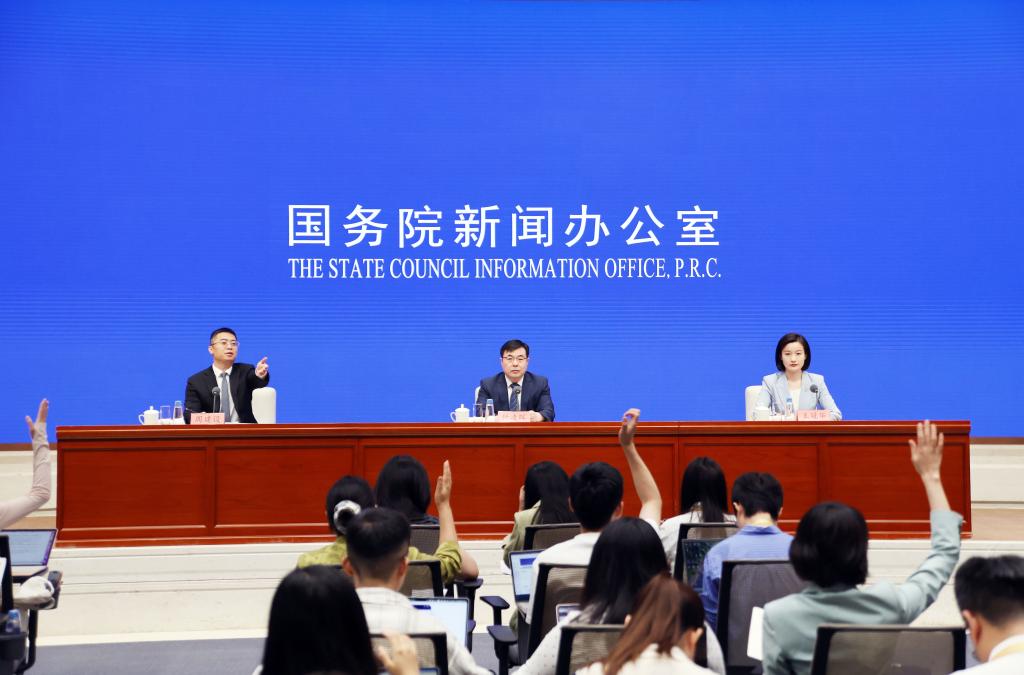
The State Council Information Office (SCIO) holds a press conference on China's economic performance in May 2026 in Beijing, capital of China, June 16, 2026. (Xinhua/Pan Xu)
China's economy sustained generally stable momentum in May, as solid fundamentals and strong resilience helped withstand external challenges, while growing new drivers continued to provide firm support for high-quality development, official data showed Tuesday.
China's value-added industrial output grew 4.5 percent year on year in May, 0.4 percentage points faster than the growth in April. On a month-on-month basis, the volume rose 0.4 percent from April, according to data released by the National Bureau of Statistics (NBS).
By sector, equipment manufacturing and high-tech manufacturing posted faster growth, underscoring the strengthening role of new drivers.
The value-added output of equipment manufacturing rose 9.5 percent year on year in May, while that of high-tech manufacturing surged 15.1 percent, accelerating by 1.2 and 2.3 percentage points from the previous month, respectively.
Output of 3D printing equipment, lithium-ion batteries, and industrial robots jumped 54.4 percent, 40 percent, and 27.9 percent, respectively.
Despite a complex and volatile international environment, the continuing spillover effects of geopolitical conflicts in the Middle East, and the impact of high temperatures and heavy rainfall in some regions, China's economy continued to show a generally stable trend with improving structure and quality, noted NBS spokesperson Fu Linghui at a press conference.
While Tuesday's data showed that China's fixed-asset investment remained under pressure due to weakness in the property sector, investment in innovation-related areas continued to expand, reflecting the ongoing transition from old growth drivers to new ones and the shift in investment from aggregate expansion toward quality improvement.
In the first five months, fixed-asset investment excluding rural households totaled 17.85 trillion yuan (about 2.62 trillion U.S. dollars), down 4.1 percent year on year. Excluding real estate development, fixed-asset investment declined 1.2 percent.
By contrast, investment in intellectual property products grew 9.3 percent year on year, 0.4 percentage points faster than in the January-April period. High-tech industry investment rose 4.5 percent, with investment in computer and office equipment manufacturing, aerospace equipment manufacturing, and information services up 18.3 percent, 16.7 percent and 13.8 percent, respectively.
Despite the overall slowdown, continued policy support, stronger innovation-led development, and greater efforts to safeguard people's well-being have helped further improve the investment structure, according to Fu.
On the closely watched consumption market, China's total retail sales of goods and services increased by 2.8 percent year on year in the first five months.
Service consumption maintained solid growth, with retail sales of services rising 5.4 percent year on year, continuing to outpace retail sales of goods.
New forms of consumption continued to expand. Online retail sales of goods and services grew 5.9 percent in the first five months, faster than overall goods retail sales. Digital and green consumption also gained momentum, with retail sales of communication and information services rising by more than 10 percent and sales of high-efficiency home appliances by over 30 percent.
Still, residents' capacity and willingness to consume need to be further strengthened, and market supply in some areas has yet to fully meet the needs of consumption upgrading, Fu said, pledging more efforts to boost consumption, raise incomes, create new consumption scenarios and improve the consumption environment.
The set of economic data came as, since the second quarter, some economic indicators in China have slowed, and some enterprises have faced operational difficulties due to a more complex international environment and domestic structural adjustment pressures.
However, Fu stressed that the broader trend of China's economy remaining generally stable and making steady progress has not changed, and the shift toward new growth drivers and an improved structure remains clear.
"Going forward, the growth of new quality productive forces, the continued release of reform and opening-up dividends, and the impact of stronger macro policies will continue to support stable economic performance and further improvement in structure and quality," Fu said.
You May Like
-
China targets quality growth in 2026 and beyond amid weakeni...
China on Thursday set an economic growth target of 4.5 to 5 percent for 2026, aiming for a good start to the new five-year plan that charts the course for high-...
InKunming 2026-03-06 -
Giving the real economy an AI upgrade
At a factory in Central China, production once depended on workers dashing between machines, adjusting schedules by hand and fixing faults after they occurred. ...
InKunming 2026-03-03 -
China Focus: Elderly fitness fuels silver economy in China
At 9 a.m. sharp, when much of Shanghai is just settling into its workday rhythm, 84-year-old Cao Jin'gen is already midway through his daily exercise routine.
InKunming 2026-03-02 -
China aims to basically establish standards system for low-a...
A system of standards for the low-altitude economy is expected to be basically established by 2027, according to guidelines published on Monday.
InKunming 2026-02-03 -
Across China: China's river delta balances bird conservation...
In the Yellow River Delta of eastern China, flocks of oriental white storks glide gracefully overhead or forage across the vast wetlands. For Zhu Shuyu, this fa...
InKunming 2026-01-22 -
Xiconomics: China's vision for an open world economy in a tu...
The 2026 World Economic Forum (WEF) Annual Meeting opened on Monday in the snowy Swiss resort of Davos.
InKunming 2026-01-21 -
Economic Watch: AI reshapes China's blue economy with innova...
Deep beneath the ocean surface, a box-shaped robot extended a mechanical arm and delivered a lethal injection to a crown-of-thorns starfish. Through this succes...
InKunming 2026-01-19 -
China Focus: Second-hand "treasure hunting" fuels trillion-y...
Despite the winter chill, a flea market in southwest China's Chongqing Municipality is heating up as a favorite destination for young treasure hunters attract...
InKunming 2025-12-29 -
Yearender: Setting the record straight, a retrospective look...
Major international organizations, including the World Bank and the International Monetary Fund, have recently raised their economic growth forecasts for Chin...
InKunming 2025-12-25 -
Creative products drive China's growing pet economy
China's pet market is booming -- not just in food, but in fashion, toys, and daily essentials. With demand soaring, businesses are getting creative, rolling out...
InKunming 2025-11-21