5 countries elected non-permanent members to UN Security Council
Source: Xinhua | 2026-06-04 | Editor:Doe
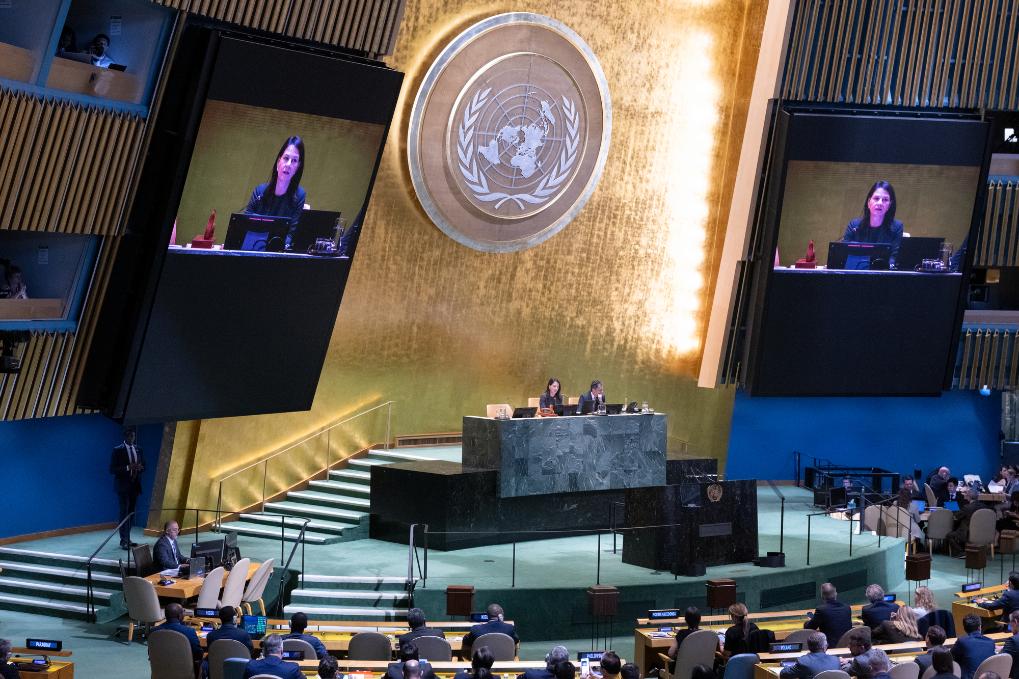
This photo shows a General Assembly session to elect non-permanent members of the UN Security Council, at the UN headquarters in New York, on June 3, 2026. Austria, Kyrgyzstan, Portugal, Trinidad and Tobago, and Zimbabwe were elected non-permanent members of the UN Security Council on Wednesday for a two-year term. (Eskinder Debebe/UN Photo/Handout via Xinhua)
Austria, Kyrgyzstan, Portugal, Trinidad and Tobago, and Zimbabwe were elected non-permanent members of the UN Security Council on Wednesday for a two-year term.
The election marked the first time Kyrgyzstan will serve on the Security Council.
The newly elected members will replace the outgoing non-permanent members -- Denmark, Greece, Pakistan, Panama and Somalia -- and assume their seats on Jan. 1, 2027, and serve until Dec. 31, 2028.
A candidate must obtain the support of two-thirds of the UN member states present and voting at the General Assembly session in order to secure a non-permanent seat on the Security Council, regardless of whether the candidacy is contested or not. A minimum of 129 positive votes is required to win a seat if all 193 member states are present and voting. Member states that abstain are considered not voting.
There were seven candidates for the five seats available this year. Austria, Portugal, Trinidad and Tobago, and Zimbabwe were elected in the first round of voting.
Three more rounds of voting were held before Kyrgyzstan defeated the Philippines in a contested race.
The Security Council has 15 members, five of which are permanent: Britain, China, France, Russia and the United States. The 10 non-permanent seats of the council are allocated by geographic region, with five replaced each year.
The five newly elected countries represent the African, Asia-Pacific, Latin American and Caribbean, and Western European and Others groups. The Eastern European group is not contesting this year, as its seat, currently held by Latvia through 2027, comes up for election every other year.
The Security Council is considered the most powerful body of the United Nations. The council, tasked with maintaining international peace and security, can make legally binding decisions and has the power to impose sanctions and authorize the use of force.
You May Like
-
AI-driven innovation opens new possibilities for smart livin...
Similar AI-powered applications are already making their way into classrooms.
InKunming 2026-06-01 -
Group of Friends of Global Governance forges consensus on 5 ...
Chinese Foreign Minister Wang Yi said Thursday that the Group of Friends of Global Governance (GFGG) has reached consensus on five key points regarding global...
InKunming 2026-05-29 -
Senior CPC official meets delegation of British MPs
Wang Huning, a senior official of the Communist Party of China (CPC), on Thursday met with a British delegation of cross-party members of parliament (MPs), wh...
InKunming 2026-05-29 -
Interview: Serbia-China ironclad friendship unbreakable: Ser...
In an exclusive interview with Xinhua in Beijing on Tuesday, Serbian President Aleksandar Vucic fondly spoke about Chinese President Xi Jinping awarding him t...
InKunming 2026-05-29 -
China-US cooperation stressed after summit
Leading scholars from China and the United States are stressing the importance of seizing the opportunity to improve bilateral ties ushered in by the summit bet...
InKunming 2026-05-29 -
Young voyagers encouraged to continue quest
Twelve days of living and learning together in China added a new item to the bucket lists of both Sun Linlin and Adrian Castillo — to explore more of each othe...
InKunming 2026-05-29 -
Skills seen as key to future job openings
Skills development is essential for the future of work, and China — home to the world's largest skilled labor force — is uniquely positioned to share its expe...
InKunming 2026-05-28 -
Xiconomics: How cooperation with China is transforming indus...
President Xi Jinping describes the China-Serbia friendship as "ironclad."
InKunming 2026-05-28 -
State Grid Huzhou builds greener and smarter power network
State Grid Huzhou power supply company conducting inspection on the photovoltaic lines and equipment at a photovoltaic power station in Changxing County of Huzh...
InKunming 2026-05-28 -
Experts see slow energy market recovery even under best-case...
Industry experts said Tuesday that even under the most optimistic scenario, in which the United States and Iran quickly reach an agreement to reopen the Strait ...
InKunming 2026-05-28