"Come on! Ke Gan the Cybersecurity Gai" — Yunnan's "Cybersecurity Market" Comes Alive in Kunming
Source: InKunming | 2026-10-08 | Editor:Flynn
On the afternoon of September 18, one of the events of the 2026 China Cybersecurity Week, Yunnan series — "Come on! Ke Gan the Cybersecurity Gai" — "Cybersecurity Market" opened to great fanfare at the Donghua Xinying Farmers' Market in Kunming. The campaign brings cybersecurity outreach straight into the lively atmosphere of a bustling wet market, letting residents absorb cybersecurity tips while they stroll, play, shop, and snack.

"Come on! Ke Gan the Cybersecurity Gai" — Yunnan's "Cybersecurity Market" Opens at Donghua Xinying Farmers' Market in Kunming
In the Yunnan dialect, "Ke" means "go," and "Gan Gai" means "hit the market." So this event is at once a trip to a lively fair and a gathering to learn about cybersecurity.
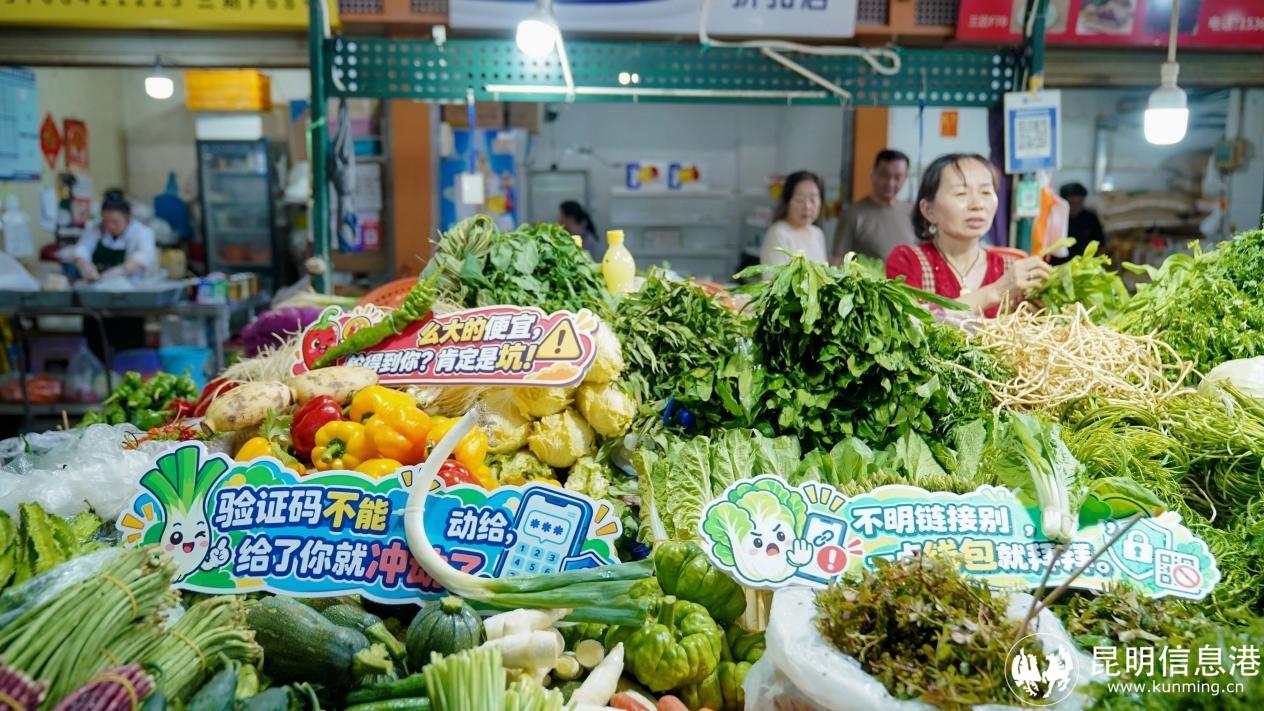
"Cybersecurity Veggie Stall": slogans hidden among the produce
Tucked between the fruit and vegetable stalls are playful puns on local produce. A sign by the Napa cabbage reads: "Don't 'step' on unknown links, one tap and your wallet's gone." Beside the scallions: "Never rush to hand out your verification code." Garlic, ginger, carrots, walnuts, chilies, watermelons, and lemons all become part of the cybersecurity messaging. Residents who snap photos and read the slogans aloud can redeem small gifts. Staff members chat face-to-face with vendors, tying advice to everyday scenarios like mobile payment QR codes, reminding everyone to keep their payment QR codes secure and avoid tapping unfamiliar links.. On the outer plaza, a long queue forms at the "Peach-and-Pear Danger" wisdom stall, a playful pun on the Chinese phrase for "escape danger." Signs are tucked into peaches, plums, passion fruit, and pomegranates. Residents who ring a fruit with a ring toss, read the slogan aloud, and name one cybersecurity prevention method get to take the fruit home.
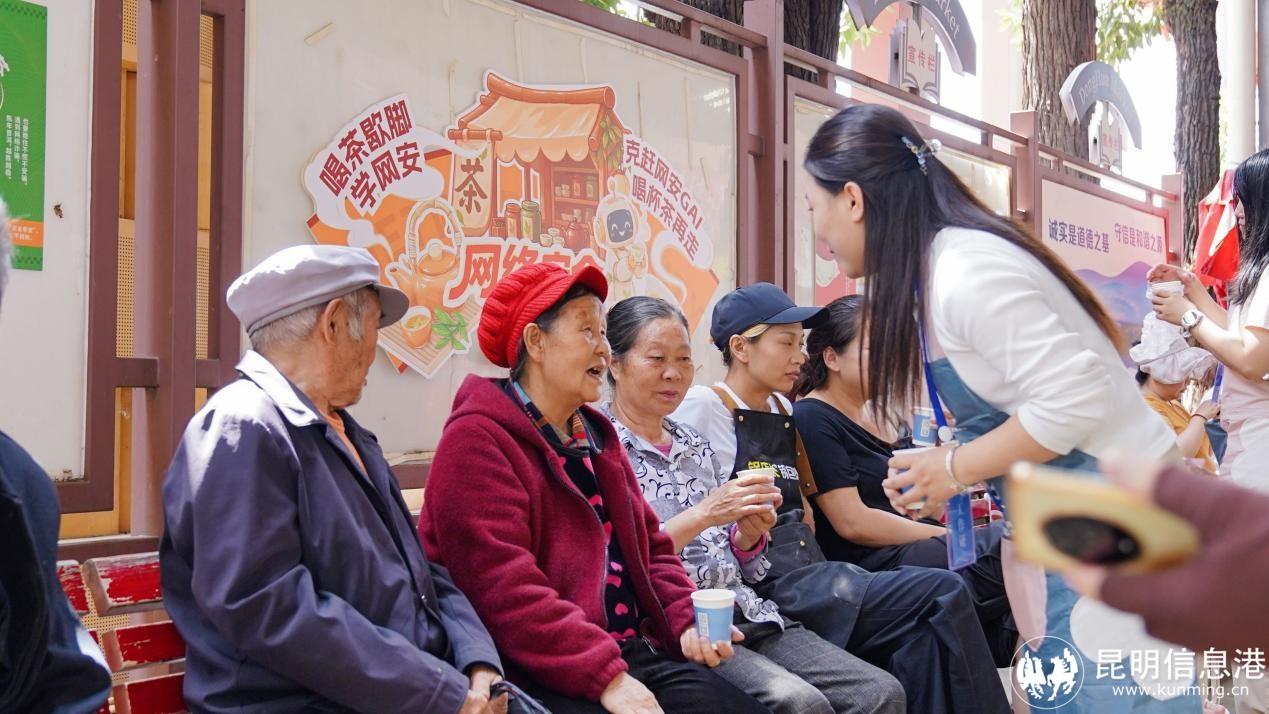
A staff member serves tea and shares cybersecurity tips with residents at the "Cybersecurity Tea House."
The market's leisure corridor has been transformed into a "Cybersecurity Tea House," offering four themed teas, each tied to a cybersecurity lesson. As staff pour tea, they explain: "Filter Tea" reminds people to filter out spam and scam calls; "Calming Tea" teaches residents not to panic when encountering fraud, but to stay vigilant; "Cooling Tea" prompts timely removal of computer viruses; and "Warming Tea" reminds everyone to set complex passwords. Over a cup of tea, cybersecurity knowledge quietly sinks in.
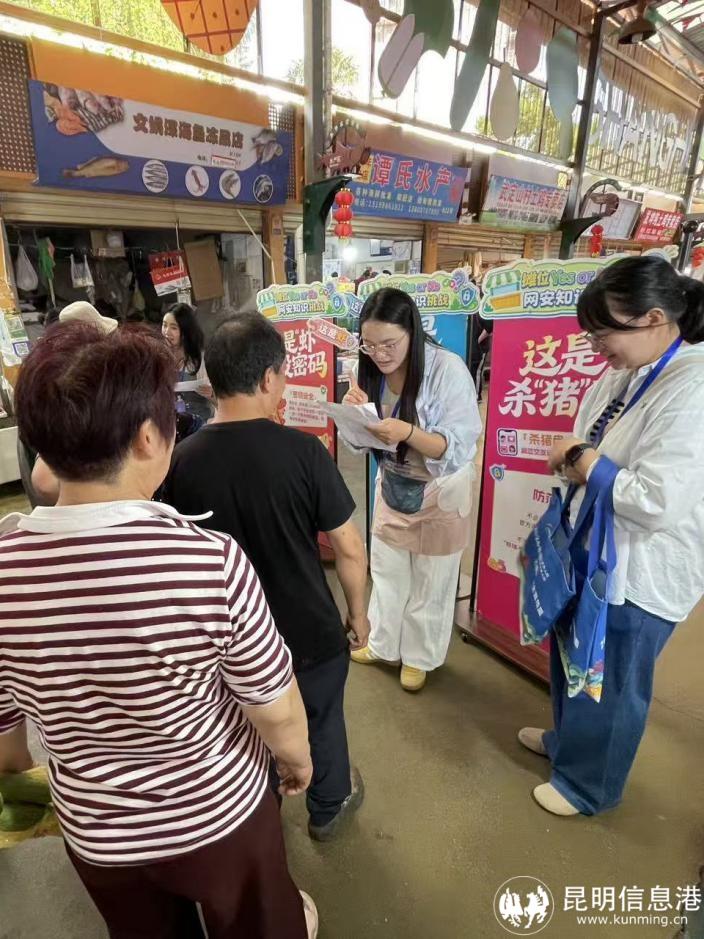
Residents join the "Stall Yes or No" cybersecurity knowledge challenge.
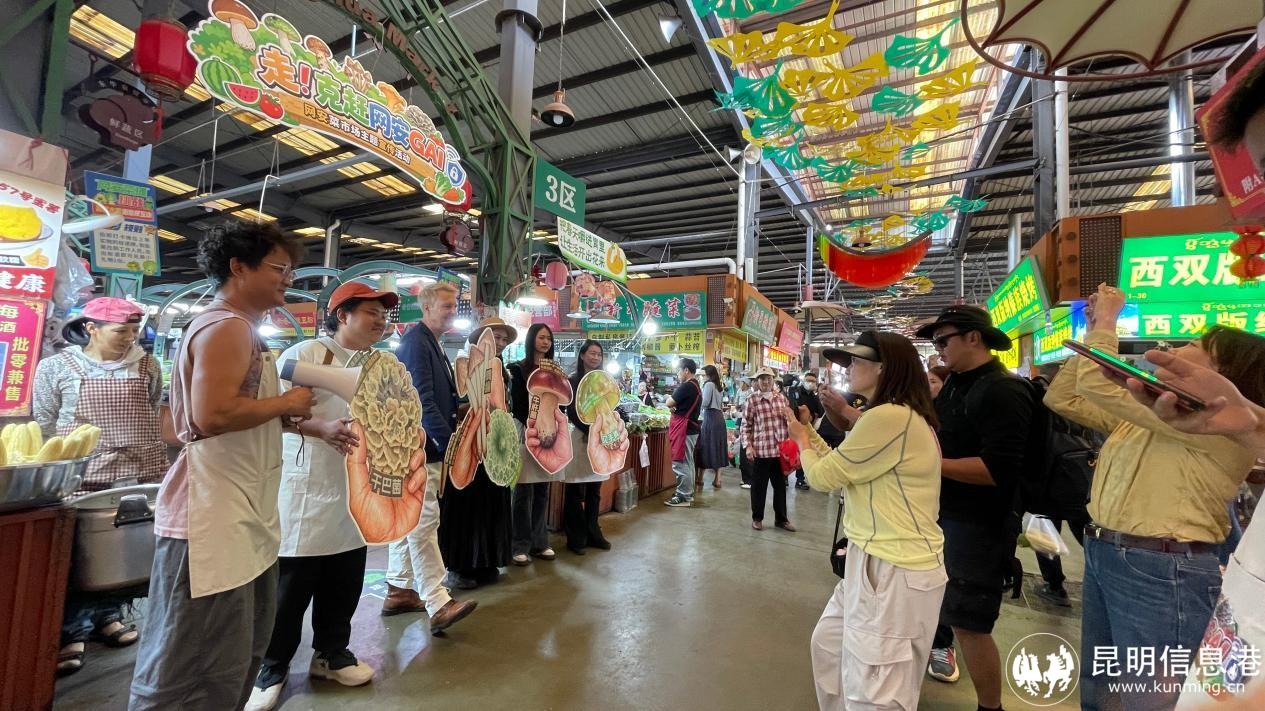
Residents check in at the wild mushroom "Cybersecurity Poison-Identification" fair.
Hidden beside real market stalls is the "Stall Yes or No" challenge: next to the pork stall is a display explaining how to avoid "pig-butchering" scams; in the seafood section, residents are randomly quizzed on topics like phishing and the risks of setting passwords carelessly. The most distinctly Yunnan-style attraction is the wild mushroom "Cybersecurity Poison-Identification" fair. Using wild mushrooms as an analogy for cyber viruses, residents learn to recognize common threats: ransomware, Trojans, worms, phishing links, and backdoors. They hold up signs for photos and flip cards to learn, identifying cyber threats just as locals tell edible mushrooms apart from toxic ones. At the "Cybersecurity Snack Grill," the aroma fills the air as vendors roast rushan, a Yunnan dairy specialty, on the spot. Residents who answer cybersecurity questions receive a freshly grilled portion. Through the lesson that "rushan stretches longer the more you pull it, just as rumors distort more the further they spread," residents understand why they should neither fabricate nor spread rumors.

"Come on! Ke Gan the Cybersecurity Gai" — Yunnan's "Cybersecurity Market" event.
The event uses everyday Yunnan life scenes as its vehicle, transforming cybersecurity knowledge from "words on a display board" into "vegetables people can hold, tea they can taste, and messages they can remember." Abstract cybersecurity concepts become tangible, accessible, and easy to share. Cybersecurity outreach moves out of conference halls and into daily life, integrating cybersecurity education into familiar daily activities. This allows cybersecurity awareness to take root naturally—making cybersecurity campaigns warmer and more down-to-earth.
You May Like
-
"We are all part of the Flying Tigers family."
On June 25, the "Flying Tigers Bond—Plaque Awarding Ceremony & Dialogue for the Flying Tigers Friendship Schools and Youth Leadership Program" was held in Kunm...
InKunming 2026-06-29 -
A Letter from Kunming | CoE International Jury Visits Haiyan...
11 leading coffee judges from different countries have arrived in Kunming for the 2nd Gems of Yunnan 2026 (Cup of Excellence Pilot Competition in Yunnan).
InKunming 2026-06-24 -
A Letter from Kunming | Kunming, China Invites Global Busine...
Open and sincere, Kunming welcomes the world; in its summer months, gentle breezes are a constant companion.
InKunming 2026-06-10 -
Cycling Along Dianchi Lake: A Date with the Sunset
As the Dianchi Lake Greenway gradually becomes fully connected, its uninterrupted lake views, long green corridor, and spectacular sunsets have made the surrou...
InKunming 2026-06-10 -
Living by the waters, walking along Dianchi — romance and d...
What defines Kunming? A national historic and cultural city with a distinctive plateau lakeside character, Kunming is naturally endowed with beauty, uniqueness ...
InKunming 2026-06-01 -
A Letter from Kunming|May Day in Kunming's Countryside: A R...
Just in time for the May Day holiday, the second season of the "A Letter from Kunming" international communication series event is officially launching, inviti...
InKunming 2026-05-03 -
A Letter from Kunming | Rain Falls on the Mountain Forests, ...
Invitation from the hills — to visit this highland city, discover the magic of Yunnan’s wild mushrooms.
InKunming 2026-05-09 -
Season 2 of “A Letter from Kunming” Officially Kicks Off ...
As the Northern Hemisphere is gradually swept up in waves of summer heat, Kunming, located at 25° north latitude, remains in a springlike embrace of 21°C. Now, ...
InKunming 2026-05-01 -
Dianchi Resort Unveils Spring Break Floral Routes
On April 25, the publicity and launch event for the Spring Break Flower-Viewing Tourism Routes of Kunming Dianchi National Tourist Resort was held as scheduled ...
InKunming 2026-05-05 -
A Horseback Can Become a Bridge: Woman from Kunming Awarded ...
Recently in Astana, the capital of Kazakhstan, Tao Mingxiu, a post-90s woman from Yunnan Province, received the Second-Class Friendship Medal from Aida Balayeva...
InKunming 2026-05-02