High-tech methods refine border checkpoint work
Source: China Daily | 2026-09-17 | Editor:Flynn

Border police officers use a smart inspection system to screen vehicles and passengers at the Mukang border checkpoint in Mangshi, Yunnan province, in June. [Photo provided to CHINA DAILY]
One morning in late August, Gao Yanping set off on a 40-minute drive through rugged mountains in Yunnan province to reach the Mukang border checkpoint and carry out his duties as a border police officer.
Located at a mountain pass between Mangshi, the capital of Dehong Dai and Jingpo autonomous prefecture, and Longling county in Baoshan, the border checkpoint is part of the Dehong Border Management Detachment under the Yunnan Entry-Exit Border Inspection General Station.
Upon arriving at the checkpoint, Gao was greeted by a steady drizzle and a sharp drop in temperature. Downtown Mangshi was basking in bright sunshine and experiencing soaring temperatures when he had left.
Situated at an altitude of over 1,600 meters, the border checkpoint is perched on a hilltop, with mountain ranges rising majestically on either side. The area is usually hit by six months of relentless rain followed by six months of biting winds and frost, making the conditions extremely harsh.
Gao worked at the checkpoint for 12 years until 2019 and in May decided to return to his old post.
Reunited with past
Gao, 37, started working at the checkpoint in 2007. In those early years, he would bend down multiple times to inspect under vehicles and often dealt with more than 1 metric ton of cargo a day. Work shifts sometimes stretched up to 10 hours.
Located less than 100 kilometers from the notorious Golden Triangle, one of the world's largest illicit drug-producing regions, the checkpoint is tasked with inspecting the flow of people, vehicles, and goods across the region, playing a vital role in combating illegal activities such as border crossings, smuggling, and drug and firearm trafficking.
"Before Mangshi opened its first expressway in 2015, all vehicles entering and exiting Dehong had to pass through the Mukang border checkpoint," Gao said. "This posed a significant mental and physical challenge for the officers on duty."
For instance, if a truck transporting watermelons was suspected of carrying concealed drugs or other contraband, Gao would have to unload tons of melons. He would then closely inspect them before reloading them onto the truck, all the while ensuring the fruit remained undamaged. The process typically took several hours.

A cargo truck undergoes inspection at the checkpoint in June. [Photo provided to CHINA DAILY]
"Our night shift lasted from 10:30 pm to 8:30 am, with barely any time for breaks. As soon as we finished inspecting one vehicle, the next one rolled in," Gao said.
With the expansion of expressways and development of new roads, National Highway 320 was no longer the only road access to Dehong. As a result, Gao and his colleagues began conducting inspections on mountain roads that branched off the main routes, where the risks were even greater.
One summer morning around 1 am, while patrolling the mountains, Gao heard the rumble of a car engine. Acting swiftly, he intercepted the vehicle and requested identification from the two men inside. The man in the passenger seat, appearing to reach for his ID, instead tried to grab a 50-centimeter machete from the back seat.
"I grabbed him immediately and apprehended him before he could cause any harm," Gao said. "During that operation, we uncovered over 1 kilogram of heroin in the back seat."
For Gao and his colleagues, such confrontations are just part of the job.
"Reflecting on these incidents can be terrifying, often leaving us in a cold sweat," he said. "However, when we consider the harm that drug users inflict on families and society, we remain undeterred."
During his 12 years at the checkpoint, Gao seized nearly 100 kg of drugs and earned a second-class merit award and five third-class merit awards.
He epitomizes the dedication of generations of border officers, who have fought on the front lines of drug enforcement, garnering numerous accolades for the checkpoint over the past 48 years.
In July this year, the checkpoint was recognized as an "outstanding primary-level Party organization" by the Central Committee of the Communist Party of China. In 2001, it was distinguished as a "pioneer anti-drug checkpoint" by the State Council and the Central Military Commission.
The deep sense of honor, responsibility, and belonging has made this checkpoint a place of pride for generations of officers.
Earlier this year, Gao made his way back to the checkpoint after working for seven years at the Dulongjiang border police station in the Nujiang Lisu autonomous prefecture, Yunnan.
His return was made possible by the National Immigration Administration's Reunion Plan, a program designed to allow immigration police officers to transfer to locations where their spouses reside. Despite having the opportunity to work in more comfortable conditions, Gao chose Mukang.
"I have a deep attachment to the checkpoint, and it has always been difficult for me to part with it," Gao said. "Working here enables us to intercept drug trafficking and smuggling activities at the border, preventing drugs from infiltrating inland areas and thereby transforming the lives of many individuals and families."

Officers conduct an emergency drill at the checkpoint in 2021. [Photo provided to CHINA DAILY]
Advanced operations
For Gao, one notable change has been the integration of technology to bolster inspection capabilities.
Before 2021, the officers at the checkpoint depended heavily on their experience and skill for conducting inspections, a method familiar to Li Cunlong, 33, who has worked at the checkpoint since 2014.
Li received a second-class merit for uncovering a large heroin stash on a truck in April 2017. During the inspection, he followed his instincts that something was amiss on a shipping list, which included a package labeled as toys destined for an internet cafe.
Back then, advanced technology was not available, so he used a forklift to move the cargo piece by piece. After nearly four or five hours of effort, he located the "toy" package and discovered two wooden sculptures inside.
When he opened it, a strong odor of industrial glue filled the air. Li suspected that the wooden sculptures had been hollowed out, filled with contraband, and then glued back together. An X-ray scan showed the sculptures concealed a significant quantity of heroin.
"Now, with the introduction of new technology, the process has become much more efficient," Li said.
In 2021, the checkpoint rolled out a smart inspection system featuring facial recognition and license plate recognition technologies that was integrated with back-end data systems.
This advancement has reduced vehicle inspection times from a minimum of 1 minute and 30 seconds to just 40 seconds, while greatly improving crime-fighting efforts, according to Lyu Ting, deputy director of the checkpoint.
The construction of the Mukang Big Data Center is also assisting in the detection of offenders trying to avoid checkpoint controls.
"If a person or vehicle shows unusually frequent travel across border areas, big data analytics can identify and flag these patterns for further investigation," said Lyu.
Hu Di, a female police officer, has a crucial role to play in checking statements against collected data.
"When colleagues on duty bring me leads, I assist in verifying if the statements made by individuals align with our system data," said the 29-year-old.
"If someone claims to be a tourist, we can cross-check their itinerary and activities, such as hotel accommodations and places visited, to assess whether they are genuinely here for tourism or possibly scouting purposes."
She said the job is suitable for women as they tend to be more thorough and patient, which enables them to deeply analyze a lead. "Of the three jobs I've held for an extended period at the checkpoint, this one stands out as my favorite. I want to keep going in this direction in the future," she said.

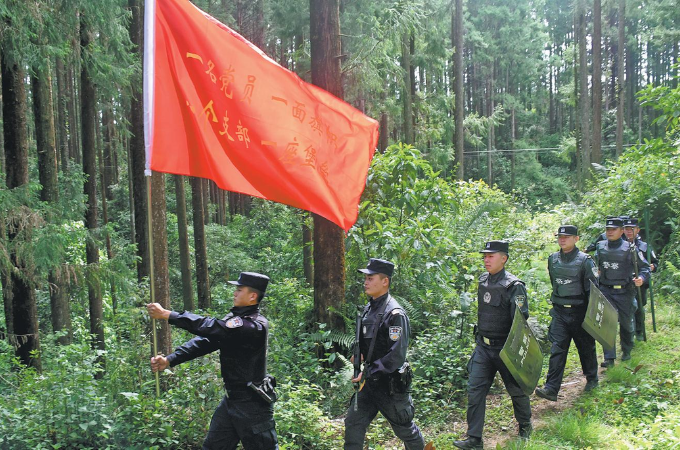
A border patrol conducts a routine inspection along a pathway near the checkpoint in Mangshi in 2020. [Photo provided to CHINA DAILY]
Decline in drug cases
Since its establishment in 1978, the checkpoint has uncovered over 13,000 drug-related cases, seizing a total of 13 tons of drugs and over 400 tons of precursor chemicals for drug production.
Through the implementation of data analysis and other enhanced anti-drug measures, the border checkpoint has seen a marked decline in the number of drug cases detected.
Liu Cuibin, director of the checkpoint, said there was a major drug seizure at the checkpoint on New Year's Eve in 2023.
Shortly after 7 pm, a truck carrying charcoal arrived at the checkpoint. Utilizing big data insights, the officers identified the driver as a local resident. Records indicated the charcoal had been loaded onto the truck three days earlier.
Analysts suggested that if the delivery was urgent, the driver would have departed already. Conversely, if there was no rush, a local driver would typically return home for New Year's Eve dinner. The analysts believed the situation appeared quite unusual.
Acting on this intelligence, the duty officers decided to conduct a thorough inspection of the vehicle and uncovered nearly 93 kg of methamphetamine concealed beneath the charcoal.
"Over the past year, no drug-smuggling activities were detected at this checkpoint. However, leveraging intelligence leads, officers from the checkpoint successfully uncovered three cases in other locations, seizing a total of 53.6 kg of drugs," Liu said. "This reflects a downward trend compared with previous years."
Recent statistics on drug users released by the Yunnan Provincial Narcotics Control Commission underscored the success of drug control efforts.
In 2025, the number of registered drug users in the province fell by 30 percent year-on-year to the lowest level in two decades, while the number of former drug users remaining drug-free for more than three years also reached a 20-year high.
Hu Wenwu, a political instructor at the checkpoint, said with drug-related cases now comprising only a small fraction of cases handled at the checkpoint, new directions for development are being looked at.
"We will further strengthen our data analysis capabilities to more accurately target a range of illegal and criminal activities," Hu said.
The checkpoint also intends to implement measures to speed up the inspection and clearance process, especially for logistics vehicles transporting fresh produce. Hu said even a one-hour delay for perishable goods can lead to higher costs and increased risks for drivers, who might feel compelled to rush to make up for lost time.
"We are considering the implementation of a green passage scheme," Hu said. "For example, vehicles and cargo from a reputable logistics company that are currently inspected daily could have their inspection frequency adjusted to random checks every three, five, or even seven days, depending on their track record."
You May Like
-
Heavy rain forecast for Gyirong in Xizang as rescue efforts ...
Gyirong County in southwest China's Xizang Autonomous Region is expected to see more rainfall in the coming days, with significant nighttime precipitation, the ...
InKunming 2026-08-31 -
China sees 7 pct rise in newly established foreign-invested ...
China saw 35,000 newly established foreign-invested enterprises in the first half of 2026, up 7 percent year on year, the State Administration for Market Regu...
InKunming 2026-08-31 -
Trump signs order renaming Lake Ontario "Lake America" amid ...
U.S. President Donald Trump on Thursday signed an executive order directing the Department of the Interior to rename Lake Ontario "Lake America," as trade tensi...
InKunming 2026-08-28 -
Tour along Yellow River becomes popular choice for summer tr...
An aerial drone photo taken on Aug. 10, 2026 shows a view of the Yellow River's Hukou Waterfall on the border of north China's Shanxi Province and northwest Chi...
InKunming 2026-08-19 -
Remains of late Chinese leader Zhu Rongji to be cremated
The remains of late Chinese leader Zhu Rongji will be cremated in Beijing on Tuesday.
InKunming 2026-08-17 -
Security averts Ceuta crossing, revives Schengen migration d...
More than two weeks after tens of thousands of people entered Ceuta from Morocco, around 5,000 remain in the enclave, according to Spain's Interior Ministry. Th...
InKunming 2026-08-17 -
China Focus: Smart tech secures China's major water lifeline
InKunming 2026-08-13 -
Economic Watch: Digital technology reshapes China's service ...
InKunming 2026-08-10 -
Intl travel to US falls in 2025 amid policy strains
International travel to New York and the entire United States was "constrained" last year due to geopolitics and federal policies including tariffs and higher i...
InKunming 2026-08-07 -
China Focus: Shenzhou-21 crew makes first public appearance ...
The three astronauts from China's Shenzhou-21 crewed mission met the press in Beijing on Wednesday, their first public appearance after returning to Earth in Ma...
InKunming 2026-08-06