Joint effort sheds light on ancient past
Source: China Daily | 2026-09-01 | Editor:Flynn
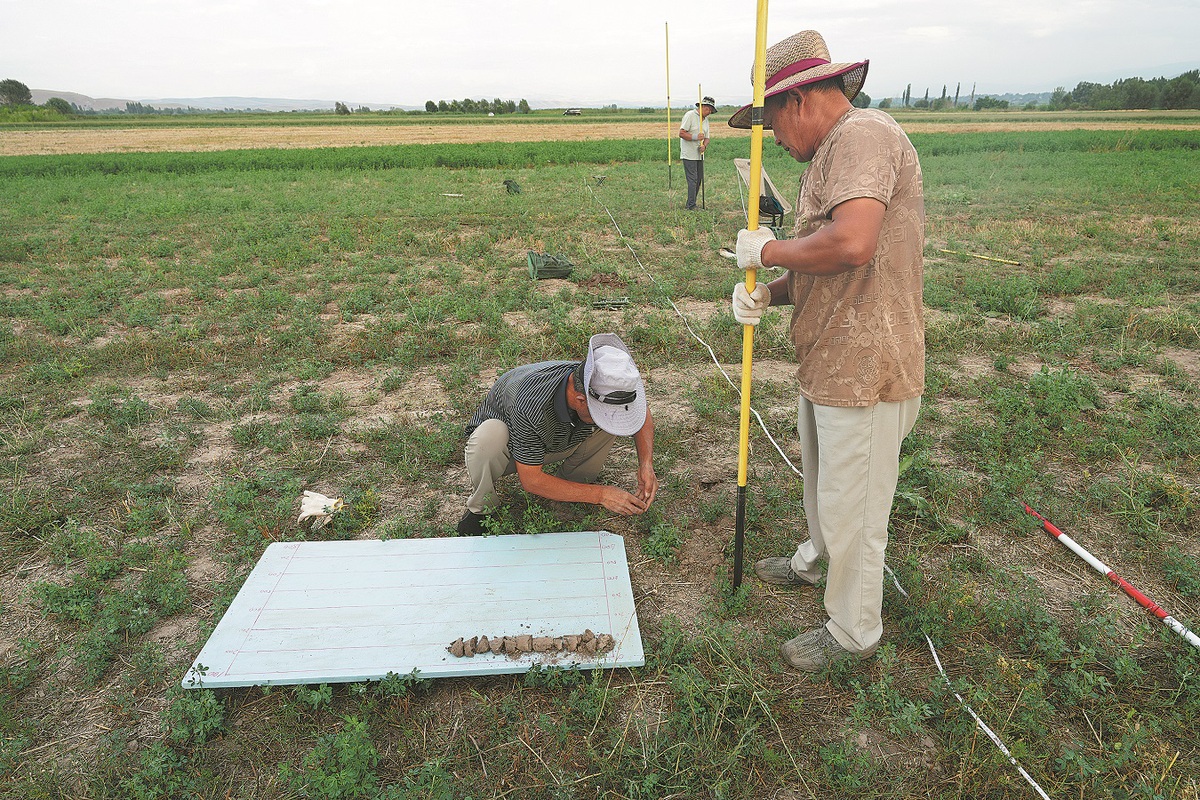
Archaeologists identify soil types at the site of the Shorobashat ruins near the Fergana Mountains in Kyrgyzstan. CHINA DAILY
On the northern bank of the Yassy River beneath the Fergana Mountains, the ruins of Shorobashat in Kyrgyzstan are offering new clues to the region's ancient past, thanks to a joint effort by Chinese and Kyrgyz archaeologists.
The collaborative archaeological program at the site was recently launched by the Institute of History, Archaeology and Ethnology of the National Academy of Sciences of the Kyrgyz Republic and the Collaborative Research Center for Archaeology of the Silk Roads, affiliated with Northwest University in Xi'an, Shaanxi province.
Located in the eastern Fergana Valley, which stretches across parts of present-day Uzbekistan, Kyrgyzstan and Tajikistan, the site in Kyrgyzstan's Osh region includes a central city spanning about 1.5 square kilometers, two medium-sized cities, tombs, high-platform structures and smaller settlements.
This year, the team has begun more detailed exploration.
"Building on previous archaeological surveys, we have now begun further explorations using a Luoyang shovel, a traditional curved spade that we insert into the ground and withdraw to examine soil layers, identifying their types and dates. This gives us a clearer picture of the central city's nature, layout, and the preservation of its archaeological features," said Zhang Weixing, the Chinese side's lead archaeologist.
The choice of Shorobashat followed extensive preliminary research.
Wang Jianxin, chief expert at the Collaborative Research Center for Archaeology of the Silk Roads, said the team's approach to Central Asian archaeology combines large-scale regional surveys with small-scale, targeted excavations.
Since 2023, during the first phase of the project, archaeologists have surveyed more than 500 sites, including cities, high-platform structures and tombs. They have carefully documented each site through observation, mapping, measuring, and photography.
Based on this extensive body of data, the team selected Shorobashat for further exploration. No systematic archaeological research had been conducted at the site for about seven decades.
This year, the archaeologists have examined the city walls, tower structures, gates and roads, while identifying key areas for future excavation.
Zhang said the team has drawn up a five-year plan and will continue its work at the site in the years ahead.
He said the research forms part of a broader effort to understand the Fergana Valley before the 7th century, when the region maintained close ties with ancient China.
Chinese historical records offer clues to the location of Dayuan, an important Hellenistic state in Central Asia that existed during the Han Dynasty (206 BC-AD 220).
According to Zhang, Chinese records mention three major cities in Dayuan: its capital, Guishan; Ershi, a major horse-breeding hub; and Yucheng, located in eastern Dayuan. Based on textual analysis, the Shorobashat site is generally believed to be associated with the ancient city of Yucheng.
"We pay special attention to the historical development of Dayuan, its material culture, people's thoughts and beliefs, and its role along the ancient Silk Road ... We also want to trace the valley's civilizational progress during the prehistoric period," said Zhang.
The Northwest University team's involvement in Fergana Valley archaeology dates back to 2019, when Wang invited scholars from Uzbekistan, Kyrgyzstan and Tajikistan to Xi'an for a seminar on archaeological research in the valley. The meeting led to an agreement on future multilateral cooperation.
"Many Central Asian scholars have a strong sense of responsibility toward their cultural heritage," said Zhang. "For example, Kyrgyz scholars played a big role in the application for World Heritage status for 'Silk Roads: the Routes Network of Chang'an-Tianshan Corridor' in 2014.
"On this project, we work side by side, communicating constantly, with a shared goal: to identify significant sites, protect them, and eventually present them to the public. That common purpose and the friendship it has fostered have brought us together."
You May Like
-
Letter from China: Robot athletes break human records, heral...
InKunming 2026-08-24 -
China reshapes housing provident fund management rules as pr...
China on Tuesday announced a decision to revise its regulations regarding housing provident fund management, in the latest effort to adapt the long-standing hou...
InKunming 2026-08-21 -
Across China: Tibetan medical thangkas draw global spotlight...
An international symposium opened in southwest China's Xizang Autonomous Region on Thursday to shed light on the growing global interest in traditional Tibeta...
InKunming 2026-08-21 -
AI drives China-Africa media collaboration
China and African nations are strengthening cooperation on artificial intelligence (AI) applications and governance to drive mutual progress in the media sector...
InKunming 2026-08-21 -
China Focus: Unitree's STAR Market debut shines light on Chi...
China's Unitree Robotics on Wednesday became the first humanoid robot maker listed on the A-share market, marking a significant step for the country's humanoi...
InKunming 2026-08-20 -
China think tank releases report on Kunlun culture
A think tank affiliated with Xinhua News Agency released on Wednesday a report examining the historical origins, spiritual essence, and contemporary value of ...
InKunming 2026-08-20 -
China prepares to launch Chang'e-7 lunar probe
The Chang'e-7 lunar probe is scheduled for launch at an appropriate time, according to the China Manned Space Agency (CMSA).
InKunming 2026-08-20 -
Xi Focus: Charting a green path to development
China's landmark Ecological and Environmental Code, which for the first time enshrines Xi Jinping Thought on Ecological Civilization in law, will take effect on...
InKunming 2026-08-18 -
How flutters of great little birds weave together Asia-Pacif...
Each year, millions of migratory birds embark on grueling transcontinental journeys along the East Asian-Australasian Flyway (EAAF), braving storms, food shorta...
InKunming 2026-08-17 -
Explainer: Why a sweet wrapper is sweeping the internet
InKunming 2026-08-13