China think tank releases report on Kunlun culture
Source: Xinhua | 2026-08-20 | Editor:Doe
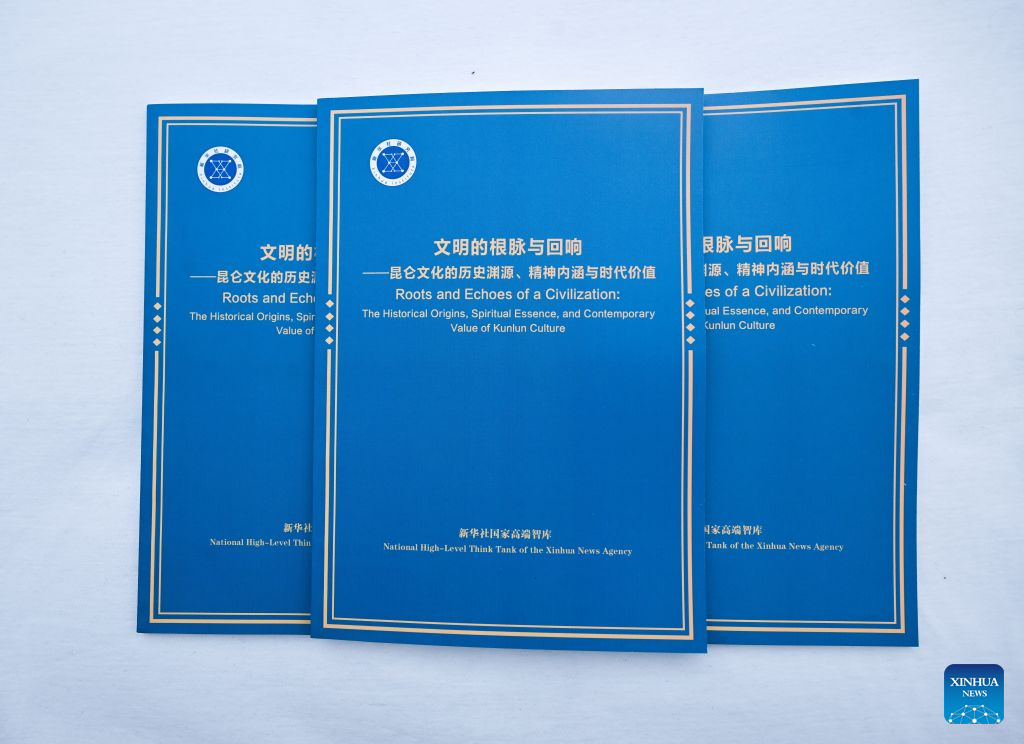
This photo shows copies of a think tank report examining the historical origins, spiritual essence, and contemporary value of Kunlun culture released during the Kunlun Culture Forum held in Xining, northwest China's Qinghai Province. A forum exploring the preservation and promotion of Kunlun culture, centering around a celestial peak in the shared mythology and collective memories of various Chinese ethnic groups, took place Wednesday in northwest China's Qinghai Province. The Kunlun Culture Forum, being hosted in Xining, capital of Qinghai, is dedicated to exploring the historical roots, spiritual connotations and contemporary relevance of Kunlun culture. (Xinhua/Zhang Long)
A think tank affiliated with Xinhua News Agency released on Wednesday a report examining the historical origins, spiritual essence, and contemporary value of Kunlun culture.
The National High-Level Think Tank of the Xinhua News Agency unveiled the Chinese and English versions of the report at the Kunlun Culture Forum in Xining, capital of northwest China's Qinghai Province.
The report describes Kunlun culture as an important origin of Chinese civilization and a vital spiritual emblem of the Chinese nation. It said the culture offers both theoretical and practical guidance for carrying forward fine traditional Chinese culture, forging a strong sense of community for the Chinese nation, and advancing exchanges and mutual learning among civilizations.
Stretching over 2,500 km across western China with an average elevation surpassing 5,000 meters, the towering Kunlun Mountains have long been revered as "the ancestor of all mountains and the source of all waters."
Drawing on archaeological evidence and historical records, the report said Kunlun culture carries the historical memory of shared origins and symbiosis among ethnic groups in three dimensions: the cosmic cognition of early Chinese people, the spiritual homeland of the Chinese nation, and the territorial symbol of ancient China. It also confirmed the unity in diversity and inclusiveness of Chinese civilization.
The report summarizes five core values of Kunlun culture: harmony between man and nature, great unity, vigorous self-improvement, cherishing life and caring for the people, and all under heaven as one family.
Rooted in millennia of cultural inheritance and ethnic integration, these values have shaped the cosmological view, the state view, the ethos of great resolve and perseverance, the people-centered view, and the worldview of Chinese civilization.
In the new era, Kunlun culture has undergone creative transformation and innovative development.
Local regions have tapped into Kunlun cultural resources and made coordinated efforts to advance cultural inheritance, ethnic unity, ecological conservation and industrial development, said the report.
Through initiatives such as themed study tours, folk performances, and integrated cultural and tourism development, the regions are achieving cultural inheritance, the continuity of national ethos, and the improvement of people's incomes and well-being.
"Exploring the wisdom embedded in Kunlun culture can provide a temperate yet profound Chinese approach to dissolving antagonism among civilizations and resolving development dilemmas," the report noted.
It added that the concepts of "harmony between man and nature" and "all under heaven as one family" in Kunlun culture offer precious oriental wisdom for resolving ecological challenges, civilizational estrangement, and geopolitical antagonism, and for advancing the building of a community with a shared future for humanity.
In Chinese mythology, Kunlun is a sacred peak where the Queen Mother of the West resides and where the Yellow Emperor, the cultural progenitor of the Chinese nation, built palaces to inaugurate the civilization of ritual and music.
At least nearly 20 ethnic groups, including the Qiang, Yi, Jingpo and Pumi, trace their ancestry to the foot of the Kunlun Mountains. Since modern times, Kunlun has been a spiritual homeland for the Chinese, often eulogized to invigorate the national spirit in times of national peril.
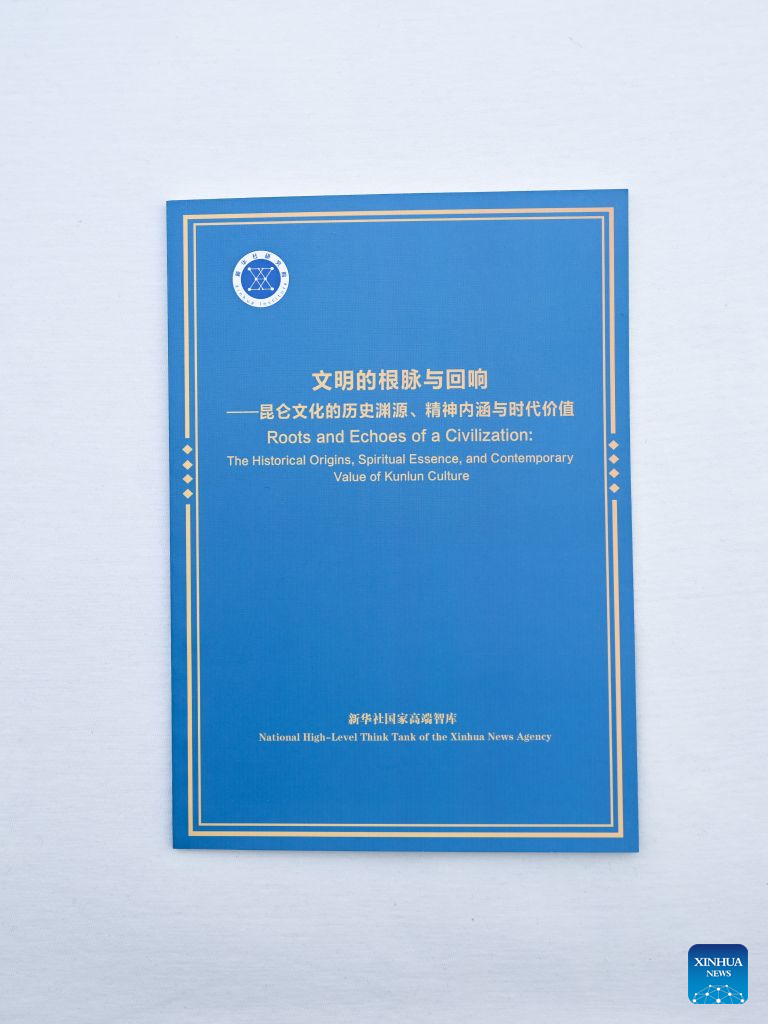
This photo shows a copy of a think tank report examining the historical origins, spiritual essence, and contemporary value of Kunlun culture released during the Kunlun Culture Forum held in Xining, northwest China's Qinghai Province.
A forum exploring the preservation and promotion of Kunlun culture, centering around a celestial peak in the shared mythology and collective memories of various Chinese ethnic groups, took place Wednesday in northwest China's Qinghai Province.
The Kunlun Culture Forum, being hosted in Xining, capital of Qinghai, is dedicated to exploring the historical roots, spiritual connotations and contemporary relevance of Kunlun culture. (Xinhua/Zhang Long)
You May Like
-
Interview: Jordanian king looks to advance Jordan-China stra...
Jordan looks forward to expanding cooperation with China into areas such as green energy, scientific innovation, tourism and civil aviation, said King Abdulla...
InKunming 2026-08-18 -
World's largest green methanol bunkering operation completed...
China's Shanghai Electric Group successfully bunkered 8,000 tonnes of green methanol into a container ship at Yangshan port in Shanghai on Monday, setting a glo...
InKunming 2026-08-18 -
Chinese national flag flies at half-mast at Tian'anmen Squar...
A Chinese national flag flies at half-mast to mourn the death of Comrade Zhu Rongji at Tian'anmen Square in Beijing, capital of China.
InKunming 2026-08-18 -
2026 CIFTIS opens for media registration
Media registration for the 2026 China International Fair for Trade in Services (CIFTIS) is open from Aug. 10 to 26.
InKunming 2026-08-17 -
China-Europe Arctic shipping route enters regular weekly ope...
The China-Europe Arctic container express route entered regular weekly operations for the summer season on Saturday, opening a faster and more resilient logisti...
InKunming 2026-08-17 -
Remains of late Chinese leader Zhu Rongji to be cremated
The remains of late Chinese leader Zhu Rongji will be cremated in Beijing on Tuesday.
InKunming 2026-08-17 -
China pilots "quiet communities" to curb urban noise, disput...
When 72-year-old Shi Jikun opened his windows at home in Yuxi, southwest China's Yunnan Province, he used to hear the repeated thud of balls and blowing of whis...
InKunming 2026-08-17 -
Aerial view of China's Huangyan Dao
Huangyan Dao in the South China Sea. Huangyan Dao, located in China's Zhongsha Qundao
InKunming 2026-08-17 -
How flutters of great little birds weave together Asia-Pacif...
Each year, millions of migratory birds embark on grueling transcontinental journeys along the East Asian-Australasian Flyway (EAAF), braving storms, food shorta...
InKunming 2026-08-17 -
Fishing season of South China Sea kicks off
departing for fishing in Beihai
InKunming 2026-08-17