Savor Yunnan Coffee, Share China's Story | From the Hills of Chiang Mai to the Shores of Dianchi Lake: A Thai Barista's Coffee Story and Love for Home
Source: InKunming | 2026-08-25 | Editor:Flynn

Along the lush, green shores of Dianchi Lake in August, the air at the 2026 Dianchi International Coffee Culture Carnival market is filled with the mingled aromas of coffee. Among the rows of booths, a simple, unadorned canopy stands out: red, blue and white handwoven fabric hangs like banners from its sides, swaying gently in the breeze. The tablecloth bears traditional Thai patterns, and a shiny vintage moka pot emits a fine, steady sizzle on a portable stove. The vendor, Mhaa, wearing a fabric headscarf, leans over to adjust the flame, her movements calm and deliberate.
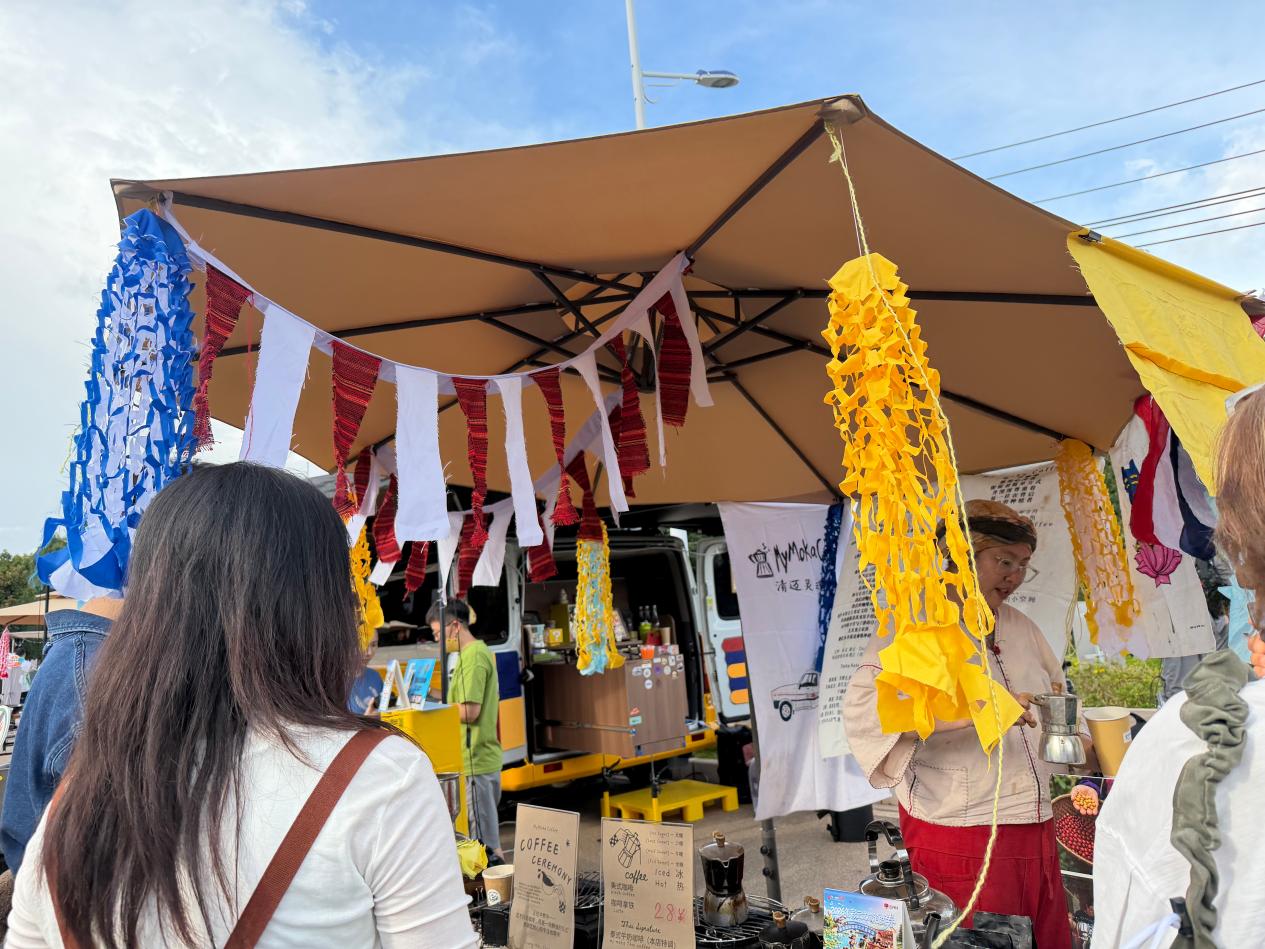
Mhaa's booth, where hand-woven cloth in red, blue, and white hangs as curtain banners, swaying gently in the breeze. Photo by Tan Shiyan/Reporter
Her booth is "My Moka Coffee," hailing from Chiang Mai, Thailand. The sign bears a gentle brand motto — "A Soulful Creation from Chiang Mai." There are no flashy machines, no elaborate decorations. Two canvas banners hang on either side: one tells the story behind the brand, the other reads "A Coffee Story from the Mountains." A hand-cranked coffee grinder bears the wear of years of use; a kraft paper menu lists drinks and prices. Beside it, a display board offers details about the coffee beans sourced from Doi Chang. The whole stall feels like a corner transported from the hills of Chiang Mai — simple and unadorned, yet filled with a quiet, heartfelt warmth.
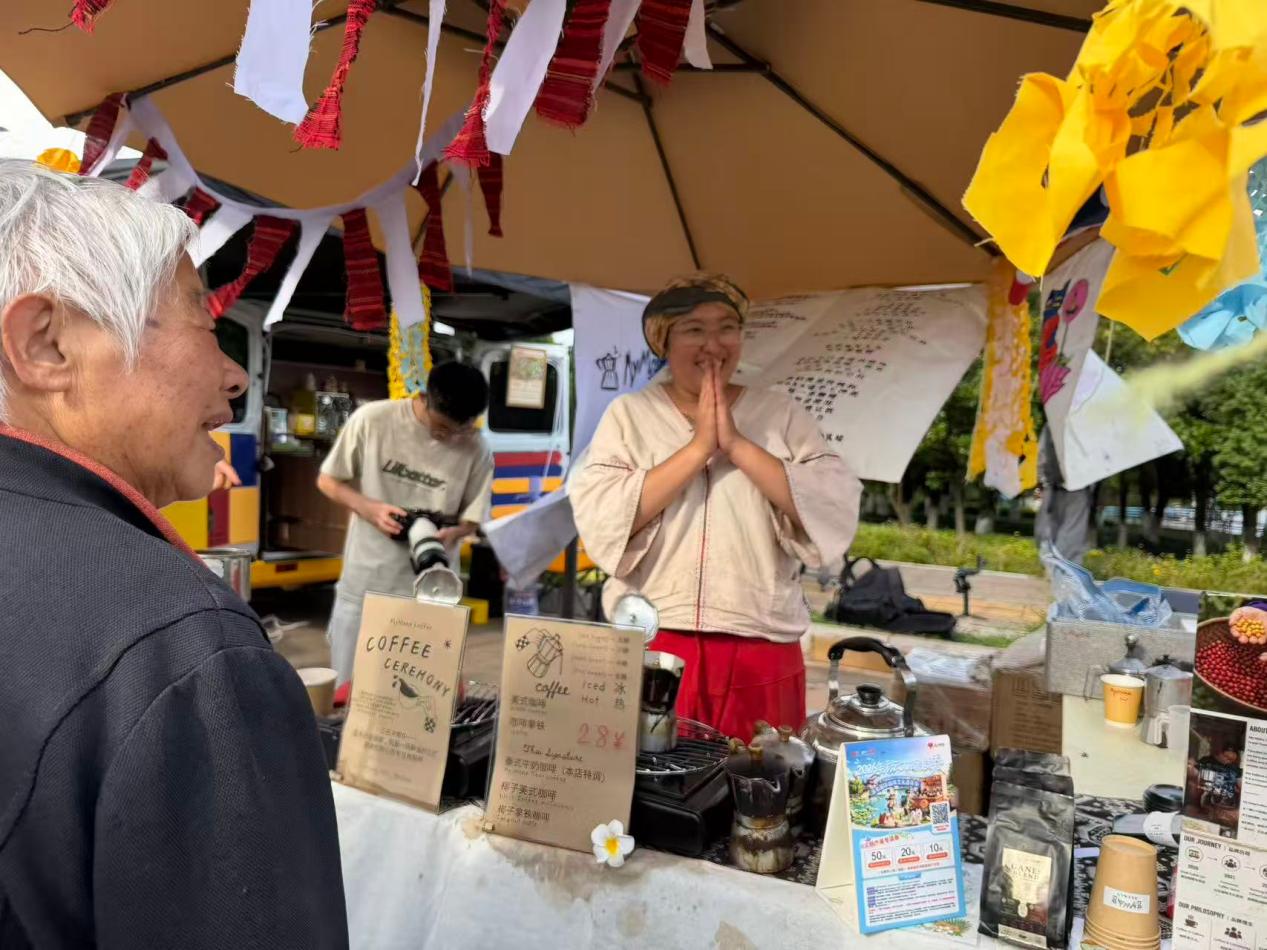
An elderly visitor with silver hair pauses at the booth as Mhaa greets him with a traditional Thai wai and a smile. Photo by Tan Shiyan/Reporter
"Sawasdee ka." When someone stops by, Mhaa brings her palms together in greeting and smiles. With each cup, she takes her time weighing the coffee, pouring in the water, then quietly waits as the moka pot slowly releases the coffee. When visitors ask about the beans, she picks up a sample bag from the table and points to the farm pictured on it, explaining softly: "These beans come from my family's highland farm. They're organically grown."
This slowness is precisely what makes her coffee so special.
All of Mhaa's beans come from her family's farm in the Doi Chang mountains of Chiang Mai, where generations of her family have been growing Arabica coffee for decades. The region lies within a Geographical Indication (GI) protected area, follows organic farming standards, and uses the traditional washed processing method of the mountains — every step done by hand by local farmers. This interview was conducted in English, and Mhaa spoke with earnestness about this commitment: long ago, before electricity reached the mountains, people relied entirely on hand-making to brew coffee. She insists on manual brewing with a moka pot and grinding beans by hand precisely to preserve this most traditional flavor — no reliance on electricity, no rush for efficiency, only the most authentic taste of coffee.
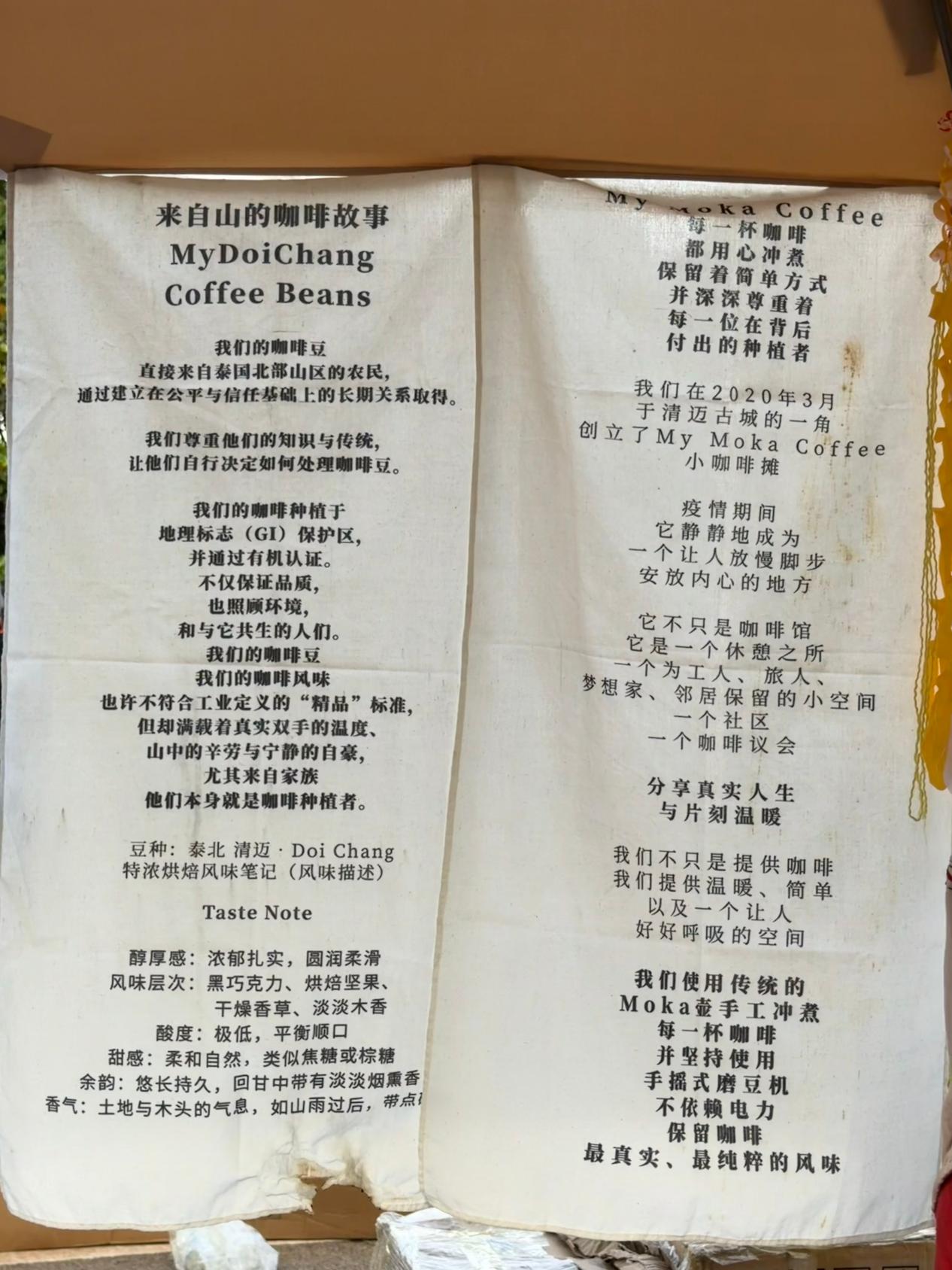
The themed canvas banner hanging at the booth records the farming philosophy of Doi Chang coffee beans and the brand's founding vision. Photo by Tan Shiyan/Reporter
This slower way of making coffee also marked a turning point in Mhaa's life. During the pandemic in 2020, Mhaa lost her previous job, so she set up a tiny coffee stall on a street in old Chiang Mai. "At that time, I felt so small. I didn't know if anyone would appreciate what I was making," she admits. In the hardest moments, it was the coffee she brewed cup by cup that carried her through. From a roadside stall to a small shop in an alley, My Moka Coffee has been running for seven years, gradually becoming a little gathering spot for local office workers, travelers, and neighbors. "It's not just a coffee shop — it's a place where people can rest, a warm little community." Those words, printed on the banner, are exactly what she believes a coffee shop should be.
Her connection with Kunming began three years ago, when she was invited to the Dianchi International Coffee Culture Carnival. The first time she stood at the market by Dianchi Lake, she fell in love with the city. "Kunming really feels like my second home." Returning this year, regular customers she met last year always make a special trip to see her — some learn a few words of Thai just to greet her, others bring local Yunnan beans to exchange and compare flavors.
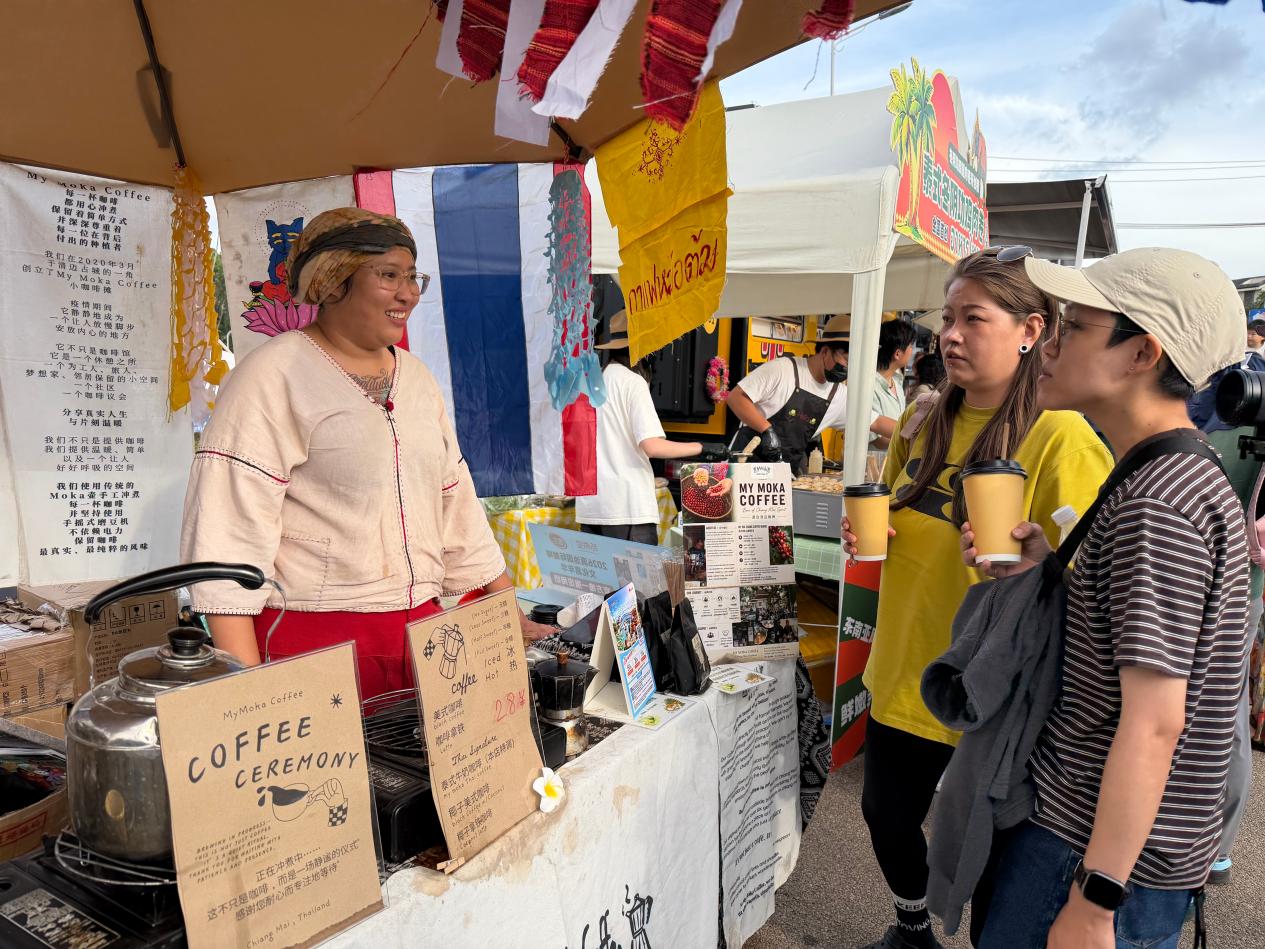
At the My Moka Coffee booth, traditional brewing utensils are lined up as Mhaa chats with a visiting friend. Photo by Tan Shiyan/Reporter
During a break in the interview, two young women walked up to the stall and greeted her with a cheerful "Sawasdee ka." Mhaa's eyes lit up instantly, and she responded warmly in Thai. The three of them chatted back and forth — from coffee flavors to the weather in Chiang Mai — across the small coffee counter, like friends reunited after a long separation. "It's like a cultural exchange. I practice my Chinese, they practice their Thai. It's so much fun," she says with a laugh. Every visit to Kunming brings her so much encouragement; when she returns to Thailand and recalls these moments of kindness, she feels that what she does is full of meaning.
In her philosophy, coffee is never just a drink. "Every cup of coffee is brewed with care and simplicity, and carries deep respect for the growers behind the beans." Those words, printed in the most prominent spot on the banner, are the principle she has always upheld.
Her beans are sourced directly from mountain farmers, with no middlemen involved, building long-term partnerships based on trust and fairness. She does not force farmers to abandon their traditional growing methods; instead, she chooses to preserve this wisdom passed down from the land. For this reason, her coffee may not meet the industrial definition of "specialty coffee," yet it carries the warmth of hands and the breath of the mountains — rich and full-bodied, with caramel and nut sweetness on the finish, and a faint smokiness and herbal aroma lingering in the aftertaste.
"Even in Thailand, there's no coffee festival on this scale, with more than a hundred coffee shops coming together," Mhaa says with admiration of this year's Dianchi International Coffee Culture Carnival. In her view, this grand event is more than a gathering of coffee professionals; it is a bridge where cultures from different regions meet. Every year she brings her own beans to Kunming, and returns home with a bag full of local Yunnan beans. This back-and-forth is an exchange of flavors, and a meeting of cultures.
As the sun began to dip, the crowd at the booth remained steady. Mhaa picked up the moka pot once more; its surface reflecting the evening light, and the coffee slowly rose in the pot, its aroma drifting on the wind. When asked whether she would come again in the future, she nodded without hesitation: "As long as I have the chance, I will definitely come back. No one can predict the future, but I’m always ready to make the journey here."
For her, this coffee journey across mountains and seas has long been about more than just business. It is a meeting of the mountain winds of Chiang Mai and the clouds drifting over Dianchi Lake; an encounter between unhurried craftsmanship and genuine kindness. And every cup of moka coffee placed in a guest's hands is a warm letter from Chiang Mai.
Click here to view the Chinese report
(Editors: Flynn, Doe)
You May Like
-
Fireflies light up Yunnan's night sky
From now through mid-July, the fireflies at the Xiaowazi Coffee Manor in Pu'er, Yunnan province, are at their peak viewing season.
InKunming 2026-06-24 -
A Letter from Kunming | Kunming, China Invites Global Busine...
Open and sincere, Kunming welcomes the world; in its summer months, gentle breezes are a constant companion.
InKunming 2026-06-10 -
Living by the waters, walking along Dianchi — romance and d...
What defines Kunming? A national historic and cultural city with a distinctive plateau lakeside character, Kunming is naturally endowed with beauty, uniqueness ...
InKunming 2026-06-01 -
Friendship gallops across the Kazakh steppe
InKunming 2026-05-28 -
Starbucks teams up with Chinese university to boost coffee i...
A university in Yunnan Province, a renowned coffee production base in southwest China, has partnered with Starbucks to nurture homegrown talent for the boomin...
InKunming 2026-05-22 -
Yunnan: A Many-Splendored Life: A Vivid, Multidimensional Po...
From April 23 to May 2, nearly 50 representatives from Chinese-language media outlets in 23 countries across five continents gathered in Yunnan for the Global C...
InKunming 2026-05-19 -
A Letter from Kunming | Rain Falls on the Mountain Forests, ...
Invitation from the hills — to visit this highland city, discover the magic of Yunnan’s wild mushrooms.
InKunming 2026-05-09 -
"Experience economy" brews new vitality for Yunnan coffee
In the lush mountains of Pu'er in southwest China's Yunnan Province, Liu Xiaodong, head of a coffee estate, runs a "field classroom" in his coffee plantation.
InKunming 2026-05-08 -
Season 2 of “A Letter from Kunming” Officially Kicks Off ...
As the Northern Hemisphere is gradually swept up in waves of summer heat, Kunming, located at 25° north latitude, remains in a springlike embrace of 21°C. Now, ...
InKunming 2026-05-01 -
A Horseback Can Become a Bridge: Woman from Kunming Awarded ...
Recently in Astana, the capital of Kazakhstan, Tao Mingxiu, a post-90s woman from Yunnan Province, received the Second-Class Friendship Medal from Aida Balayeva...
InKunming 2026-05-02