New sea-rail intermodal railway boosts logistics efficiency at Xiamen port
Source: Xinhua | 2026-07-30 | Editor:Doe
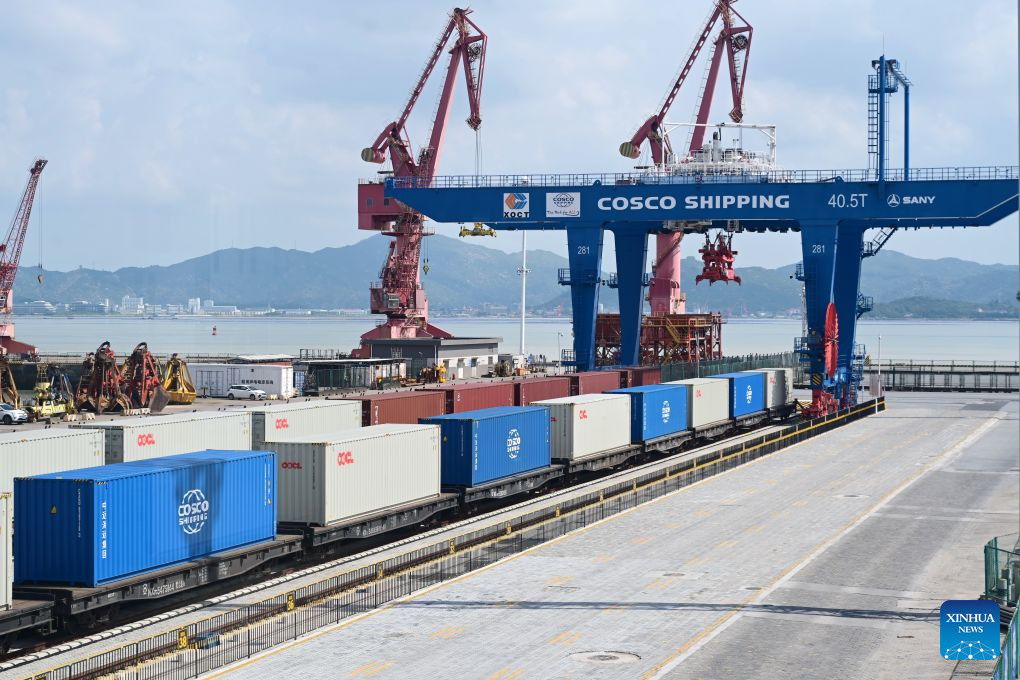
This photo taken on July 29, 2026 shows a sea-rail intermodal rail line at a quay in Xiamen, southeast China's Fujian Province. The sea-rail intermodal rail line is among China's first batch of key projects promoting the integration of transport and logistics. Stretching 1,586 meters, it is designed to handle an annual throughput of 250,000 TEUs of containers and 250,000 tonnes of bulk cargo.
Running perpendicularly to the shoreline and located just 70 meters from the quay apron, the rail line enables cargo to be transferred directly from ships to trains for onward transport. (Xinhua/Lin Shanchuan)
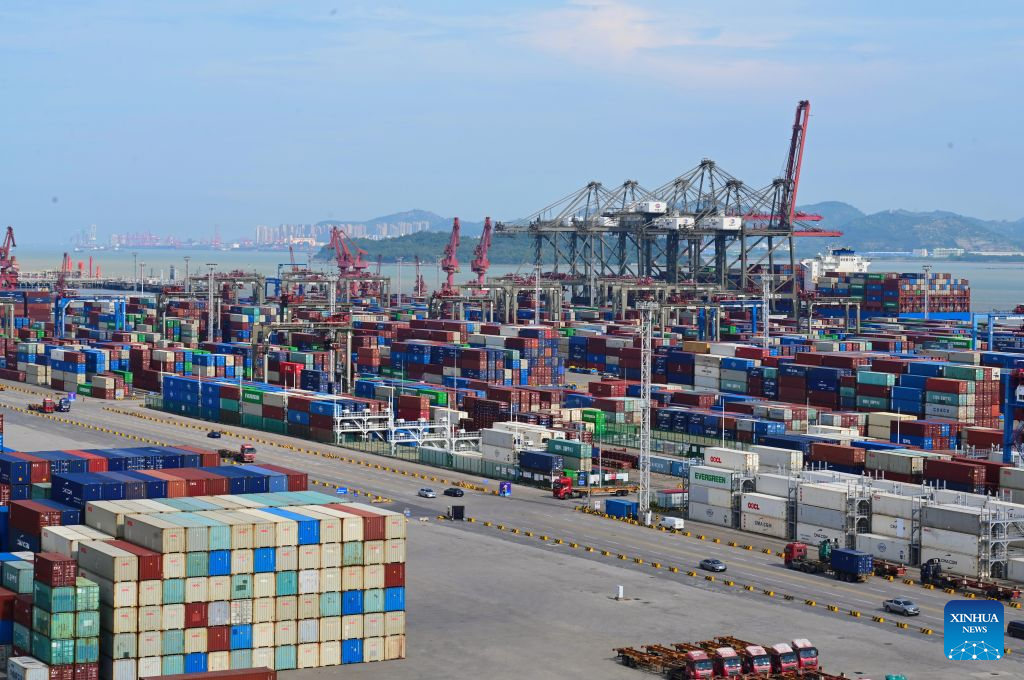
This photo taken on July 29, 2026 shows a view of a quay in Xiamen, southeast China's Fujian Province. The sea-rail intermodal rail line is among China's first batch of key projects promoting the integration of transport and logistics. Stretching 1,586 meters, it is designed to handle an annual throughput of 250,000 TEUs of containers and 250,000 tonnes of bulk cargo.
Running perpendicularly to the shoreline and located just 70 meters from the quay apron, the rail line enables cargo to be transferred directly from ships to trains for onward transport. (Xinhua/Lin Shanchuan)
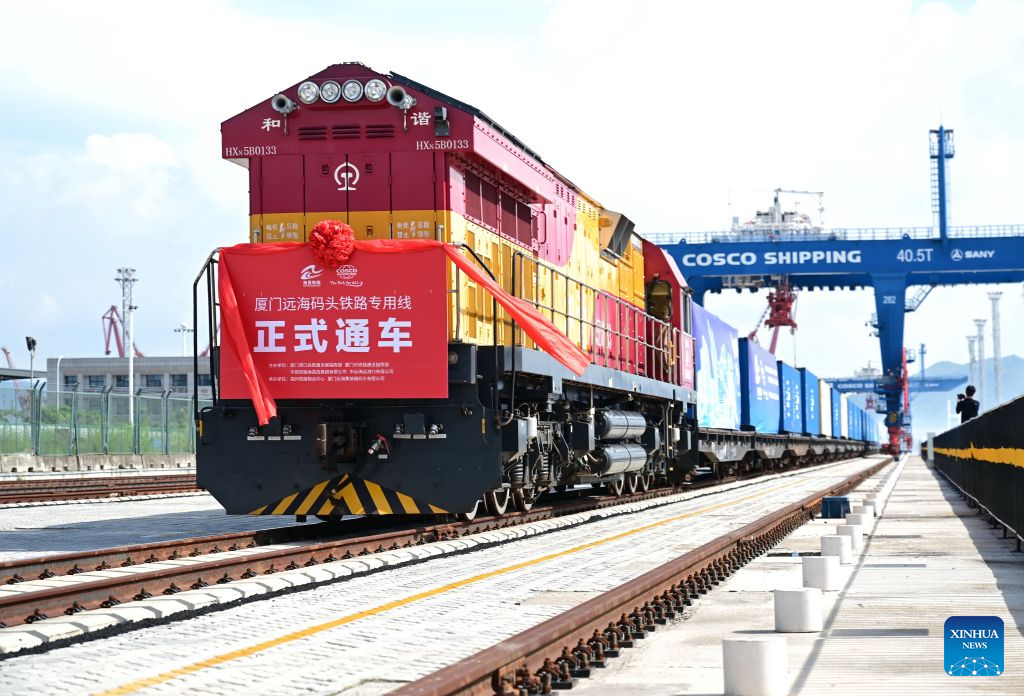
A freight train loaded with containers on a sea-rail intermodal rail line is pictured departing from a quay in Xiamen, southeast China's Fujian Province, July 29, 2026. The sea-rail intermodal rail line is among China's first batch of key projects promoting the integration of transport and logistics. Stretching 1,586 meters, it is designed to handle an annual throughput of 250,000 TEUs of containers and 250,000 tonnes of bulk cargo.
Running perpendicularly to the shoreline and located just 70 meters from the quay apron, the rail line enables cargo to be transferred directly from ships to trains for onward transport. (Xinhua/Lin Shanchuan)
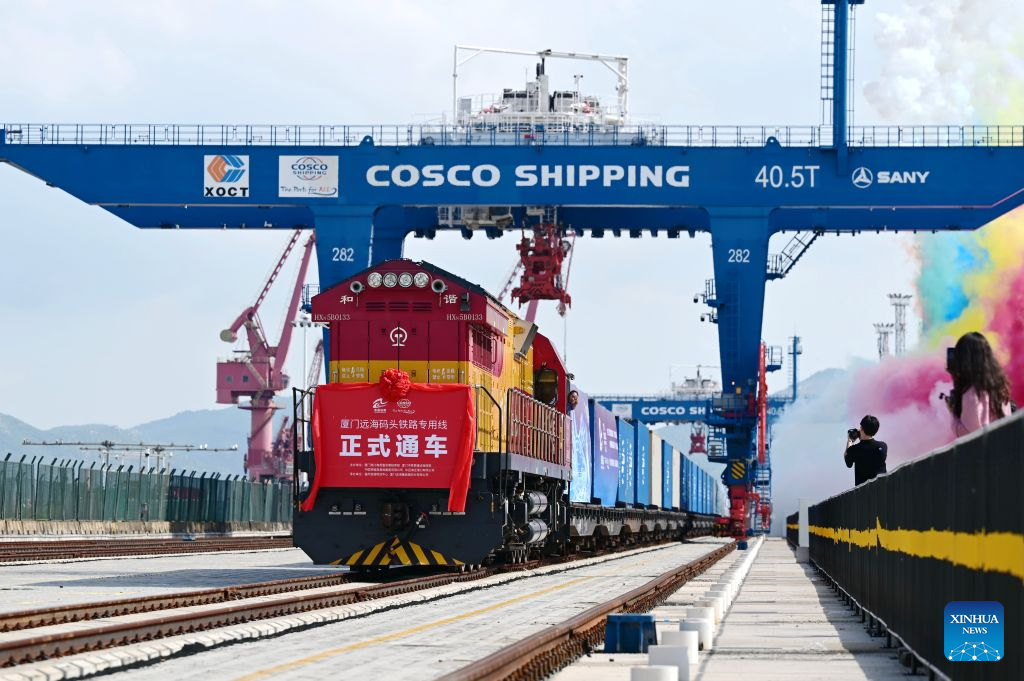
A freight train loaded with containers on a sea-rail intermodal rail line is pictured departing from a quay in Xiamen, southeast China's Fujian Province, July 29, 2026. The sea-rail intermodal rail line is among China's first batch of key projects promoting the integration of transport and logistics. Stretching 1,586 meters, it is designed to handle an annual throughput of 250,000 TEUs of containers and 250,000 tonnes of bulk cargo.
Running perpendicularly to the shoreline and located just 70 meters from the quay apron, the rail line enables cargo to be transferred directly from ships to trains for onward transport. (Xinhua/Lin Shanchuan)
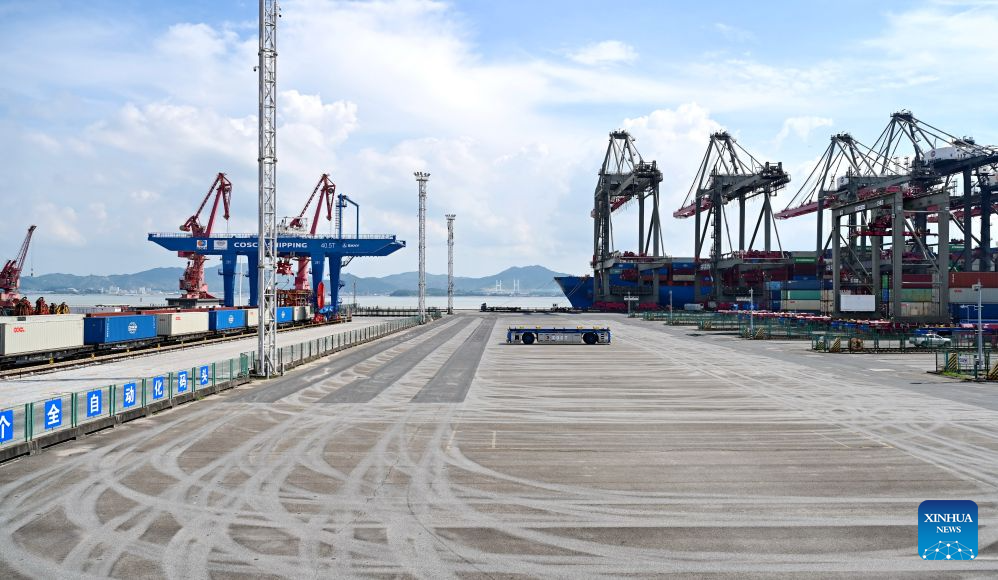
This photo taken on July 29, 2026 shows a view of a sea-rail intermodal rail line (L) at a quay in Xiamen, southeast China's Fujian Province. The sea-rail intermodal rail line is among China's first batch of key projects promoting the integration of transport and logistics. Stretching 1,586 meters, it is designed to handle an annual throughput of 250,000 TEUs of containers and 250,000 tonnes of bulk cargo.
Running perpendicularly to the shoreline and located just 70 meters from the quay apron, the rail line enables cargo to be transferred directly from ships to trains for onward transport. (Xinhua/Lin Shanchuan)
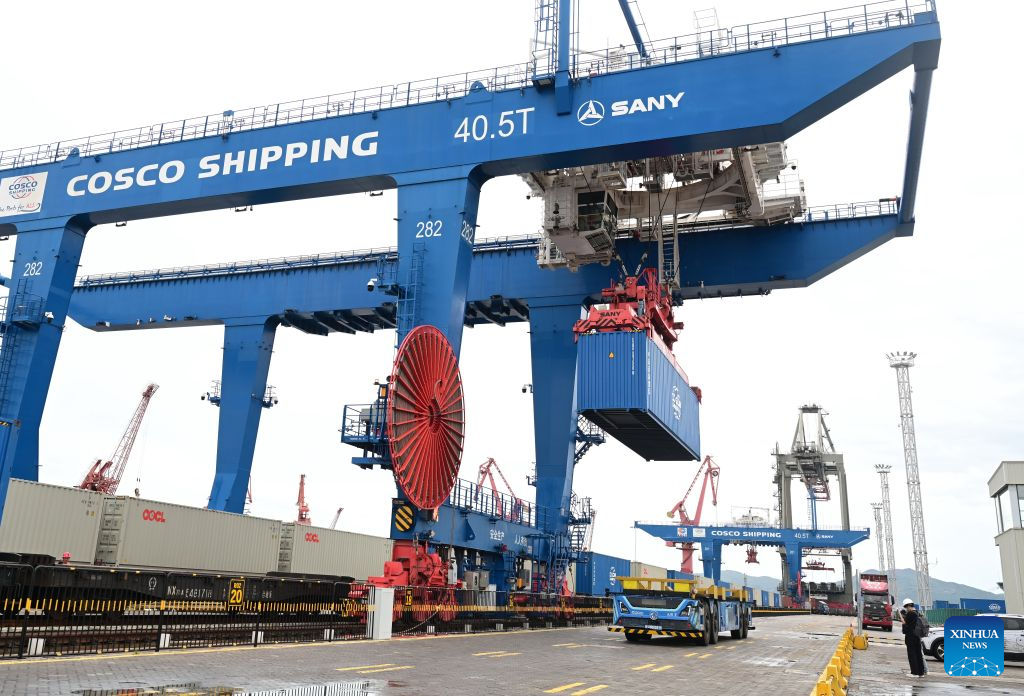
A container is hoisted onto a freight train on a sea-rail intermodal rail line at a quay in Xiamen, southeast China's Fujian Province, July 28, 2026. The sea-rail intermodal rail line is among China's first batch of key projects promoting the integration of transport and logistics. Stretching 1,586 meters, it is designed to handle an annual throughput of 250,000 TEUs of containers and 250,000 tonnes of bulk cargo.
Running perpendicularly to the shoreline and located just 70 meters from the quay apron, the rail line enables cargo to be transferred directly from ships to trains for onward transport. (Xinhua/Lin Shanchuan)
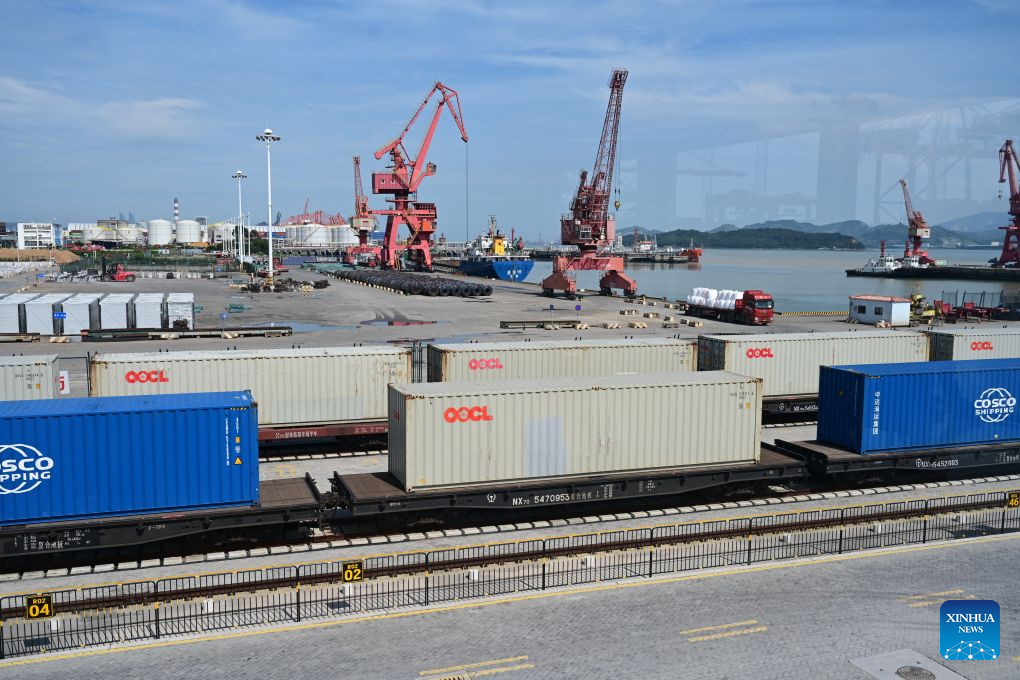
This photo taken on July 29, 2026 shows freight trains at a quay in Xiamen, southeast China's Fujian Province. The sea-rail intermodal rail line is among China's first batch of key projects promoting the integration of transport and logistics. Stretching 1,586 meters, it is designed to handle an annual throughput of 250,000 TEUs of containers and 250,000 tonnes of bulk cargo.
Running perpendicularly to the shoreline and located just 70 meters from the quay apron, the rail line enables cargo to be transferred directly from ships to trains for onward transport. (Xinhua/Lin Shanchuan)
You May Like
-
Solid factory activity boosts expansion
China's manufacturing activity maintained solid momentum in June, rounding off the sector's strongest quarter since late 2020, a private survey showed on Wednes...
InKunming 2026-07-03 -
China set to unveil 12 new occupations as emerging industrie...
China plans to recognize 12 new occupations, including digital twin engineers, embodied intelligence robot technicians and sports data analysts, as the country'...
InKunming 2026-07-03 -
Nation provides global access to innovation
China's technological advances and industrial strengths, combined with its market-opening efforts, represent "China Opportunity 2.0" for global businesses, expe...
InKunming 2026-07-03 -
China-Europe freight train, an artery for growth between Xi'...
In November 2013, the first Chang'an China-Europe freight train departed from Xi'an to Almaty in Kazakhstan, making the two cities ever since become key transit...
InKunming 2026-07-03 -
Voyah to expand footprint with premium EVs
Voyah, the premium electric vehicle brand under China's Dongfeng Motor, is betting on full-chain control, faster product cycles and an expanding overseas footpr...
InKunming 2026-07-03 -
Visa-free extension spurs travel
Driven by the optimization of the China-Russia visa-free policy and the expansion of round-trip flight capacity, the number of inbound and outbound Russian nati...
InKunming 2026-07-02 -
Xiconomics: A railway express that goes beyond trade
The inaugural freight train of China Railway Express (CR Express) established a high-speed logistical link between western China and Europe.
InKunming 2026-07-02 -
All units online for record-breaking hydroelectricity statio...
The full operation of a record-breaking pumped-storage hydroelectricity station in East China is poised to further accelerate the nation's green energy transiti...
InKunming 2026-06-30 -
AI boom spurs electronics manufacturing
China's electronic information manufacturing industry is set to embark on a transformative journey from scale expansion to quality enhancement and resilience bu...
InKunming 2026-06-30 -
Solar policy shift set to shake up industry
China's solar power industry is entering a mature phase of stable pricing and high-quality manufacturing, following the recent removal of a key export tax rebat...
InKunming 2026-06-26