Economy on track to meet growth target
Source: China Daily | 2026-07-01 | Editor:Diana
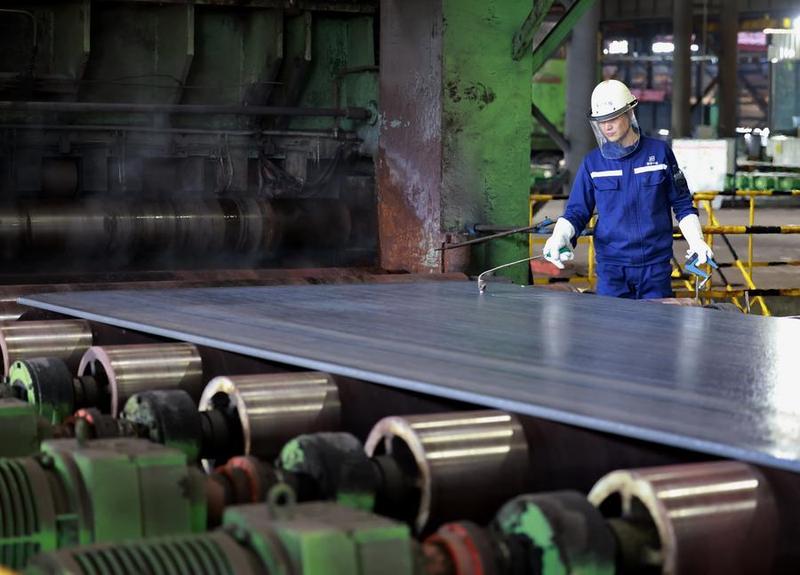
A man works on the production line of a shipbuilding steel enterprise in Tangshan Port economic development zone in Tangshan, North China's Hebei province, Dec 26, 2025. [Photo/Xinhua]
Buoyed by improving market demand amid robust global appetite for artificial intelligence-related products and stronger pro-growth policy support, China's factory activity returned to expansion in June after standing at the boom-bust threshold a month earlier, official data showed on Tuesday.
The latest readings, analysts said, pointed to stronger new growth drivers and resilient export performance as key pillars of economic stabilization, bolstering confidence that China's economy will stay on track to meet its full-year growth target.
Data from the National Bureau of Statistics show that China's official purchasing managers' index for the manufacturing sector came in at 50.3 in June, up 0.3 percentage points from the previous month.
Wang Qing, chief macroeconomic analyst at Orient Golden Credit Rating International, said the rebound was mainly driven by a faster recovery in market demand, as the new orders sub-index rose 1.3 percentage points to 51.2, the highest level in three months, according to the NBS.
"Domestic demand in the manufacturing sector improved notably," said Wen Bin, chief economist at China Minsheng Bank.
Wen said the steady implementation of the "Six Networks" initiative, measures to promote large-scale equipment upgrades and consumer goods trade-ins, as well as a mild recovery in the consumer market, had provided strong support for demand.
The improvement was not limited to domestic demand. On the external front, the new export orders subindex returned to expansion territory at 50.1, according to the NBS.
"The notable easing of tensions in the Middle East, coupled with sustained momentum in the AI sector, also supported the rebound in export activity," Wen added.
Echoing that view, Wang said China's exports are expected to sustain robust growth in June, lending solid support to the overall performance of the manufacturing sector.
New growth drivers also provided strong support. The PMI for high-tech manufacturing stood at 53.5 in June, compared with 52.9 in May, while the reading for equipment manufacturing reached 52.5, up from 52.1 in May, with both staying firmly in expansion territory, according to the NBS.
"Advanced manufacturing continued to make robust progress, further strengthening its role as a key driver of economic growth," said Huo Lihui, an NBS statistician.
Highlighting AI's potential to reshape growth momentum, Cai Fang, a member of the academic divisions of the Chinese Academy of Social Sciences, said, "AI is expected to help China ease deflationary pressure, improve the balance between supply and demand, and foster a new cycle of economic growth."
The overall improvement in the PMI also offered an encouraging signal for industrial activity heading into the end of the quarter, said Lynn Song, chief economist for China at Dutch bank ING.
The bank expects China's GDP growth to moderate to 4.6 percent year-on-year in the second quarter. But with first-quarter growth having come in stronger than expected, Song said the economy remains on track to deliver first-half growth broadly consistent with the country's full-year target.
The improvement was also seen in non-manufacturing activity. China's non-manufacturing PMI, which includes sub-indexes for service sector activity and construction, stood at 50.2, edging up 0.1 percentage point from May, NBS data showed.
Despite the simultaneous pickup in manufacturing and non-manufacturing activity, economists cautioned that the recovery still needed to become more balanced, as traditional industries and small, medium-sized and micro enterprises continued to face pressure, and domestic demand had yet to gain a firmer footing.
Tang Guanghua, an analyst at Shenyin & Wanguo Futures, said more targeted support measures should be rolled out to help small, medium-sized and micro enterprises reach wider markets and improve demand flows through traditional industrial chains.
You May Like
-
China International Digital Economy Expo 2023 kicks off
The China International Digital Economy Expo 2023 kicked off here on Wednesday, focusing on the development of the industrial internet.
InKunming 2023-09-07 -
Unlock China's Economy: Foreign journalist experiences drive...
What kind of commuter services do you prefer to choose every day? Click the video and travel with our Colombian journalist to experience the driverless robotaxi...
InKunming 2023-09-02 -
EconomyInFocus | China's auto industry witnesses high-qualit...
The five millionth new energy vehicle (NEV) produced by China's leading NEV manufacturer BYD rolled off the production line on Wednesday.
InKunming 2023-08-11 -
Global Digital Economy Conference 2023 held in Beijing
The Global Digital Economy Conference 2023 is scheduled from July 4 to 7 in Beijing.
InKunming 2023-07-05 -
Analysts: Economy set for faster growth pace in Q2
China's consumer inflation edged up marginally while its factory-gate prices dropped further in May amid weak demand, suggesting more stimulus policies may be n...
InKunming 2023-06-10 -
EconomyInFocus | New railway-highway combined transport rout...
A freight train departed from the Jiangjin District of southwest China's Chongqing Municipality on Monday, marking the opening of a new transport route via the ...
InKunming 2023-04-04 -
EconomyInFocus | Spring sowing of cotton starts in Xinjiang
Northwest China's Xinjiang Uygur Autonomous Region, the country's major cotton producer, has entered its cotton sowing period this year, local agricultural auth...
InKunming 2023-04-04 -
Economy stabilizing, picking up pace, NBS data shows
China's economy is stabilizing and picking up pace with a marked improvement in key economic data for the first two months of 2023, the National Bureau of Stati...
InKunming 2023-03-16 -
China's COVID response in numbers: Economy to embrace bright...
China's COVID response in numbers: Economy to embrace brighter future
InKunming 2023-01-19 -
Economy likely to recover after April doldrums
Fundamentals on firm footing as long-term growth prospects remain unchanged, NBS says
InKunming 2022-05-17