Confucius and Plato: the quest for modern relevance
Source: China Daily | 2026-06-02 | Editor:Jennifer
In The Odyssey, Odysseus leaves Ithaca and journeys through a world of profoundly different city-states and cultures, encountering unfamiliar customs, political orders, and ways of life. The voyage becomes more than a long return home. By stepping beyond his own world, the wandering king gains the distance necessary to reflect upon it; travel becomes a form of learning, about others and self.
As Chinese scholars gather in Athens this year for the second World Conference of Classics, they will, in a sense, be embarking on a similar intellectual journey, said He Fangying, a classics professor closely involved in organizing the event, which was jointly initiated by China and Greece in 2024.
"The king, who 'saw the cities of many men and learned their mind' — to quote directly from Homer, is ultimately led to a single question: what is the best way to live? It is a question asked by our sages as well — one that has echoed across millennia and feels no less urgent today," she said.
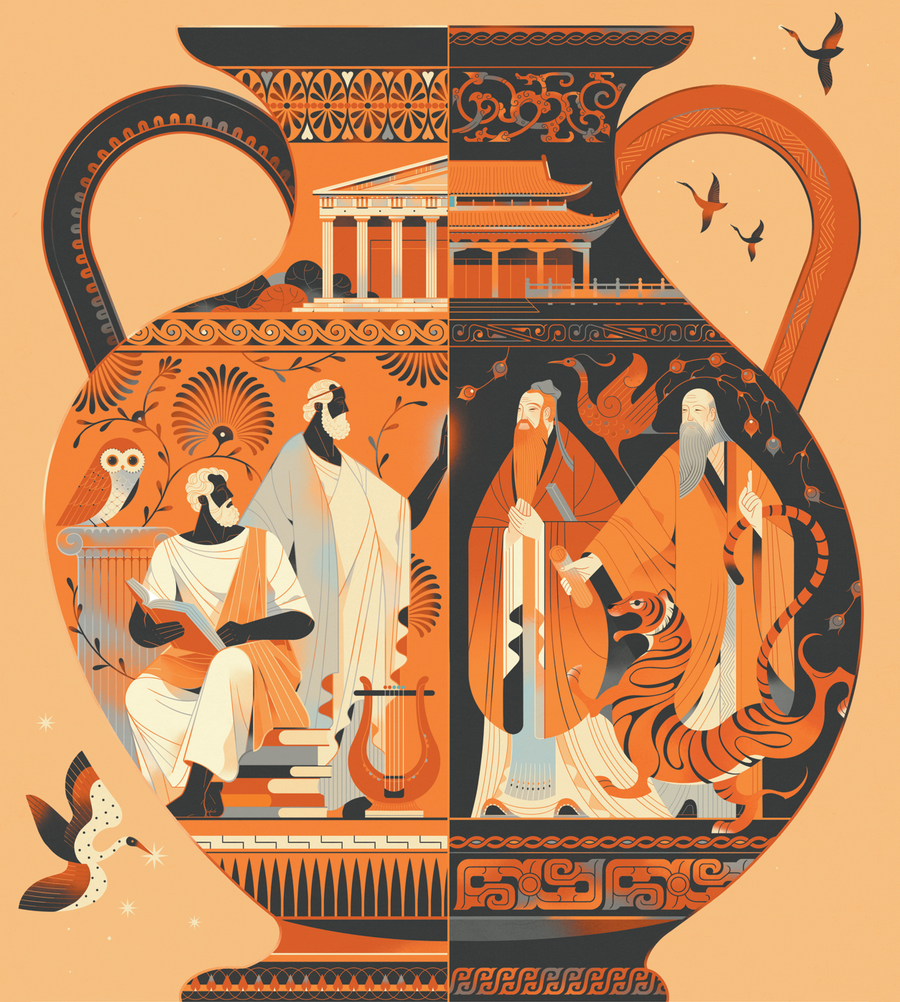
Plato answered this question through the pursuit of justice, reason, and truth. Aristotle, meanwhile, saw the good life as one of human flourishing achieved through the cultivation of excellence and virtue, guided by practical wisdom and the "golden mean" — the balance between extremes in both personal conduct and civic life. For Chinese scholars, such ideas often resonate with the Confucian concept of "zhongyong" (Doctrine of the Mean), revealing striking echoes between the Greek and Chinese classical traditions in their shared search for moral and ethical order.
"The enduring influence of Homer's epics lies not simply in their antiquity, but in the fact that they helped shape the West's fundamental imagination of human nature, society, and political life," He said.
In 2017, He launched the first courses of ancient Greek and Latin for postgraduate students at the Institute of Foreign Literature, Chinese Academy of Social Sciences, one of the conference's co-hosts alongside China's Ministry of Education, Ministry of Culture and Tourism, Greece's Ministry of Culture, and the Academy of Athens.
Having translated Plato's dialogue Lysis from Greek, her own path into the field began in 2002, when she enrolled in an ancient Greek class taught by Liu Xiaofeng, the philosopher-turned-classicist widely regarded as a leading figure in the revival of classical studies in China.
"Chinese classical studies and the study of the Western classics should not be treated separately, for the historical challenges confronted by modern China emerged, in large part, from its encounter with the West," said Liu in a previous interview.
According to He, what her mentor sought was to engage the Western classics on equal terms — neither venerating them from afar nor reducing them to instruments for contemporary use — but as traditions to be read seriously and respectfully from within his own horizon of thought.
In 2002, Liu co-launched the academic series Classics and Interpretation, organized around three main branches — Western Tradition, Chinese Tradition, and the Classics and Interpretation Journal. Since then, the series has expanded to 800 volumes.
Drawing in part upon the Chinese exegetical tradition, which dates back to around the second century BC, when Confucianism was canonized as a guiding moral foundation of Chinese society, Liu championed a method of close reading grounded in fidelity to the original language and textual precision. Moving beyond purely technical or ideological debate, it sought instead to return to the enduring questions posed by ancient thinkers from Plato to Confucius.
In the spring of 2000, Wu Fei, then a Ph. D. student in anthropology at Harvard, met Liu during the latter's visiting sojourn there. "He had only recently turned toward classical studies," recalled Wu, now a philosophy professor at Peking University.
Among the thinkers who most profoundly influenced Liu was German-American political philosopher Leo Strauss, whose work helped revive the study of classical political thought in the twentieth century.
"Strauss believed that modernity had not abandoned the idea of 'natural right', but fundamentally altered its meaning. For classical philosophers such as Plato and Aristotle, natural right referred to what is naturally just or proper — an objective standard for justice, political order, and the good life. Modern thought, by contrast, increasingly recast it as individual rights grounded in self-preservation," said Wu. "Strauss argued that this shift gradually gave rise to historicism, in which values became products of historical circumstance; and to relativism and nihilism, where objective truth and moral order themselves appeared uncertain."
"Having witnessed the rise of Nazi Germany before emigrating to the United States, Strauss responded not by calling for a return to antiquity, but by urging a renewed engagement with the concerns of the classical tradition," said Wu, referring to this year's conference theme, "Dialogue between Ancient and Modern: Contemporary Inspirations of Classical Wisdom".
"The question of how classical studies may still speak to modern life is, before all else, a question of whether modern people still trust in the wisdom of the ancients," said Liu, whose philosophical writings Wu first encountered in the 1990s as a sociology undergraduate at Peking University before later pursuing philosophy there as well.
"Those books were attempts to diagnose the spiritual and social tensions of the modern world, and it was precisely through that process that he was ultimately led to look further back," said Wu, who sees himself as having undergone a similar journey. His study of contemporary funerary practices in rural China gradually drew him into the world of traditional Confucian commentary centered on ritual, kinship, and moral cultivation, while also revealing the central role family played in both personal and political life across the ancient Chinese and Greco-Roman worlds.
Having translated into Chinese such works as Augustine's City of God — written in the aftermath of the Sack of Rome as the classical Roman world gave way to the Christian Middle Ages — and Plato's The Apology of Socrates, Wu is acutely aware of the layers of interpretation that have accumulated around classical Greco-Roman texts over centuries of Christian theology and modern Western thought.
"For Chinese scholars, the task is therefore not only to examine these established readings, but also to gradually peel back those layers in order to recover the original forms of thought beneath them," said Wu, who is the director of the Center for Nomos Studies at Peking University.
"The original Chinese concept is li, which can be understood on three levels. At its most basic, it refers to ritual or ceremony, something found in every civilization. More deeply, it extends to institutions and the normative ordering of political and social life. But li also carries an inward moral dimension: as Chinese philosopher Mencius suggested, human beings possess an innate ethical capacity that must be cultivated. It is this union of institutional order and inner virtue that I see as especially distinctive within the Chinese classical tradition," Wu said.
"I chose the ancient Greek word nomos because I believe it captures one of those striking moments of convergence in human thought. Nomoi — the title of Plato's final work, usually translated as The Laws — signifies more than law in the narrow legal sense; it also encompasses ritual, custom and normative order."
Reflecting on an intellectual life that has straddled the dual worlds of Western and Chinese classical studies, Wu said: "True immersion requires a degree of intellectual and moral identification, because classical studies are ultimately concerned not only with knowledge, but with the cultivation of character and the transformation of one's inner disposition."
In the 2024 volume of In the Mind, in the Body, in the World, scholars of early China and ancient Greece investigate how emotions were understood in philosophy, medicine, and literature from approximately the 5th century BC to the 2nd century AD. Topics covered range from equanimity in Taoism and Stoicism, to therapies of emotion in Greco-Roman and Chinese medicine, to the social function of contempt in Greek literature and Confucian thought.
Myrto Garani, a professor of Latin literature at the National and Kapodistrian University of Athens, spent three weeks teaching in Beijing last summer under a collaborative program between her university and the Center of Ancient Greek and Chinese Civilization in Athens, opened last year as China's first overseas high-level research center dedicated to classical studies.
Garani said that the Chinese scholars she was in touch with impressed her by "the seriousness of their scholarship, the strong philological training and the openness to comparative and interdisciplinary approaches", while her Chinese students stood out for "their critical perspectives, respect, and remarkable devotion".
"What I found particularly meaningful was the combination of academic professionalism with genuine human warmth," said Garani, who believes that "intercultural approaches in a global academic context demonstrate that the classics are not the exclusive inheritance of a single cultural world."
Last autumn, Wu traveled to Greece for the first time. Visiting Piraeus, the historic port of Athens, he found his mind returning to the opening line of Plato's The Republic: "I went down yesterday to the Piraeus with Glaucon the son of Ariston".
"The sight of Chinese cargo vessels," Wu said, "made me think about how civilizations continue to encounter one another across the same seas, and through memory, texts, and the lasting human search for meaning."
Both Wu and He will be among nearly 100 Chinese scholars attending this year's conference in Athens, scheduled for June 9 and 10.
"This is the first time Chinese classicists have appeared collectively in Athens, the cradle of the Western classical world," said He.
"For much of Chinese history, the study of canonical texts stood at the center of intellectual life. Deeply embedded within China's civilizational consciousness, this reverence for the wisdom of the past had persistently drawn generations of Chinese scholars toward classical studies — whether of their own tradition or others — as a way of engaging the foundational inheritances of the world's great civilizations: Greek, Chinese, Mesopotamian, Indian, and beyond."
One of them He had in mind was Luo Niansheng (1904–1990), who, having studied in Athens in the early 1930s, returned to China and devoted the rest of his life to translating the ancient Greek world into Chinese.
In 1986, a production of Oedipus Rex by Beijing's Central Academy of Drama was invited to the International Ancient Greek Drama Festival in Delphi and later performed in Athens. Luo, who first translated the play in 1935 while working with a Chinese archaeological team in northern China, attended as head of the Chinese delegation and later wrote an essay titled "Returning to Greece". A year later, the Academy of Athens awarded him its Highest Prize for Literature and Art.
When Luo died in 1990, his unfinished translation of Homer's Iliad, completed only halfway, was carried forward by another Chinese scholar, Wang Huansheng, who first learned ancient Greek through Russian in the former Soviet Union in the 1960s before completing Chinese translations of both The Iliad and The Odyssey.
These days, He has joined Wang in sustaining the interpretation and study of Homer's epics, continuing across three generations a distinctly Chinese intellectual journey into the heart of the ancient Greek world.
In The Odyssey, Odysseus descends into the underworld to seek guidance from the prophet Tiresias on his journey home. There he encounters Achilles, the greatest hero of The Iliad, who confesses that "I'd rather slave on earth for another man … than rule down here over all the breathless dead".
"Achilles is defined by glory and remembrance, Odysseus by endurance and return. Both represent the highest ideals of life held by ancient Greeks, and yet Homer seems to have given his final word to Odysseus," said He.
Two centuries after the composition of The Odyssey, Confucius was born in the mid-sixth century BC. Like Odysseus, who spent two decades away from Ithaca, Confucius traveled for 14 years among the competing states of his age, not by force of circumstance but by conscious choice.
If the Greek tradition often framed travel as a heroic encounter with difference, the Confucian tradition understood it as ethical and political learning, the search for moral order and wise governance. Yet both suggest that a culture comes to know itself more deeply through encountering another.
In The Analects, compiled by later generations after the death of Confucius, the sage once asks his disciples about the way of living they aspire. While the others speak of governing states and achieving distinction, the disciple Zeng Dian offers a quieter vision, one attuned to both nature and the self: in the warmth of late spring, to bathe in the river, stroll in the breeze, and return home singing.
Confucius responds simply: "I am with Dian."