Overseas gamers blown away by Chinese wuxia game
Source: China Daily | 2026-05-26 | Editor:Flynn
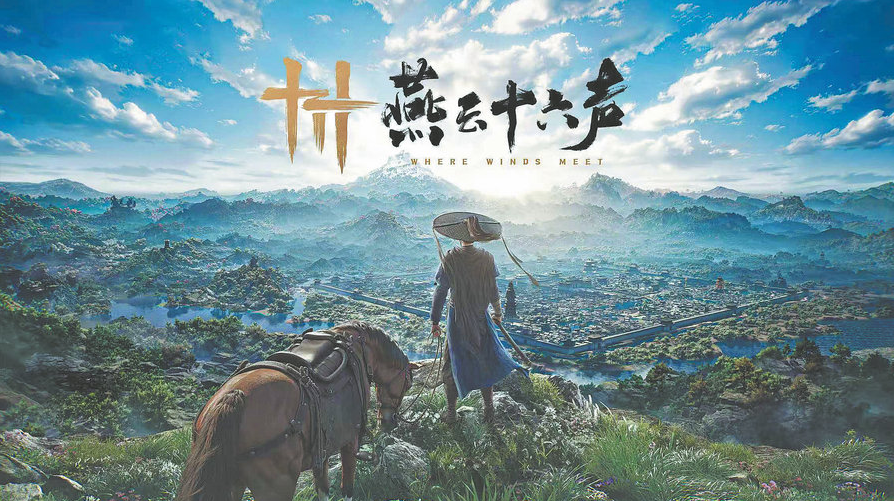
A poster for Where Winds Meet, an open-world role-playing game developed by China's Everstone Studio and NetEase Games. [Photo provided to China Daily]
The concepts of wuxia and jianghu can be difficult for the uninitiated to grasp, but they have carried some of the deepest ideals in Chinese culture for centuries.
Wuxia refers to wandering martial heroes, often possessing otherworldly powers, who hone their skills not for conquest, but for the protection of the vulnerable. Jianghu — literally meaning "rivers and lakes" — is the world that wuxia inhabit, shaped by loyalty, personal bonds and an unyielding belief in justice.
Perhaps the simplest way to understand them is to step inside Where Winds Meet, an open-world role-playing game that has become one of China's most unexpected global hits.
"The path into the jianghu begins," a voice murmurs at the end of the game's opening chapter, after your village has been destroyed and your family scattered. As you ride alone on horseback, the screen unfolds a haze of purple blossoms, drawing you toward an uncertain future.
"It was so sad and so beautifully done. I cried when I played that scene," said Itsjavachip, the username of a British-born, New York-based Twitch streamer with more than 500,000 followers.
Ahead of the overseas launch of Where Winds Meet in November, there was a concern that without the necessary cultural context, the game might remain a niche historical fantasy.
Instead, it exceeded expectations, becoming a worldwide sensation, climbing into the top three on Steam's global best-seller list and attracting tens of millions of players.
"We thought foreign players would connect with it," said Wen Jie, the game's publishing director, who prefers to go by Eric. "But we never imagined how far it would travel."
Part of the surprise lies in the game's subject matter. Drawing heavily from real Chinese history and culture, the game is set during the turbulent transition from the Five Dynasties and Ten Kingdoms (907-960) period to the Northern Song Dynasty (960-1127) — a fragmented era unfamiliar even to many Chinese players, let alone overseas audiences.
However, this historical complexity gives players even more to uncover and explore.
One of the game's most beloved characters among overseas players, Tian Ying, was inspired by a real historical episode known as the Qingfeng Post Station Incident, a covert political assassination that took place during the early years of the Northern Song Dynasty.
In the game, Tian assassinates a Khitan envoy and frames a rival state to stop an alliance that threatens his homeland. Overseas players praised the plot's intrigue and moral ambiguity, with some calling it "an entire game within the game".
Beyond grand quests and heroic sacrifices, players can also enjoy quieter pleasures such as house decoration or customizing characters.
Eric said he hopes that, by playing the game, overseas players will become curious about wuxia and jianghu — concepts deeply embedded in Chinese storytelling traditions — and will be encouraged to further explore Chinese culture.
Many, it seems, have done just that. The game inspired Itsjavachip to learn more about Chinese history and literature.
"In jianghu, what matters isn't origin, but action," she said, recalling a wounded ally who detonated explosives after being stabbed, in order to protect the protagonist. "He chose to go out fighting bravely. That, to me, is wuxia."
"Wuxia and jianghu trace their roots to ancient China," Eric said, "but their values belong everywhere — protecting what you love, staying true to your beliefs, growing through hardship and defending the place you call home."
You May Like
-
Diverse modes of business contribute to nighttime economic v...
Tourists visit the Orange Isle scenic area in Changsha, central China's Hunan Province, April 25, 2026.
InKunming 2026-04-29 -
An ancient game that transcends borders and generations
At the China Cultural Center in Belgrade, the quiet click of black and white stones carried more than the rhythm of competition. Over two days at the 2026 Serbi...
InKunming 2026-04-28 -
Sealing the deal: Artisans offer visitors a signature souven...
While China is famous for its beautiful calligraphy, important documents and letters were for centuries signed not with a handwritten name, but with a carved se...
InKunming 2026-04-28 -
China Focus: Brick-and-mortar bookstores turn to digital too...
China's brick-and-mortar bookshops, once under pressure from the growth of online reading and e-commerce, are now adopting digital tools in an effort to recon...
InKunming 2026-04-28 -
Children shine at Chinese language recitation competition in...
Children gathered at the China Cultural Center in Yangon on Sunday for the final round of the 9th Chinese Language recitation competition, showcasing their lang...
InKunming 2026-04-27 -
Xinhua Headlines: China brings classics to life to attract y...
China has made nationwide reading a national strategy. To enhance institutional support, a regulation on promoting nationwide reading, which took effect in Febr...
InKunming 2026-04-27 -
Young fighters take center stage as Beijing tournament break...
The 2026 Youth Martial Arts Tournament for Beijing's Xicheng and Mentougou districts was held in Beijing over the weekend, marking a new milestone in its decade...
InKunming 2026-04-23 -
Collected works on Chinese bronze artifacts lost overseas pu...
A sixty-volume compendium documenting more than 23,000 ancient Chinese bronze artifacts lost abroad was published on Sunday by Shanghai Classics Publishing Hous...
InKunming 2026-04-21 -
From Long-Stay Living to Lifestyle Entrepreneurship: Kunming...
Stroll along the Dianchi Greenway to watch the floating bridge at Caohai open and close, and the sun set over Dianchi Lake glow like molten gold; wander around ...
InKunming 2026-04-10 -
Students embrace first spring break around Qingming Festival
On the first day of the spring break, eight-year-old Wang Siyuan could hardly contain his excitement as he ran into a science museum in the eastern Chinese city...
InKunming 2026-04-07