Make yourself at home with a delivery from China
Source: China Daily | 2026-05-09 | Editor:Flynn
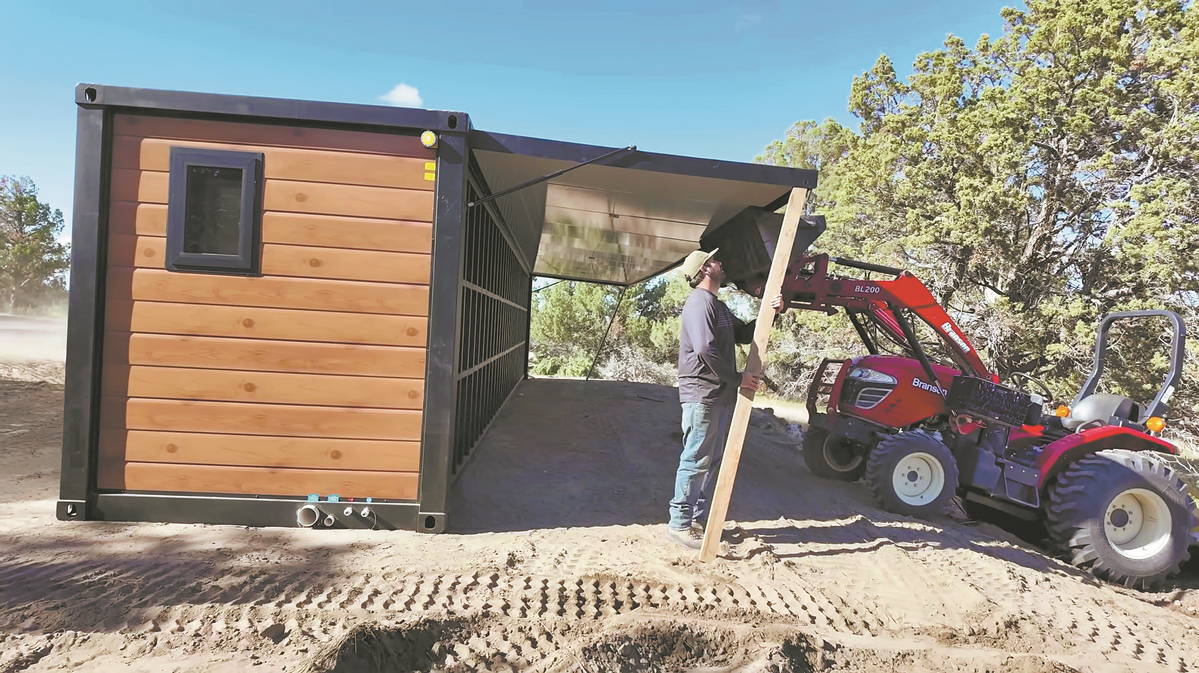
A Chinese-made expandable container house is installed by YouTube content creators in the United States. Provided to China Daily
A fully furnished home for less than $20,000 might sound improbable in today's housing market; yet one such unit has made its way across the Pacific to the United States.
Spanning 770 square feet (about 71.5 square meters), a flat-packed house will arrive move-in ready, complete with a bedroom, kitchen, independent bathroom — and even preinstalled windows.
For the creators behind the YouTube channel Grateful Off-Grid, this wasn't just a matter of curiosity, but a home purchase.
In a widely viewed video, the US couple documented their unboxing of the Chinese-made expandable container house, ordered online through e-commerce platform Alibaba.
With the help of a crane, the couple transformed the "house in a box" into a livable space in just one day. What arrived as a flat-packed kit quickly unfolded into a tiny house for just $15,800, which is less than the price of many cars in the US.
"Once you added in the shipping, tariffs and all the fees, the total came out to $28,689," they said in the video. The amount is still significantly below the cost of a traditional home in most parts of the US.
Their experience has struck a chord with viewers.
Under another YouTube video showcasing a 36 sq m expandable prefabricated house, one comment said: "Renting an apartment easily costs $12,000 to $15,000 per year. These are better choices for low-income people."
These Chinese-made "prefab homes" come in a wide range of forms, from compact tiny houses and foldable container units to futuristic capsule cabins and upscale modular villas. Most are designed with an intended service life of around 50 years, they can act as individual living spaces to full-scale family residences.
Prices also vary widely depending on size and customization. Basic units can start below $10,000, while larger, design-led models for resorts or boutique stays may reach $30,000 to $100,000, offering a markedly more accessible path to homeownership for budget-conscious buyers.
The growing interest is also reflected in online search trends. According to market intelligence firm ShelfTrend, high-volume keywords related to prefabricated housing in the United States have surged, with "tiny house" attracting more than 450,000 monthly searches, followed by "modular homes" at over 201,000 and "prefab homes" exceeding 165,000.
Such signals point to a broader global curiosity about prefabricated housing.
According to market research firm Mordor Intelligence, the global prefabricated housing market is projected to reach $152.74 billion this year, and is expected to grow to $210.33 billion by 2031, showing a compound annual growth rate of 6.62 percent.
For Chinese manufacturers, interest is opening new doors overseas.
"Demand is growing rapidly, especially in markets where flexible and cost-effective accommodation is highly sought after," said Serena He, founder of Luban Cabin, a manufacturer based in Linyi, Shandong province.
"In Australia and New Zealand, our units are popular for glamping and holiday camps, while in the Middle East, they are used for high-end desert tourism," He said, adding that the company is also seeing strong interest from Southeast Asia for resort projects and from parts of Europe for customized homestays and eco-friendly accommodation.
Among the most popular products sold overseas are futuristic "space capsule" units, designed for social media-friendly campsites, mobile vacation homes that can be deployed quickly and high-end modular suites tailored for hospitality upgrades, she noted.
According to He, a single modular unit such as a "space capsule" home can be installed in one to two days. Small projects combining several modules usually take three to seven days, while medium — to large-scale developments — such as camps or boutique hotels — can be completed within four weeks.
"Depending on the scale, installation timelines can be shortened by 60 to 80 percent compared with conventional building methods," He said.
She attributes the competitiveness of Chinese prefab housing to three key factors: cost, quality and efficiency.
"China's well-established supply chains allow us to offer competitive pricing without compromising on quality," she said, adding that advances in manufacturing have brought structural safety and durability in line with international standards, while also improving design and aesthetics.
lijiaying@chinadaily.com.cn
You May Like
-
Diverse modes of business contribute to nighttime economic v...
Tourists visit the Orange Isle scenic area in Changsha, central China's Hunan Province, April 25, 2026.
InKunming 2026-04-29 -
An ancient game that transcends borders and generations
At the China Cultural Center in Belgrade, the quiet click of black and white stones carried more than the rhythm of competition. Over two days at the 2026 Serbi...
InKunming 2026-04-28 -
Tea farmers bring aroma from deep mountains to urban custome...
Taiping Houkui is a renowned green tea from Anhui, known for its flat, elongated leaves. It offers a unique aroma, mellow taste, and sweet aftertaste.
InKunming 2026-04-28 -
Sealing the deal: Artisans offer visitors a signature souven...
While China is famous for its beautiful calligraphy, important documents and letters were for centuries signed not with a handwritten name, but with a carved se...
InKunming 2026-04-28 -
China Focus: Brick-and-mortar bookstores turn to digital too...
China's brick-and-mortar bookshops, once under pressure from the growth of online reading and e-commerce, are now adopting digital tools in an effort to recon...
InKunming 2026-04-28 -
Children shine at Chinese language recitation competition in...
Children gathered at the China Cultural Center in Yangon on Sunday for the final round of the 9th Chinese Language recitation competition, showcasing their lang...
InKunming 2026-04-27 -
Xinhua Headlines: China brings classics to life to attract y...
China has made nationwide reading a national strategy. To enhance institutional support, a regulation on promoting nationwide reading, which took effect in Febr...
InKunming 2026-04-27 -
Collected works on Chinese bronze artifacts lost overseas pu...
A sixty-volume compendium documenting more than 23,000 ancient Chinese bronze artifacts lost abroad was published on Sunday by Shanghai Classics Publishing Hous...
InKunming 2026-04-21 -
Migratory birds pictured in Shahu scenic area in NW China
Baby herons are seen at Shahu scenic area in Pingluo County of Shizuishan City in northwest China's Ningxia Hui Autonomous Region, April 18, 2026.
InKunming 2026-04-20 -
From Long-Stay Living to Lifestyle Entrepreneurship: Kunming...
Stroll along the Dianchi Greenway to watch the floating bridge at Caohai open and close, and the sun set over Dianchi Lake glow like molten gold; wander around ...
InKunming 2026-04-10