Beninese Youth Stéphane: A Ping-Pong Table Opens the Door to Life in Kunming
Source: InKunming | 2026-03-27 | Editor:Doe
On a spring afternoon, a lively gathering is in full swing. In the corner, at a ping-pong table, a white ball darts back and forth like a streak of light, punctuated by the crisp “thwack-thwack” of paddle against ball. At one end of the table, a dark-skinned young man leans forward, eyes fixed on the incoming shot. In the middle of a rally, he suddenly adds force, sending the ball skimming just over the net before his opponent can react. He looks up with a grin, flicks the ball back across the table, and readies himself for the next rally.
In the hearts of many Chinese, table tennis is the “national sport.” Yet in this moment, the one dictating the pace is a young man from West Africa. His name is Stéphane, a native of Benin and a doctoral candidate in ethnology at Yunnan University. This year marks his eighth year in Kunming.
“Wherever the ping-pong table is, that’s where my friends are.”
Sept. 2, 2018, Kunming Changshui International Airport. Stéphane walked out of the terminal, dragging his suitcase, surrounded by voices speaking a language he couldn’t understand. Before coming to China, he had studied Chinese for only a month. He had never heard of Kunming and knew no one. Everything around him was unfamiliar, yet he held one firm belief: in this city known as the “Spring City,” there must be a place to play ping-pong.
His luggage was still spread out on the bed when he opened the map app on his phone and began searching for “nearby ping-pong clubs.” After finding Tuodong Gymnasium on the map, he immediately set off.
That day, Tuodong Gymnasium was hosting an amateur table tennis tournament, and the venue buzzed with activity. Since he hadn’t brought his racket, he could only stand quietly by the side of the court and watch. Before long, a female coach noticed him, walked over, and asked, “Do you know how to play table tennis?”
“I can play a little,” he replied with a shy smile, in halting Chinese.
After a few rounds, the coach’s eyes lit up. She exclaimed, “Wow, you play really well.” They exchanged contact information and agreed to play together again. From then on, whenever the coach had a match, she would invite him to join.
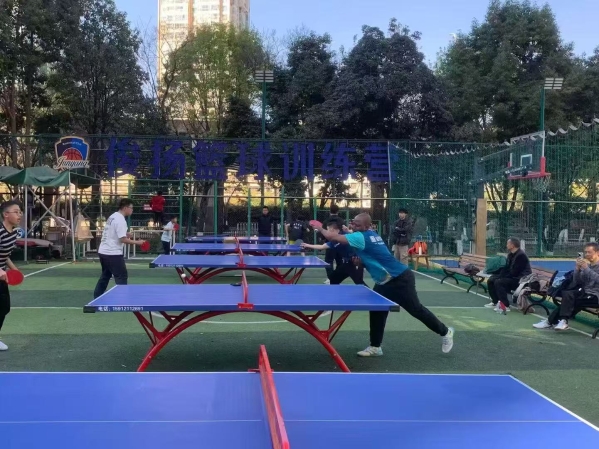
Stéphane plays table tennis with friends. Photo provided.
In 2019, Stéphane moved to Yunnan University’s Chenggong campus, nearly two hours away from Tuodong Gymnasium. Yet whenever his friends called him to play, he would still show up on time. “The moment they call, I rush over from Chenggong,” he said. “Wherever the ping-pong table is, that’s where my friends are.”
To Stéphane, strangers don’t need lengthy introductions—pick up a racket and the conversation begins. After the game, his fellow players often invite him to a street-side eatery. Over bowls of rice noodles and small plates of dishes, their conversation drifts from loop shots to the black-headed gulls of Green Lake and the lively street life of Kunming.
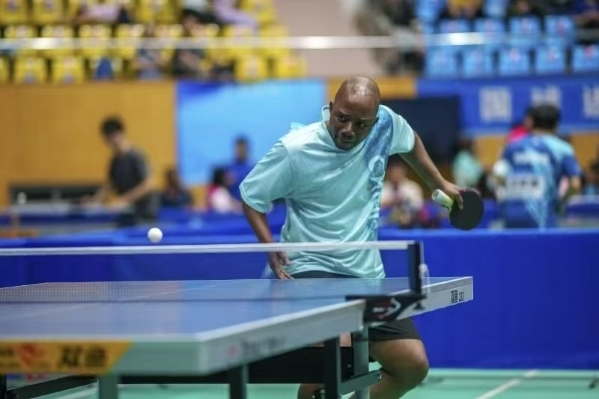
Stéphane competes in a table tennis competition at Yunnan University in 2020. Photo provided.
In 2020, he claimed the championship at Yunnan University’s table tennis tournament. “For an African to win the title here,” he recalled with a smile, “I was overjoyed. I wanted everyone to see who I am and know the name of my country.”
“You can’t truly belong somewhere without understanding it.”

Stéphane and his classmates attend a reading seminar. Photo provided.
Originally, Stéphane had planned to pursue a degree in civil and commercial law, hoping to return to his home country with legal expertise and start his own business. However, during four years of living and studying in Kunming, he learned about Yunnan’s rich ethnic cultures from friends and encountered something far more vivid than legal theories. When he completed his master’s degree, he chose to leave the legal path behind and apply for a PhD in ethnology at Yunnan University. “There are still many ethnic cultures in Yunnan that I’ve never even heard of before,” he said.
“You can’t truly belong somewhere without understanding it.”Stéphane said. Now, what he wants to understand most is the people here—how they live, how they tell their stories, and how they pass their culture down from generation to generation.

Stéphane poses for a photo along the Dulong River, July 13, 2024. Photo provided.
In the summer of 2024, Stéphane accompanied his mentor to the Dulong River valley. The mountain road wound through mist and clouds as the car jolted along the bumpy path. He leaned against the window, watching the mountains rise one after another before fading back into the distance. Two days later, the car finally stopped along the banks of the Dulong River. He smiled and said, “It was a really long journey.”
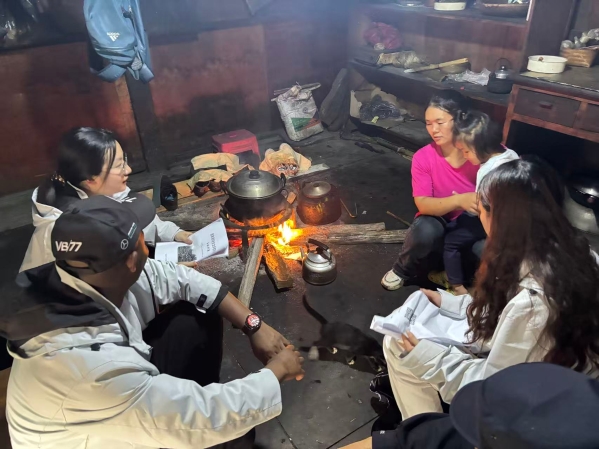
Stéphane sits with classmates around a hearth in the home of a Dulong family, July 16, 2024. Photo provided.
As night fell, he was invited into a Dulong family's home, where they gathered around the hearth. The flickering flames lit the room and danced across everyone’s faces. People spoke little; now and then someone added a piece of firewood to the fire or exchanged a quiet smile. The warmth of sitting together reminded him of his home far away in Benin. As a child, he often gathered with his family in the courtyard, chatting quietly under the night sky while watching the flames sway. “The same hearth, people sitting together—the feeling was familiar.”
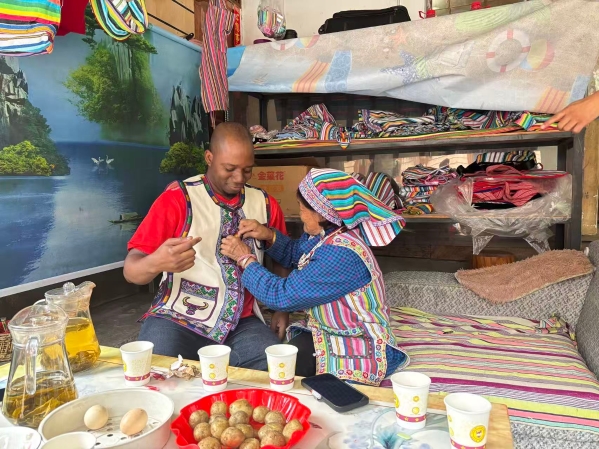
A Dulong elder helps Stéphane put on traditional attire, July 15, 2024. Photo provided.
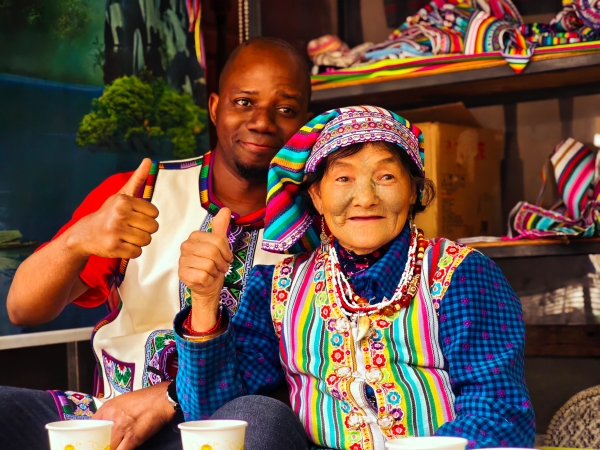
Stéphane, clad in traditional Dulong clothing, poses for a picture with a Dulong elder adorned with traditional facial tattoos.
In the home of a Dulong elder with traditional facial tattoos, the elder used her rough yet warm hands to dress him in traditional attire, fastening each cloth button one by one. Though he could not understand her language, he saw her smiling warmly. He later bought the outfit and hung it in the most visible spot in his dormitory.
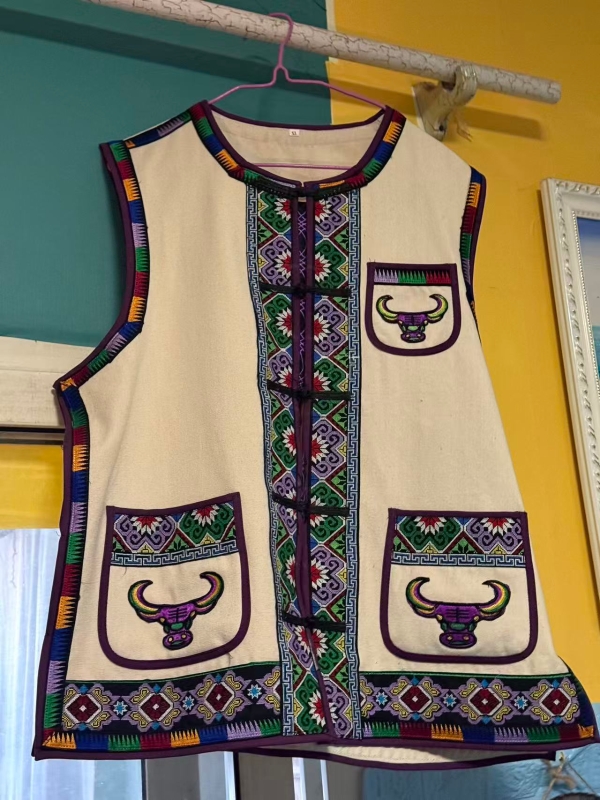
Stéphane hangs Dulong traditional attire in a prominent spot in his dorm room. Photo provided.
“If my family ever gets the chance to come to Yunnan,” he paused, then smiled, “I could introduce them to so many of Yunnan’s ethnic cultures. Not the kind you learn from books, but the kind you gain by sharing meals with people and sitting around the same hearth.”
After eight years without returning home, in a recent video call with his mother, he said, “I miss you so much.” His mother smiled and replied, “As long as you're happy there, we're happy.” He paused for a moment, then said quietly, “Eight years is a long time, but Kunming is worth it.”
“Kunming's climate is very similar to that of Benin,” Stéphane said. “It's sunny and warm, so you don't need heavy winter clothes. Often when I'm walking down the street and look up at the same blue sky I knew back home, I feel as if I'm still there.”
Every winter, he visits Cuihu Lake to watch black-headed gulls that migrate from Siberia for the season, photographing them as they skim across the water. Each season, he can be found at Tuodong Gymnasium, training and competing at the table tennis tables. During holidays, he also travels across Yunnan to learn about the cultures and ways of life of different ethnic groups.
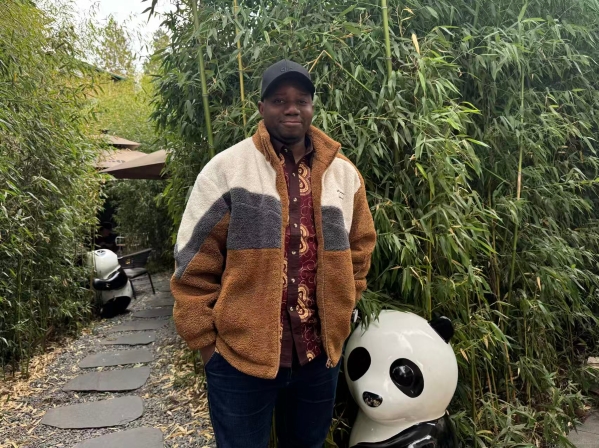
Stéphane walks near Cuihu Park. Photo by Wang Tiandou, intern reporter.
Looking ahead, he hopes to return to Benin and set up a small “Window to Yunnan” cultural museum in his hometown, allowing more people to learn about Kunming and get to know Yunnan.
Click here to view the Chinese report
(Editors: Doe, Flynn)
You May Like
-
Dreamlike Encounters: David's Extraordinary Adventures in Ku...
In the corner of a quiet café, the reporter meets David. Dressed in a light blue shirt, his demeanor exudes a quiet elegance and calm. His hair has turned silve...
InKunming 2024-11-08 -
German Michael Hermann: With a Passion for International Cha...
Michael's story is like the subtle fragrance of osmanthus flowers on the streets of Kunming—unassuming yet capable of warming hearts and inviting reflection.
InKunming 2024-10-15 -
Li Yingxiong’s “Heroic Dream” Coming to Fruition in Kunmi...
Propriety, righteousness, probity, a sense of shame, perseverance, self-restraint, and indomitable spirit are the twelve-word-spirit of Taekwondo engraved in Li...
InKunming 2024-05-28 -
Jaruwan Records Yunnan's Story with Sincerity
The Thai Chen Muyun, who is active on various social platforms, came to Kunming for the first time 13 years ago with the initial intention of pursuing education...
InKunming 2023-08-02 -
Andre falls in love with the ethnic culture of Yunnan
He is Andre Jacques du Plessis from South Africa, a son-in-law of Yunnan, and also a short video blogger.
InKunming 2023-01-20 -
French sinologist Yin Dongming: Spring Festival is a window ...
In a French restaurant in Kunming sat a foreigner with brown hair and blue eyes, wearing a very eye-catching ethnic necklace. She is Yin Dongming (Dorothée Riha...
InKunming 2023-01-30 -
Dwight's adventurous and curious "life experiments" in Kunmi...
Press the "play" button! The crackling rock music was on. Dwight Goldwinde started an improvised dance and invited the people sitting nearby to dance with him. ...
InKunming 2022-07-29 -
Filipino Bam finds ideal life in Kunming
Kunming is Bam's home in China. He found his ideal life here, which is to do what he loves and love what he does.
InKunming 2022-05-27 -
Beautiful but not delicate, bustling but gentle: Kunming in ...
“…… All the past and gone, for truly great men, look to this age alone.” Accompanied by Tra My’s sound of reading, her story in Kunming has not come to an ...
InKunming 2022-01-12 -
Poetic and Picturesque Yunnan seen through Thierry's lens
Born in a small town in the south of France, Thierry had worked as a CFO in an international fashion company in New York. According to him, his daily work was m...
InKunming 2021-12-14