'Factory flaw' spurs toy horse to instant popularity
Source: China Daily | 2026-01-12 | Editor:Rachel
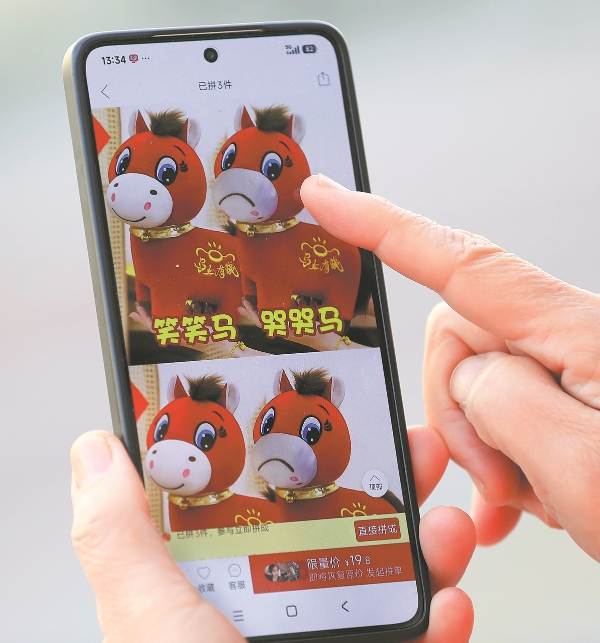
From production flaw to cultural icon, this accidental "cry-cry horse" resonates with young professionals as a symbol of resilience in the face of exhaustion and high pressure. China Daily
A plush toy horse designed as a cheerful Chinese New Year mascot has galloped into unexpected popularity — with an ironic twist.
Created for the upcoming Year of the Horse in the Chinese zodiac, it was originally meant to wear an upturned smile. Instead, due to a production error at a factory in Yiwu, Zhejiang province — widely known as the world's capital of small commodities — the toy left the assembly line with its mouth stitched into a distinct, down-turned pout.
"It was simply a worker's mistake — the mouth was sewn upside down," factory owner Zhang Huoqing said in an interview on Friday.
The story began when a social media user in Hangzhou, the provincial capital, received the flawed toy and contacted customer service to request a replacement. After posting photos of its melancholic expression online, the plush unexpectedly surged to fame.
Netizens quickly dubbed it the "cry-cry horse", and demand for the "accidental edition" flooded in. By Sunday, the hashtag #YiwuCryCry-HorseGoneViral had garnered about 100 million views on the social media platform Sina Weibo.
The toy's forlorn pout, paired with determined eyes, was swiftly embraced as a "cyber mouthpiece" for a generation of office workers. It embodies a collective sentiment of maintaining outward composure while enduring internal pressure — a feeling often described by the popular term "cattle-and-horse", a euphemism for being overworked.
"It's a true depiction of the 'cattle-and-horse' mindset," one user wrote. Another added, "It's quite adorable and looks really stubborn. For the Year of the Horse, let's make it a determined and hardworking one."
Wang Bin, a professor of social media communication at Renmin University of China, interpreted the trend as a psychological response to widespread social fatigue. He said the plush toy functions as an emotional anchor for consumers grappling with uncertainty and daily pressures.
"Everyone feels exhausted and faces many uncertainties about the future," Wang said, adding that the toy serves as a form of emotional comfort that people can buy.
The factory in Yiwu seized the moment with remarkable speed, pivoting production almost overnight. The number of assembly lines dedicated to the toy expanded from two to more than 10, with workers now meticulously trained to replicate the signature "sad" mouth — the very flaw they had once been instructed to avoid.
The identity of the original artisan responsible for the error remains unknown. Zhang said the company would award a bonus to the entire production team in recognition of their role in the toy's unexpected success.
Despite the frenzy, the company has pledged to keep the retail price fixed at 25 yuan ($3.5).
Its rapid rise to popularity underscores a shifting industrial paradigm whereby manufacturers increasingly prioritize consumer feedback, turning sentiment into a key factor in new product launches, said Zhu Huasheng, a professor at Beijing Normal University who studies industrial clusters.
"The success is not just about supply chain agility," Zhu said. "The internet-driven thinking of vendors played a major role."
He pointed to Yiwu — known as the "world's supermarket" — as a prime example of how online sentiment can now be translated almost instantly into physical products.
For decades, Yiwu has relied on flexible networks of small suppliers capable of rapid retooling and small-batch production. What has changed, Zhu said, is the addition of a digital layer. Social media and online platforms now provide real-time, high-resolution data on niche emotional trends, allowing factories to identify and validate new market signals almost overnight.
"Consumers, especially young people, are no longer passive buyers but active participants," he said."Their emotional expressions can directly shape what gets made."
The "cry-cry horse" illustrates this system in action. Yiwu's sprawling commercial complex, home to more than 75,000 wholesale booths, has long served as a bellwether for disposable consumer trends and a sourcing base for global bargain retailers.
However, the toy industry remains notoriously fickle, and viral crazes often last only months. Zhu said manufacturers in Yiwu are keenly aware of the "burst" nature of internet trends. Their strategy centers on hyper-agile production — riding the wave at its peak and winding down quickly.
Low per-unit costs help minimize financial risk, and the dense local supply network allows labor and materials to be swiftly redirected to other products. Ultimately, Zhu said, the strength of such hubs lies less in predicting a trend's longevity than in mastering the logistics of a short life cycle — maximizing returns within a narrow window before enthusiasm fades.
You May Like
-
Xi, his wife send New Year card in return to representatives...
Chinese President Xi Jinping and his wife, Peng Liyuan, on Wednesday sent a New Year card in return to representatives of middle school teachers and students ...
InKunming 2025-01-03 -
Sunrise scenery on New Year's Day across China
Sunrise scenery on New Year's Day across China.
InKunming 2025-01-02 -
China's Shenzhou-19 astronauts deliver New Year greetings fr...
China's Shenzhou-19 crew aboard the orbiting Tiangong space station sent their New Year greetings in a video on Tuesday, anticipating more breakthroughs in the ...
InKunming 2025-01-02 -
New Year's Day celebrated across China
Shanghai, Jan. 1, 2025. People across China enjoy themselves in various activities
InKunming 2025-01-02 -
Chinese leaders attend New Year gala featuring traditional o...
Chinese leaders attended a 2025 New Year gala featuring traditional operas Monday evening in Beijing.
InKunming 2024-12-31 -
China expects New Year holiday tourism boom with relaxed imm...
With the latest relaxation and extension of its immigration policies, China is expected to become a popular destination for foreign tourists this upcoming New...
InKunming 2024-12-31 -
People across China prepare for upcoming New Year 2025
China is gearing up for the upcoming New Year 2025 with festive decorations and various activities nationwide.
InKunming 2024-12-30 -
China's State Council Information Office hosts New Year rece...
China's State Council Information Office hosted a New Year reception on Wednesday, gathering nearly 500 participants from home and abroad at the National Muse...
InKunming 2024-12-19 -
Lunch is in for Lunar New Year's Eve
Bookings for lunch banquets on Lunar New Year's Eve have soared as Chinese consumers prepare to celebrate the Year of the Snake in 2025, with several restaurant...
InKunming 2024-12-18 -
People fly Kongming lanterns to celebrate New Year of calend...
People celebrate the New Year of the calendar of the Dai ethnic group.
InKunming 2024-04-15