News Analysis: Five challenges facing Netanyahu ahead of Israeli election
Source: Xinhua | 2026-10-26 | Editor:Doe
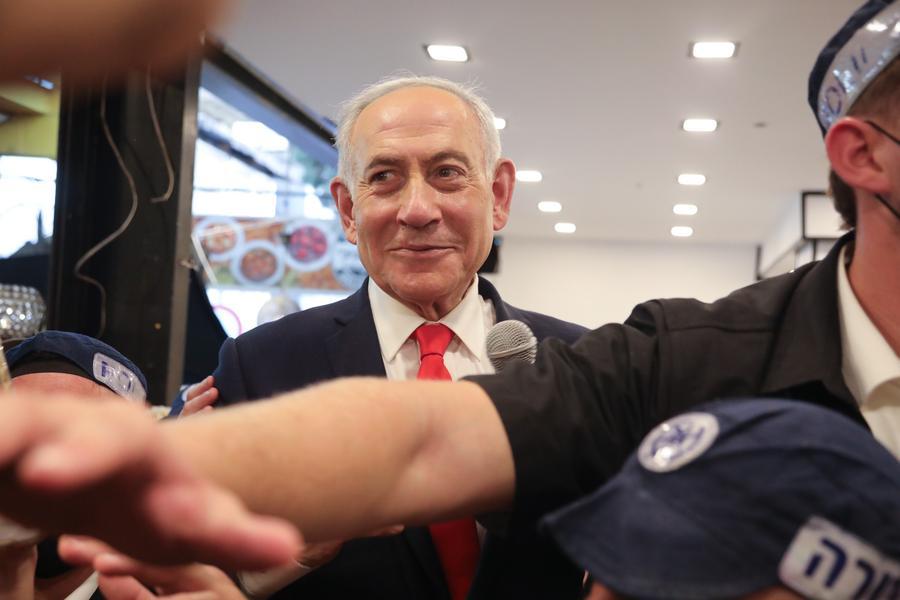
Israeli Prime Minister and Likud party leader Benjamin Netanyahu visits the Hatikva Market in Tel Aviv as part of his election campaign, Oct. 22, 2026. (Gideon Markowicz/JINI via Xinhua)
Israeli Prime Minister Benjamin Netanyahu, who has served 19 years in office across several terms since 1996, is fighting for his political survival in Tuesday's parliamentary election.
Analysts say Netanyahu is seeking to turn military gains into electoral support while facing public anger, economic isolation and a shortage of potential coalition partners.
The vote, Israel's first since the Hamas-led Oct. 7, 2023 attack, comes after three years of wars in Gaza, Lebanon and Iran that have reshaped Israeli politics and deepened divisions over the country's future.
LEGACY OF OCT. 7 AND PROLONGED WARS
Analysts note that Netanyahu's central challenge is persuading voters to judge him by Israel's military achievements rather than the failures that allowed the Oct. 7 attack, which the Israeli authorities said killed about 1,200 people and took 251 hostages.
He has refused to accept personal responsibility or establish an independent state commission of inquiry, instead campaigning on Israel's military achievements against Hamas, Hezbollah and Iran.
Political scientist Ilana Shpaizman at Bar-Ilan University told the Jewish Telegraphic Agency (JTA) that Netanyahu's campaign sought to avoid discussing the Oct. 7 attack and instead emphasize subsequent military successes.
But victims' families dispute the narrative. On Oct. 20, relatives representing 17 hostages who died in Gaza accused Netanyahu of exploiting their deaths in his campaign.
"Do not use their deaths to ask the public for another term in office," they said.
A Channel 12 poll on Oct. 5 found that 65 percent of respondents held Netanyahu largely responsible for the failures, yet 75 percent of coalition voters attributed him at least some responsibility.
Tamar Hermann, a public opinion expert at the Israel Democracy Institute, said the Oct. 7 attack had reinforced existing political loyalties.
"Most of the facts are already on the table, and it is the interpretation of the events that influences people's decisions," Hermann said.
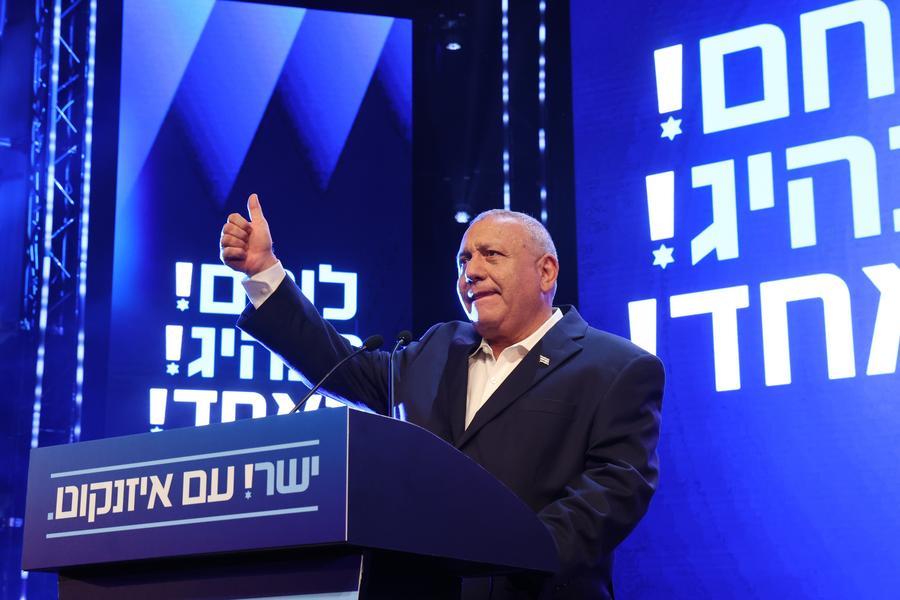
Gadi Eisenkot, former Israeli military chief and leader of the centrist Yashar party, attends a campaign event unveiling his party's candidate list for the upcoming parliamentary election in Rosh Haayin, Israel, Sept. 7, 2026. (Photo by Gil Cohen Magen/Xinhua)
CHALLENGE FROM EISENKOT
Netanyahu faces an unusual challenger in Gadi Eisenkot, a former military chief who served in his wartime cabinet before resigning in 2024. Eisenkot's son and two nephews were killed fighting in Gaza.
Eisenkot questions Netanyahu's ability to turn military operations into strategic gains.
"Never has an Israeli government been given so much room to maneuver and so much legitimacy, from the public and the world, and suffered such a resounding strategic failure," Eisenkot said earlier this month.
He promises an independent Oct. 7 inquiry, broader conscription and restored confidence in state institutions.
Yet their differences on Palestinian policy are narrower. Both oppose Palestinian statehood and demand Hamas's disarmament. Eisenkot criticizes settler violence and some settlement expansion, while Netanyahu governs with parties advocating West Bank annexation.
The contest is therefore less about competing visions of peace than about leadership, accountability and the conduct of war.
ECONOMIC PRESSURE, INTERNATIONAL ISOLATION
Netanyahu faces a growing economic dilemma: military policies presented as essential to security have deepened Israel's international isolation and increased the threat of sanctions.
In a Friday interview with Channel 10, he acknowledged concerns over possible banking sanctions.
"Of course I'm concerned," Netanyahu said, suggesting blockchain technology as a possible workaround.
The Bank of Israel rejected the proposal, while 109 economists, business leaders and former officials warned Sunday that sanctions could cause severe economic damage, according to the Israeli Hebrew-language business newspapers Calcalist and Globes.
The controversy highlights a broader challenge to Netanyahu's security doctrine: military gains may come at an economic and diplomatic cost Israel cannot sustain indefinitely.

Workers arrange ballot boxes at a logistics center near the central Israeli city of Modiin, Oct. 14, 2026. (Photo by Gil Cohen Magen/Xinhua)
DOMESTIC DIVISIONS, ULTRA-ORTHODOX DRAFT
Netanyahu also faces opposition over his corruption trial, attempts to weaken judicial oversight and exemptions from military service for ultra-Orthodox Jewish men.
He denies bribery, fraud and breach-of-trust charges, accusing the justice system of political persecution.
The conscription dispute has intensified after three years of wars and repeated reserve deployments.
An August survey by the Dialog Institute for Ynet and Yedioth Ahronoth found that about 70 percent of 509 reservists said the government's handling of ultra-Orthodox conscription would significantly influence their vote. Only 34 percent of former Likud voters surveyed said they would definitely vote for the party again.
Netanyahu risks alienating reservists by protecting his ultra-Orthodox allies, but enforcing broader conscription could jeopardize those alliances, analysts say.
THE BATTLE FOR A MAJORITY
Netanyahu's coalition support collapsed after the Oct. 7 attack and has only partially recovered. Final polls by Kan, Channel 12 and Channel 13 project 50 seats for his bloc in the 120-seat parliament, against 52 to 56 for the opposition and 14 to 16 for Arab parties.
Netanyahu relies on ultra-Orthodox and far-right allies, including Bezalel Smotrich and Itamar Ben-Gvir, whose demands for West Bank annexation further strain Israel's relations with Western allies.
Opposition parties, including right-wing factions, refuse to join a Netanyahu-led government, citing his corruption trial and responsibility for the Oct. 7 attack.
In an interview with Radio 103FM, Eisenkot said that he "will not serve under Netanyahu, not even in a rotation agreement," further narrowing Netanyahu's options.
Gideon Rahat, a political scientist at the Hebrew University of Jerusalem, told JTA that Netanyahu's bloc had lost support since winning 64 seats in 2022, but the opposition still lacked a majority.
The paradox is that while many opposition parties agree on replacing Netanyahu, their divisions could prevent them from forming an alternative government, leaving Israel facing another electoral deadlock.
You May Like
-
Chinese FM holds talks with Bulgarian counterpart
Chinese Foreign Minister Wang Yi said here on Monday that China is ready to be Bulgaria's partner in promoting Eurasian connectivity, pursuing common developm...
InKunming 2026-10-20 -
Economic Watch: Beijing forum calls for open, collaborative,...
High-profile guests gathered in Beijing on Monday for the opening of the Annual Conference of Financial Street Forum 2026.
InKunming 2026-10-20 -
Liangzhu forum opens, highlights heritage conservation, int'...
The fourth Liangzhu Forum opened Sunday in Hangzhou, east China's Zhejiang Province, to discuss challenges in cultural heritage conservation and paths to deep...
InKunming 2026-10-19 -
Beijing forum discusses counter-terrorism challenges posed b...
The Great Wall-2026 International Forum on Counter-Terrorism concluded in Beijing on Thursday, with more than 320 experts and frontline personnel from 62 coun...
InKunming 2026-10-16 -
World Insights: Xi's principles on settling Africa's hotspot...
The four principles proposed by Chinese President Xi Jinping for resolving Africa's hotspot issues have resonated across the continent, with diplomats, scholars...
InKunming 2026-10-16 -
China urges action on climate change
China's former vice-foreign minister Fu Ying called for greater international cooperation on scientific research and environmental protection in the Arctic, say...
InKunming 2026-10-15 -
Xinhua Headlines: China's energy push set to fuel long-term ...
As the world confronts what the International Energy Agency (IEA) has described as the most severe energy crisis in its history, China, the world's largest crud...
InKunming 2026-10-15 -
From bouldering to BMX, emerging sports gain a grip
As the National Day holiday drew to a close, young people took turns tackling a rock climbing wall at a gym in Xi'an, Shaanxi province. Some carefully tested ea...
InKunming 2026-10-15 -
Mainland imposes sanctions on companies tied to Taiwan separ...
The Chinese mainland respects and protects Taiwan compatriots' rights to freedom of speech and expression, while leaving no room for ambiguity on fundamental pr...
InKunming 2026-10-14 -
Xi Focus: Xi calls for decisive progress in Healthy China ad...
Chinese President Xi Jinping has called for efforts to firmly follow a path with Chinese characteristics in developing the country's health programs, to secure ...
InKunming 2026-10-14