China hosts event themed "AI empowering human rights development" in Geneva
Source: Xinhua | 2026-09-18 | Editor:Evan
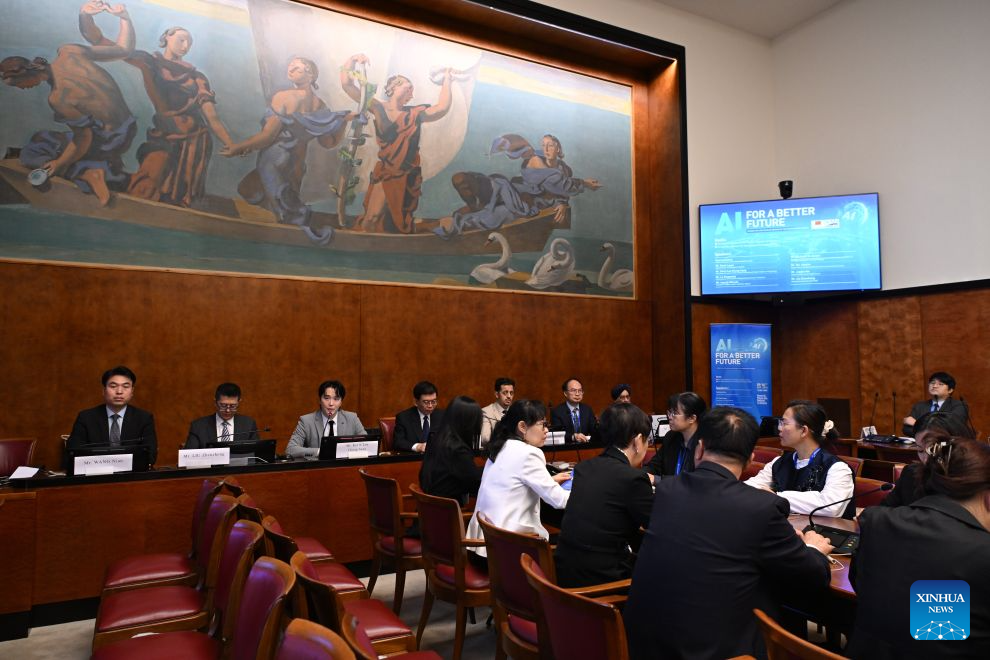
This photo taken on Sept. 16, 2026 shows a view at a side event themed "Artificial Intelligence (AI) Empowering Human Rights Development" during the 63rd session of the United Nations Human Rights Council in Geneva, Switzerland. TO GO WITH "China hosts event themed 'AI empowering human rights development' in Geneva" (Xinhua/Lian Yi)
A side event themed "Artificial Intelligence (AI) Empowering Human Rights Development" was held Wednesday during the 63rd session of the United Nations Human Rights Council.
Co-hosted by the Permanent Mission of China to the United Nations Office at Geneva and the China NGO Network for International Exchanges, the event brought together nearly 100 participants, including representatives from over 20 countries, heads of non-governmental organizations, and experts, and engaged in in-depth discussions on strengthening global AI governance and fostering the advancement of human rights.
Wang Nian, Counselor of the Permanent Mission of China to the United Nations Office at Geneva, said China is committed to responding to the calls of the Global South and uniting the international community to leverage AI in support of human rights protection.
China has presented a series of joint statements at the Human Rights Council regarding the role of AI in promoting human rights and introduced a thematic resolution on "accessibility for all," Wang said.
China advocates for a people-centered, inclusive, and mutually beneficial approach, aiming to empower groups such as persons with disabilities, the elderly, women, and children through AI, while ensuring their equal participation in social life, Wang added.
Liu Zhenzhong, Deputy Secretary-General of the China NGO Network for International Exchanges, shared his insights and practical experiences regarding the use of AI by Chinese civil society organizations in natural disaster relief.
Emphasizing that AI is a double-edged sword offering new opportunities for the advancement of human rights while posing potential governance risks, he called on the international community to fully leverage the role of civil society organizations as bridges and links, improve the global AI governance system, and ensure that the fruits of intelligent technology serve the development of human rights in all countries in a fair and inclusive manner.
Attendees shared their perspectives on how AI empowers the advancement of human rights from various angles.
Lu Xiaoguang, Vice President of Presidium of Beijing Disabled Persons' Federation, outlined how Beijing is advancing the practical application of assistive technologies, such as brain-computer interfaces and smart assistive devices, through a three-pronged approach involving institutional safeguards, technological innovation, and industrial empowerment.
By building a comprehensive ecosystem for technology-driven disability support, the city employs intelligent solutions to safeguard the legitimate rights and interests of persons with disabilities -- including convenient living and equal development -- in a holistic and precise manner, he said.
Wu Jianshe, Project Officer of Neijing NGO Network for International Exchanges, addressed the core theme of the "right to be heard."
He shared practical achievements in using AI to help individuals with conditions such as stuttering and Alzheimer's disease overcome communication barriers.
Moreover, he also detailed experiences in developing Beijing's multilingual public service platform, highlighting how intelligent public services can precisely safeguard the basic rights of the public.
Kevin Lau Chung-hang, Founding Convener of the Hong Kong Global Professional Youth Initiative, shared successful practices from Hong Kong, China, in leveraging AI to empower human rights protections across sectors such as healthcare and public welfare.
Highlighting the significant digital and healthcare development gaps facing the Global South, he called for strengthened cross-border and inter-regional non-governmental cooperation to precisely bridge the North-South development divide and promote inclusive development where smart technologies advance human rights for all.
David Lopez, representative of Association AIDHDES, said the current global landscape of smart services is characterized by unequal resource distribution and supply imbalances.
He urged nations to accelerate the development of public AI infrastructure and establish inclusive smart service systems that benefit the entire population, while breaking down technological barriers to ensure that countries and groups from all backgrounds can equitably share the dividends of AI development.
Ayyoub Mihoubi, founder of IBRAA Autism Institute, Algeria, shared innovative applications of AI technology in the early screening, rehabilitative intervention, and family guidance for autism.
Through digital and intelligent support models, these technologies effectively alleviate the caregiving burden on families of individuals with special needs, providing this group with professional and accessible social welfare and developmental support, he said.
Jasdev Rai, director of Sikh Human Rights Group, pointed out that AI holds significant value in areas such as poverty alleviation, public healthcare, and ecological governance, effectively contributing to the improvement of people's livelihoods.
At the same time, he said technological development must adhere to ethical bottom lines and establish robust risk prevention and control mechanisms to ensure that AI develops safely, for the greater good, and in an inclusive manner.
You May Like
-
High-tech sector lifts industrial growth
China's economy drew strong support from new growth drivers in August, with double-digit growth in high-tech manufacturing and solid external demand underpinnin...
InKunming 2026-09-16 -
Xi urges Chinese police to remain committed to serving peopl...
Chinese President Xi Jinping has called on the country's police officers to remain committed to serving the people, be loyal guardians of the Party and the peop...
InKunming 2026-09-16 -
Xi Story: Making canals channels for connectivity, prosperit...
Sitting in a glass case at a museum in south China's Qinzhou, a glazed porcelain bowl etched with a floral pattern offers a tantalizing clue to this coastal cit...
InKunming 2026-09-16 -
Orienspace sends 9 satellites into orbit for China's Spacesa...
Orienspace, a leading private rocket maker in China, conducted the fourth flight of its Gravity 1 carrier rocket on Wednesday morning, sending nine satellites i...
InKunming 2026-09-16 -
Trust, dialogue highlighted at forum
Experts and officials called for greater trust, dialogue and cooperation amid growing uncertainties in the international environment at the 13th Beijing Xiangsh...
InKunming 2026-09-16 -
China Cybersecurity Week opens in Jinan
The 2026 China Cybersecurity Week held its opening ceremony here on Monday. The event will be held across China from Sept. 14 to 20.
InKunming 2026-09-15 -
Economic Watch: China's smart home consumption push moves be...
For 72-year-old Zhu Chengyi and his wife Li Lan, 71, replacing a decade-old air conditioner in their home in Nanning, south China's Guangxi Zhuang Autonomous ...
InKunming 2026-09-15 -
China Focus: China fosters birth-friendly environment with b...
China will take further steps to support child-rearing, including making childcare more accessible and affordable, to build a birth-friendly society and boost i...
InKunming 2026-09-15 -
Economic Watch: China's "golden outer ring" highways fuel ne...
A scenic coastal highway in China has left a deep impression on Lee Jae-jae, a cycling enthusiast from the Republic of Korea (ROK).
InKunming 2026-09-14 -
Economic Watch: From owning to experiencing: services trade ...
With just a tap on a screen, Ms. Wang watched herself instantly transformed from a modern fashionista into Mu Guiying, her favorite Peking Opera character fro...
InKunming 2026-09-14