Tourists choose souvenirs that ensure memories don't fade
Source: China Daily | 2026-08-05 | Editor:Flynn
In Lijiang in southwestern Yunnan province, paper is crafted to endure. Handmade Dongba paper, once reserved for recording the sacred scriptures of the Naxi people, is now earning a place in the luggage of travelers from around the world.
A growing number of domestic and international visitors have left the UNESCO World Heritage-listed Old Town of Lijiang with Dongba paper products tucked into their luggage — notebooks filled with travel memories, postcards inscribed with ancient pictographs bearing blessings, and handmade paper lamps whose soft glow will follow them home.
Some visitors share their finds on social media, posting photos of the paper's fibrous texture and the enigmatic characters adorning it, introducing this centuries-old craft to a wider audience.
The alchemy of Dongba paper begins in the mountains surrounding Lijiang. It is traditionally made from the bark of the Wikstroemia shrub, which grows at elevations above 2,000 meters. The bark is soaked, softened, pounded into pulp, meticulously spread onto bamboo screens and then sun-dried — a process repeated dozens of times.
"Unlike industrial paper, where uniformity is the goal, Dongba paper keeps the traces of nature," said Zhang Jian, a product designer who runs a Dongba paper workshop in the old town.
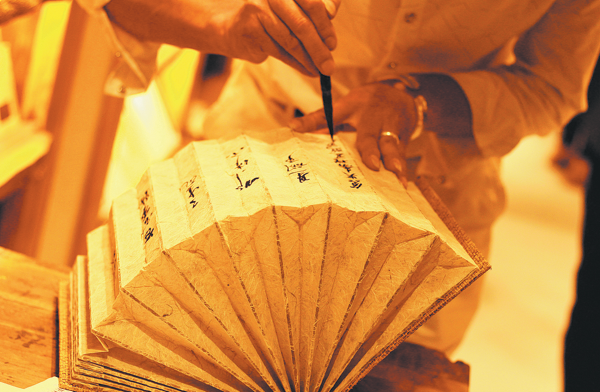
A craftsman inscribes Dongba paper with a brush in Lijiang, Yunnan province. PROVIDED TO CHINA DAILY
Plant fibers remain visible across the surface, creating subtle textures and organic patterns. No two sheets are ever alike.
"Every sheet has its own character," Zhang said. "We try to preserve the natural qualities of the raw material. The fibers themselves are what make the paper beautiful."
For centuries, Dongba paper was used by Naxi priests to record religious scriptures in a pictographic writing system that remains central to Naxi cultural heritage. Its natural resistance to insects and aging has helped preserve those texts for generations.
Today, the same durability has become part of its modern appeal.
"We used to see foreign tourists occasionally. Now we see them every day," said Zhang, who has spent nearly 23 years giving this thousand-year-old craft a modern makeover.
Han Yuchen, who oversees sales and promotion of Dongba paper, believes that its appeal goes beyond mere portability.
"Many visitors are surprised when they hear that such a delicate-looking paper can last for hundreds of years," he said. "They want to know more about how it is made."
Postcards are often the first thing overseas visitors pick up, followed by notebooks and paper lamps.
Featuring images of Lijiang's scenery alongside Dongba characters, postcards can be personalized with handwritten blessings before being sent home. The paper's natural texture gives the writing a warmth that mass-produced cards cannot replicate, Han said.
Dongba paper lamps have become an unexpected hit. Made by folding a single sheet of Dongba paper into a lampshade, they emit a soft glow that accentuates the raw plant fibers within. Each lamp has its own pattern, shaped by the plant material itself.
Notebooks are another favorite. One best-selling journal, roughly A5-sized with raw edges and a leather cover, sells for more than 180 yuan ($27). Though pricier than standard notebooks, they serve as a tactile archive for personal memories.
"Many visitors turn them into travel journals," said Zhang, the workshop owner. "They paste train tickets, flight stubs, entrance tickets and photographs inside. The notebook becomes part of their journey."
Contact the writers at yangfeiyue@chinadaily.com.cn

You May Like
-
China-DPRK train services boost links
China and the Democratic People's Republic of Korea resumed international passenger train services on Thursday, restoring a key rail link suspended since 2020 a...
InKunming 2026-03-13 -
Inbound tourism booms during holiday
During the Spring Festival holiday, crowds of foreign travelers were spotted visiting destinations across China. They explored not only major cities such as Bei...
InKunming 2026-03-05 -
Chewy rice cakes embody wishes for good fortune
On festive kitchen counters, fish will flick their tails in mid-motion, gold ingots will sit plump and round, and a square "gold brick" will stand firmly at the...
InKunming 2026-02-11 -
Various activities held across China to welcome upcoming Lab...
Various activities were held across the country to welcome the upcoming Laba Festival that falls on Jan. 26 this year.
InKunming 2026-01-26 -
History on the plate
Why do Chinese people eat dumplings during the winter solstice? Was egg-fried rice once considered a dish reserved for emperors?The answers to these questions c...
InKunming 2026-01-23 -
China Focus: Southeast Asian tourists flock north, fueling C...
Despite the biting minus 20 degrees Celsius cold on the century-old Central Street in Harbin, northeast China's Heilongjiang Province, Thai tourist Nattapong ...
InKunming 2026-01-20 -
China releases Year of the Horse stamps amid collector enthu...
China Post officially released a set of special stamps on Monday in celebration of the upcoming the Year of the Horse, sparking a frenzy among collectors.
InKunming 2026-01-06 -
Dong New Year traditions are a major attraction
To the rhythm of lusheng woodwind pipes and the scent of sticky rice cakes, a village in southwest China's Guizhou province celebrated its annual Dong Ethnic Ne...
InKunming 2025-12-31 -
China Focus: The "cultural ferrymen" offering a more authent...
As the scent of freshly steamed bean paste buns drifts through the People's Park in downtown Shanghai and laughter erupts from a nearby English-language stand-u...
InKunming 2025-12-25 -
From Yunnan Opera to Coffee, from Flowers to Seagulls: Kunmi...
Kunming is fast emerging as a new hotspot for inbound tourism to China. According to latest data, Kunming welcomed 952,100 foreign visitors in the first three q...
InKunming 2025-11-04