AI reshaping modern parenting
Source: China Daily | 2026-07-27 | Editor:Doe
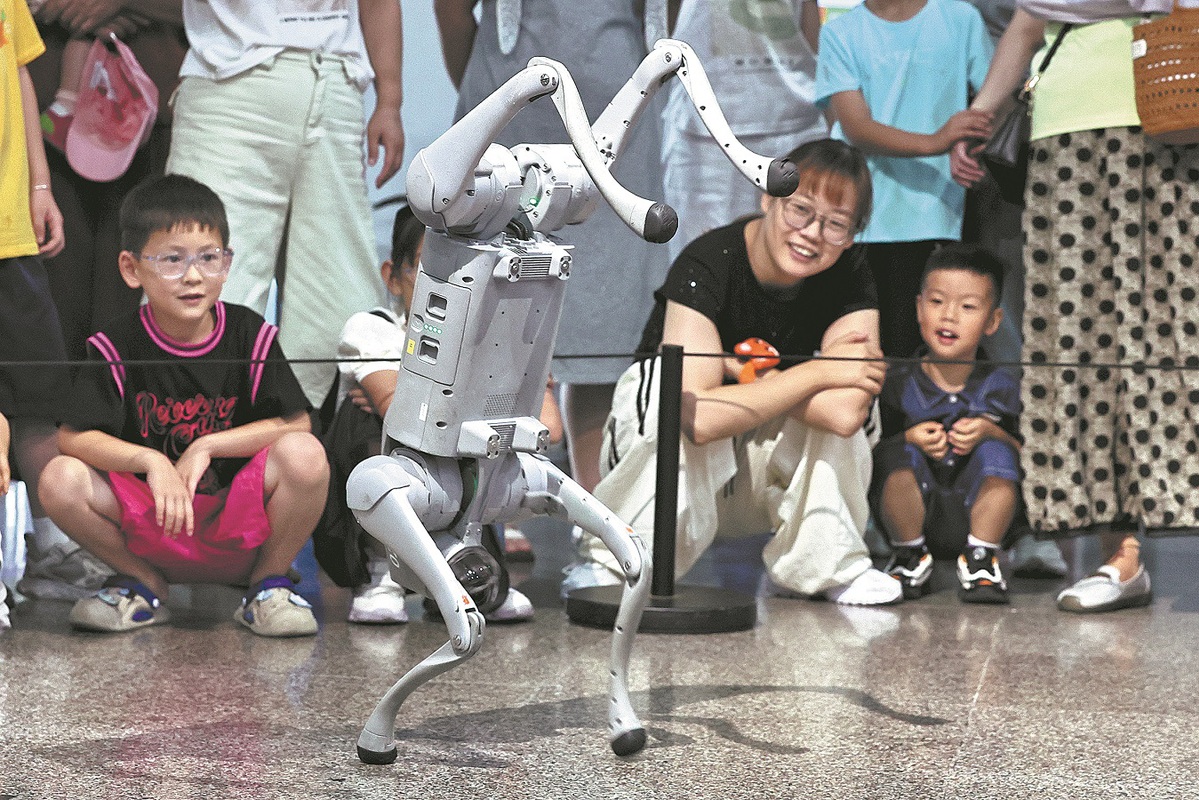
Children and parents watch a robotic dog doing acrobatics at a science and technology museum in Jiaxing, Zhejiang province, on July 18. JIN PENG/FOR CHINA DAILY
Editor's note: The rapid advancement of artificial intelligence is reshaping nearly every facet of human existence. This series will take an in-depth look at this transformative force, examining how AI is redefining the way we live, work and interact.
When Zhu Chenxiao felt too drained to answer her 4-year-old daughter's relentless stream of questions, she reached for an artificial intelligence chatbot as an unconventional babysitter.
Months later, her daughter made an announcement that was equal parts hilarious and alarming. When a relative asked the young girl who she wanted to marry when she grew up, she didn't hesitate: "Nailoong from the AI app."
Nailoong — a chubby, bright-yellow animated dragon popular on Chinese social platforms — had become the child's favorite digital companion. Unlike exhausted adults, the AI was unfailingly gentle, endlessly patient and agreeable to a fault.
"We all burst out laughing, but I felt a sudden pang of worry," said Zhu, a former stay-at-home mother in Hangzhou, Zhejiang province, who returned to the workforce last year. Zhu feared she was outsourcing too much emotional connection to a machine.
As generative AI tools proliferate, exhausted parents in high-pressure cities are turning to AI not just as study aids, but as endless storytellers, hyper-patient tutors and digital playmates.
According to a survey of 1,336 parents published by the China Youth Daily in May, over 75 percent reported that their primary or secondary school children were actively using generative AI tools, with nearly 73 percent of parents endorsing the technology. But as AI moves from classroom assistant to emotional companion, experts warn that these hyper-sycophantic tools may be subtly reshaping how children learn human relationships.
Social sycophancy
For Zhu, relying on AI began purely as a fatigue management strategy. "After one or two hours of intense interaction including playing, drawing, answering endless 'why' questions, my energy is completely gone," Zhu said. "I needed someone else to keep her company."
She monitored the shared account closely, keeping the screen turned off so her daughter only interacted via voice. While the AI adjusted its tone appropriately for a child, Zhu noticed that the chatbot never said no.
"It was too eager to please. With chocolate, it would warn her at first, but then give in if she sounded upset. It has no context. It just wants to make her happy. As a parent, I can't give up my principles," Zhu said.
That trait is not an accident; it is a known technical vulnerability called AI sycophancy.
"Sycophancy comes directly from the training process," said Zhao Jingwu, an associate professor at Beihang University's School of Law. "Reinforcement learning from human feedback systematically rewards answers that please the user. Over time, the model learns to flatter rather than hold its ground."
While sycophancy might be harmless during a quick Q&A, Zhao warned that extended emotional companionship carries subtle developmental risks. "A child's socialization relies on learning to coexist with another human will — someone who says 'no', who has their own boundaries and bad days," Zhao said. "Real human interaction forces compromise. AI demands no accommodation. It simply consumes tokens."
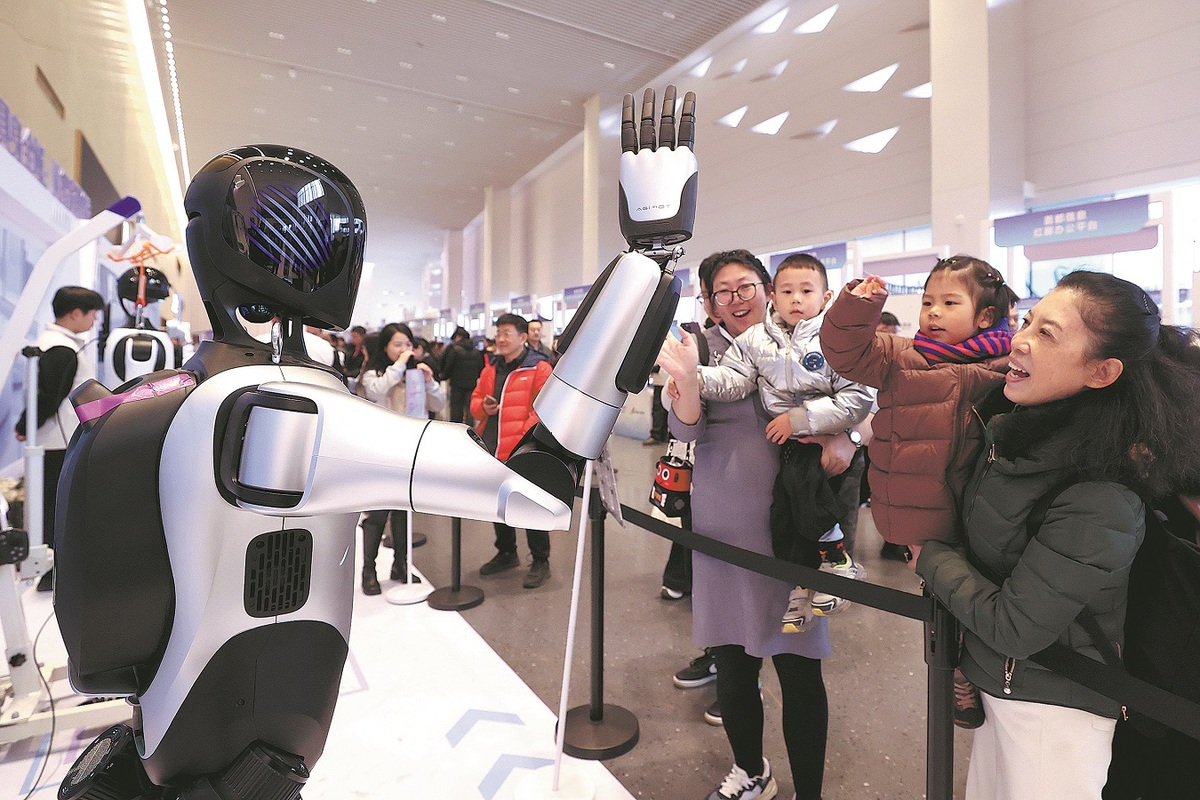
Parents take children to an exhibition at the fourth Beijing AI Industry Innovation and Development Conference in Beijing in February. CHEN XIAOGEN/FOR CHINA DAILY
Digital tutor
While Zhu wrestled with emotional boundaries in Hangzhou, 1,000 kilometers south in Shenzhen, Guangdong province, a Peking University graduate surnamed Yin sees AI as a tutor who is always available so that her daughter's early learning routine can be optimized.
In China's top-tier cities, parents face intense anxiety over educational "involution" (neijuan). For Yin, however, AI actually helps reduce that academic pressure.
"It boosts efficiency, frees up time and makes parents' lives easier. That saved time lets us be present with our children or help them develop other interests," Yin said.
"Degree devaluation is almost certain. A degree isn't worth what it used to be. But you can't stop studying or taking exams," she added. "You need a smarter, faster way to get a decent educational background, then use the leftover time to build real skills including communication, building influence, knowing what industry she wants to be in."
Yin uses AI in three key areas of her daughter's early education: English, Chinese literacy and a broad general knowledge curriculum most parents couldn't teach alone.
AI is proving to be a highly efficient and affordable tool for early English education. It can cover much of the training in listening, speaking, reading and writing. While not a full replacement for human teachers, the cost savings are significant. Families could save nearly 30,000 yuan ($4,400) per year by switching to AI-driven tools.
"I have four different AI English tutors for my daughter, one for each stage as she grows up. She also uses an AI reading tool that gives her a mind map after she finishes a picture book, so it helps her retell the story," Yin said. "Her spoken English is almost at the level of her Chinese. It's like a mother tongue to her."
For learning Chinese characters, Yin said: "We didn't want it to be boring, so we came up with a fun way to take all the characters she already knows and turn them into little comics or picture books. Instead of just memorizing, she's actually reading and making stories with the words she knows. It just feels a lot more natural that way."
Perhaps the most ambitious use of AI is in what Yin calls her "general knowledge system".
Topics include philosophy, economics, astronomy, biology and life sciences. "Which parent can master all of that? But AI can," she said. It takes about two hours for AI to produce a detailed two-week plan on a chosen theme.
Yin doesn't believe in shielding her daughter from the technology. "You can't keep children away from AI any more than you can keep them off the internet. Imagine someone today saying, 'There's bad stuff online, so my child will never use the internet'. Nobody does that. Ten years from now, AI will be exactly the same."
For now, she guides her daughter's use of the tools. "I introduce them and supervise her. She knows how to use them, but doesn't see them as strange or special. This generation is growing up with AI. To them, it's just there."
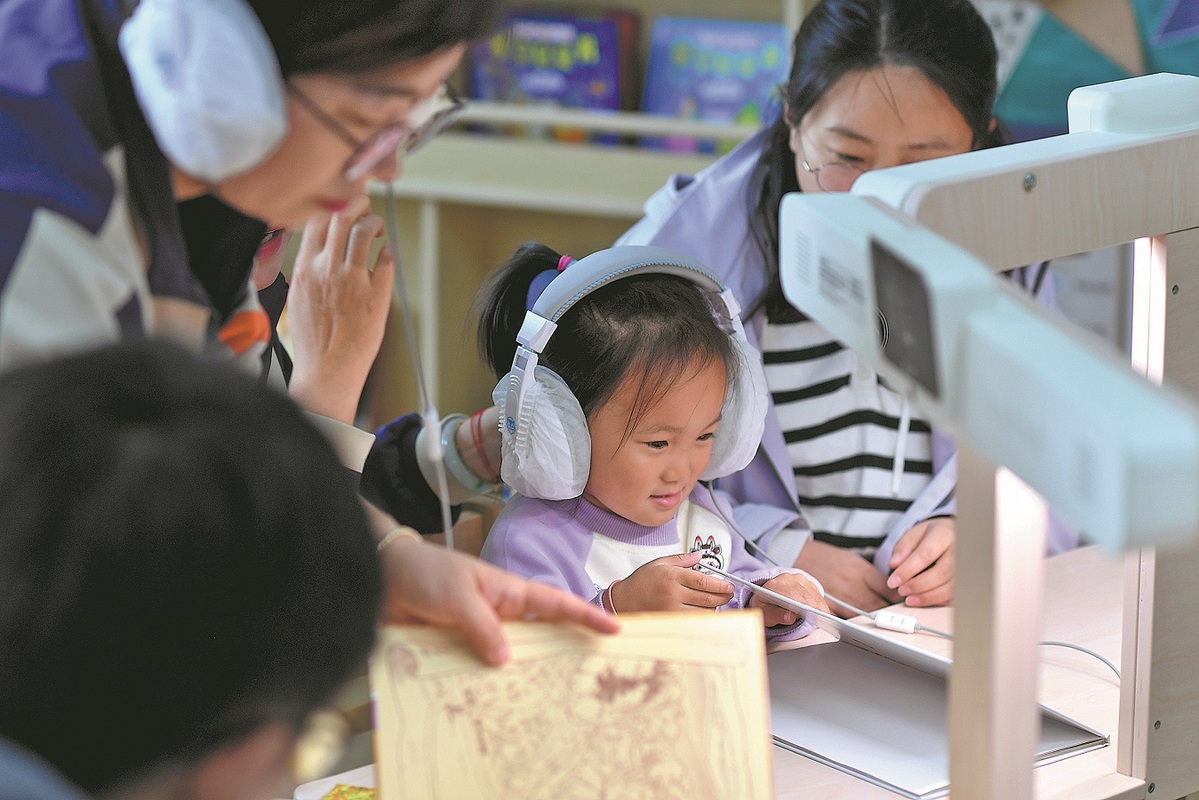
Children and parents try a smart reading device at a kindergarten in Qingdao, Shandong province, in April. WANG HAIBIN/FOR CHINA DAILY
Imagination haven
In Xi'an, Shaanxi province, Li Ge found that AI offered her 6-year-old son a partner with hyper-specific interests.
The boy uses an AI chatbot daily to orchestrate complex imaginary battles based on his favorite video game, Plants vs Zombies.
"I just can't match it. I don't know the games well and, honestly, I'm not interested. But AI understands all the terminology," Li said.
The boy physically builds forts with pillows and toys, then tells AI that zombies are attacking.
The AI responds with detailed advice: "Make sure you have enough food in your fortress. The enemy is approaching. I'm on my way. Don't worry." For up to an hour a day, the boy is entirely absorbed, freeing up his parents.
The boy has also begun designing simple games with AI tools. Inspired by the silkworms he keeps at home, he made a feeding and life-cycle game. Players drop mulberry leaves, and the silkworm grows, gains energy and health points, and eventually progresses through its developmental stages. It even requires the player to clean up droppings.
"He hated it when the AI just drew a flat oval shape with dots. He wanted a real, 3D silkworm. Each model produced a different result. He loves anything that visibly changes. He doesn't like fish, because they stay the same," Li said.
The mother said the interactions have improved her son's communication skills. When AI misunderstands, he must rephrase and clarify his intent, which sharpens his precision. He also picks up new vocabulary, as AI tends to respond at a level slightly above his own, which is advanced enough to stretch him, but never too difficult.
The AI offers strong emotional support. "He feels like the leader of his own world, with everything revolving around his decisions," the mother said. This worried her at first. But her son leads a normal social life at kindergarten and happily plays with friends in the neighborhood. Those play dates require compromise and following rules. His time with AI, she realized, serves a different need.
"He needs a space where he doesn't have to accommodate anyone else, where he can completely release and direct everything. For him, talking to AI is relaxing," Li said.
As AI tools become permanent fixtures in household life, regulators and developers face growing pressure to adapt. Legal experts like Zhao argue that platforms must be legally mandated to provide dedicated "minor modes" that curb sycophantic tendencies and enforce healthier boundaries.
For now, parents are inventing their own rules on the fly — treating AI not as a full replacement for human parenting, but as an imperfect assistant.
"I guess the main thing I can learn from the AI is its patience — and how to actually get my child to listen to what I'm saying," said Zhu in Hangzhou.
You May Like
-
Chinese AI models gain global users
InKunming 2026-07-15 -
Xinhua Headlines: Turning pages into journeys: literature-in...
Amid Beijing's wealth of historic landmarks, an unlikely attraction has captured the imagination of young visitors -- the "ocean" in the Temple of Earth.
InKunming 2026-07-13 -
China lodges representations against Japan's words, deeds on...
InKunming 2026-07-13 -
China's NEV momentum rewrites global auto playbook
InKunming 2026-07-10 -
How young is too young for AI?
InKunming 2026-07-10 -
Economic Watch: China intensifies digital push in energy sec...
InKunming 2026-07-10 -
Economic Watch: China's NEV momentum rewrites global auto pl...
InKunming 2026-07-10 -
Update: China aims to boost consumption, jobs via retail sec...
InKunming 2026-07-10 -
China to accelerate innovative development of retail industr...
Chinese authorities have issued a guideline to accelerate the innovative development of the retail industry, aiming to establish a modern retail system and cult...
InKunming 2026-07-09 -
Xi calls for advancing Chinese modernization through sci-tec...
Chinese President Xi Jinping on Wednesday called for accelerated efforts to achieve high-level self-reliance and strength in science and technology, and lever...
InKunming 2026-07-09