Asia-Pacific Community: In Singapore, a film about migration reopens family memories
Source: Xinhua | 2026-06-18 | Editor:Diana
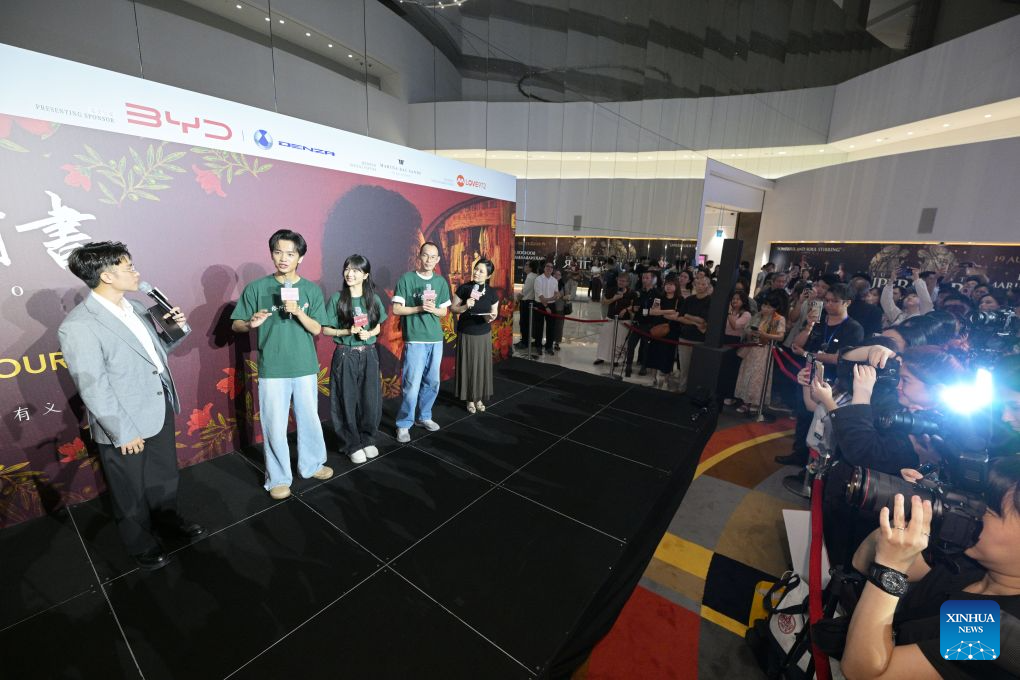
Chinese director Lan Hongchun (4th L), actors Li Sitong (3rd L) and Wang Yantong (2nd L) attend the premiere of the Chinese film Dear You in Singapore on June 17, 2026. (Xinhua/Then Chih Wey)
An hour before the lights dimmed for the Singapore premiere of Dear You on Wednesday, the audience was already gathering.
Some posed for photographs with the film's poster. Some carefully filmed every detail of the lobby for social media. Even the complimentary tissue packets arranged by the organizers became part of the atmosphere. Veteran distributors knew why: many audience members would be in tears before the credits rolled.
For much of the audience, Dear You, which opened in Singapore on Thursday following its premiere, is not simply another Chinese film. It is a story about their grandparents.
"My grandfather also came from China," said Ang, 73, as he waited outside the theater. "I hope watching this film can bring back some memories."
Those memories stretched well beyond one family.
Between the 19th and early 20th centuries, millions of Chinese left the country's southern coast for Southeast Asia in what historians now call the Nanyang migration. Many eventually settled across Singapore, Malaysia, Indonesia and other parts of the region, forming part of today's overseas Chinese communities.
Ang's grandfather came from Fujian on China's southeastern coast. His grandmother came from Chaozhou in Guangdong's Chaoshan region, one of the major origins of the Nanyang migration, and where the story of the film starts.
Rather than telling the story through sweeping historical events, the film focuses on one ordinary family. A husband leaves home to seek work overseas, while his wife stays in her hometown. Letters are sent across the sea to keep the family bond, even after he dies and she becomes a grandmother.
That intimacy, audiences here said, was precisely what makes the film feel authentic.
"I grew up hearing stories about that generation," said Clara Cheo, chief executive officer of Golden Village, which is distributing the film in Singapore together with Clover Films.
"My father-in-law came from Chaoshan," she said. "Everything in the film -- the hardship, the sacrifices -- felt familiar."
Cheo still speaks Teochew, a language widely used in the Chaoshan region, although she smiled as she compared the Teochew spoken in Singapore with the accents in the film.
"I couldn't understand every word spoken by the male lead," she laughed. "But when the grandmother spoke, it sounded very close to the Teochew we grew up speaking."
In the film, the husband lives in cramped quarters in Southeast Asia, working long hours as a rickshaw puller and later as a sailor. Cheo said the portrayal reflects what many early migrants endured. "It really shows what our ancestors went through when they first came here," she said. "It makes you remember how much they sacrificed."
Another distributor, Clover Films' Managing Director Lim Teck, said he was still thinking about the film long after watching it.
"I don't know why it is so powerful," he told Xinhua. "It doesn't rely on spectacle or a big budget, but it captures human emotion in such a precise and delicate way."
For him, the film works because of its attention to relationships -- between family members, lovers, friends, and people bound simply by shared origins.
"I think it will move audiences everywhere, especially in Singapore," he said. "That is more powerful than anything else."
He pointed in particular to the film's emotional turning point, a single missing letter.
Written by the husband in Southeast Asia, it never reaches home intact as the courier is caught in a storm. The misunderstanding that follows shapes the lives of the family for decades.
To modern audiences, it may seem like fiction, but it reflects a communication network that once connected millions of overseas Chinese families.
Known as qiaopi, these letters usually carried not only news from abroad but also money earned overseas. Long before international banking or digital transfers, families depended on them for both financial support and emotional reassurance.
Their delivery relied on an extraordinary network of trust, said Derek Goh, president of the Teochew Poit Ip Huay Kuan, a clan association for Singapore's Teochew community founded in 1929.
Couriers known as shuike -- literally "water guests" -- traveled regularly between Southeast Asia and southern China carrying letters and remittances. As migration expanded, Chinese merchants also joined the network, and some retail businesses became involved in the qiaopi and remittance trade as well, much as depicted in the film.
"If you entrusted them with your money, your family would receive it," said Goh.
He hopes younger generations will leave the cinema understanding not only the story on screen, but also the history behind it.

People take photos of the billboards of the Chinese film Dear You during its premiere in Singapore on June 17, 2026. (Xinhua/Then Chih Wey)

People take photos with a billboard of the Chinese film Dear You during its premiere in Singapore on June 17, 2026. (Xinhua/Then Chih Wey)
You May Like
-
Chinese PLA aerobatic team performs during 10th Singapore Ai...
Aircraft of the Bayi Aerobatic Team of the Chinese People's Liberation Army (PLA) Air Force perform during the 10th Singapore Airshow in Singapore, Feb. 4, 2026...
InKunming 2026-02-05 -
Chinese C919 passenger plane debuts Singapore Airshow
Chinese passenger jet C919 debuted in a flight demonstration at the Singapore Airshow, which kicked off on Tuesday.
InKunming 2024-02-22