Galloping through Chinese history
Source: China Daily | 2026-05-27 | Editor:Flynn

Visitors admire Li Gonglin's scroll at the ongoing exhibition Divine Steeds: The World of Horses in the Palace Museum's Painting and Calligraphy Collections at the Palace Museum in Beijing. [Photo by Jiang Dong/China Daily]
In the ancient Chinese classic Journey to the West, the Monkey King is appointed bimawen, a title that sounds like "avoiding horse plague" in Chinese and is associated with caring for horses in the heavenly court. Though often treated as comic, the role reflects a genuine ancient belief: keeping monkeys in stables could protect horses from disease.
The custom appears repeatedly in historical texts and ancient brick reliefs. Yet in surviving paintings, it is known from only one work — a massive scroll portraying dozens of grooms tending nearly 100 horses. The painting is now on display at the new exhibition Divine Steeds: The World of Horses in the Palace Museum's Painting and Calligraphy Collections at the Palace Museum, the former imperial palace that served Chinese emperors from 1420 to 1911.
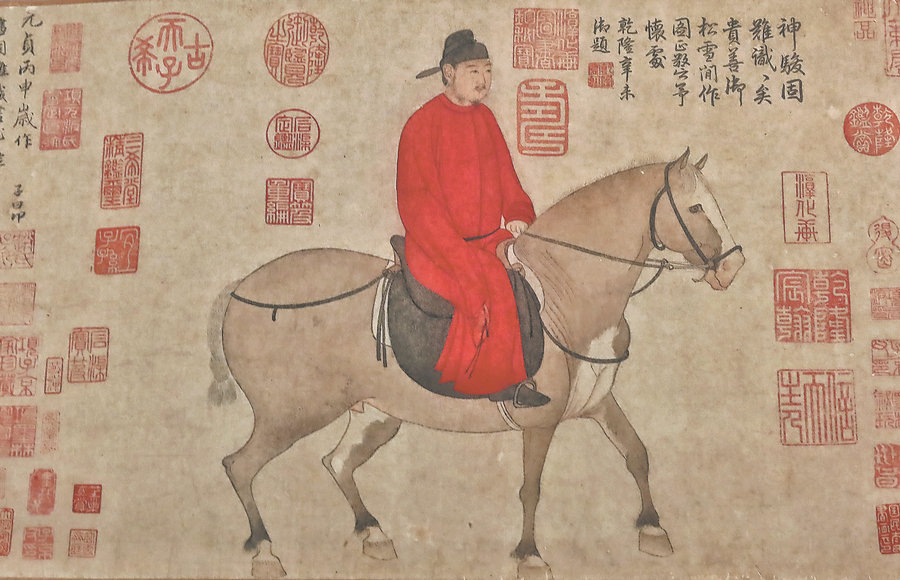
A painting on display shows a man riding a horse by Yuan Dynasty (1271-1368) artist Zhao Mengfu. [Photo by Jiang Dong/China Daily]
Running through June 21, the exhibition brings together 55 horse-themed paintings and calligraphy works from the museum's collection. Among them, 28 are being shown publicly for the first time, while 20 are classified as China's highest-grade cultural relics.
According to Zeng Jun, head of the museum's Department of Paintings and Calligraphy, horse paintings occupy a special place in the history of Chinese art because they reflect not only artistic achievement, but also broader historical and spiritual ideals.
"From the simplicity and vigor of the Qin (221-206 BC) and Han (206 BC-AD 220) dynasties, to the fully developed techniques of Tang (618-907) and Song (960-1279) paintings, and through the inheritance of the Yuan (1271-1368), Ming (1368-1644), and Qing (1644-1911) dynasties, horse painting has remained closely connected to the evolution of the times, the spirit of the nation, and the aspirations of the literati," she says.
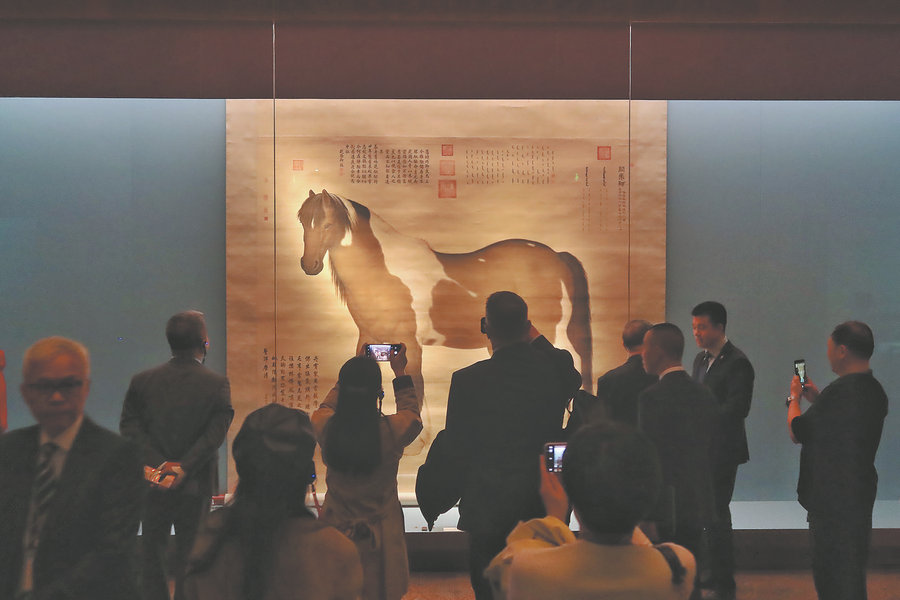
People view a monumental horse painting by Italian Jesuit missionary Giuseppe Castiglione, created during the Qing Dynasty (1644-1911). [Photo by Jiang Dong/China Daily]
For curator Ma Shunping, the exhibition also tells the story of the enduring bond between Chinese people and horses. "Chinese people began domesticating horses in the late Neolithic era," Ma says. "Since then, horses have remained deeply connected to daily life and social development."
From the Qin and Han dynasties, innovations such as saddles and stirrups transformed transportation and mobility. Horse riding gradually replaced carriage travel and spread beyond the aristocracy into broader society, Ma says.
"Officials and scholars traveled on horseback for leisure and duty, while merchants journeyed for their livelihood," Ma says. "With horses beside them, people crossed mountains and rivers and left their footprints across the country."
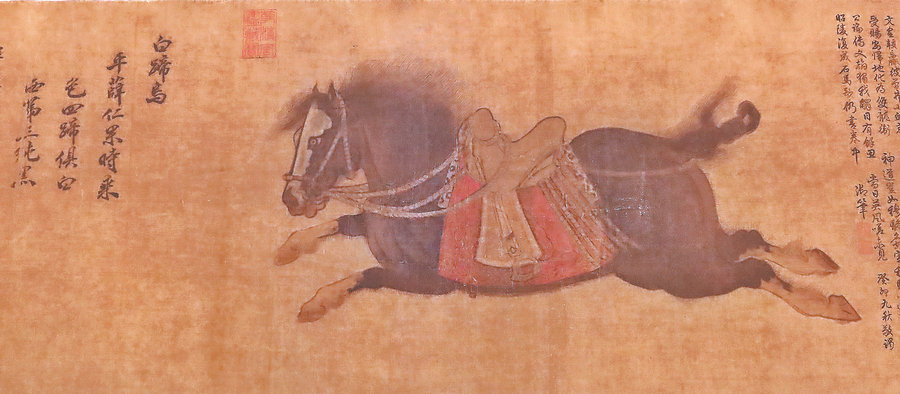
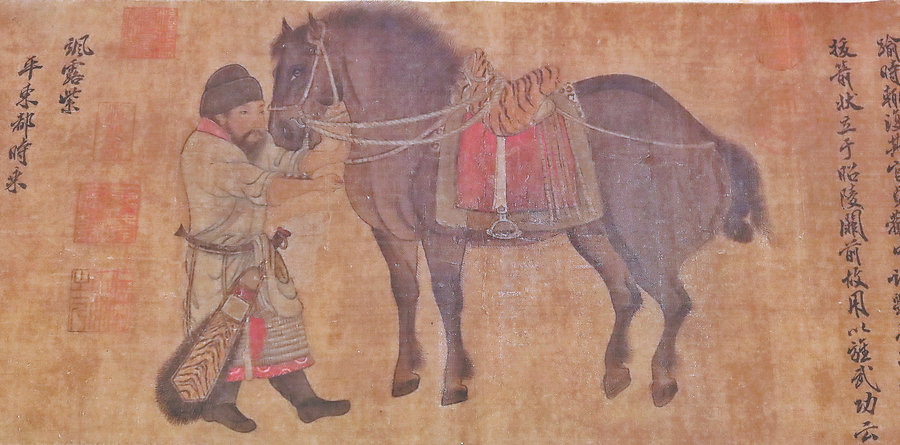
Another painting by Zhao Lin portrays one of Tang emperor Li Shimin's six favored warhorses. [Photo by Jiang Dong/China Daily]
That close relationship appears throughout the exhibition in paintings depicting seasonal journeys.
One featured work by Ming Dynasty painter Qiu Ying portrays official Tang Yi's imagined return to his hometown in today's Shanxi province after years serving in Suzhou, Jiangsu province.
Unable to return home for a long period, Tang became increasingly homesick. Sympathetic local scholars invited Qiu to paint the homecoming he longed for.
In the painting, Tang rides beside the Fenhe River in a bright red official robe. Ma describes Qiu's technique as both meticulous and fluid, with a refined composition and vivid yet restrained colors that create a peaceful atmosphere.
What makes the work particularly intriguing is that Qiu had never visited Tang's hometown. "Some of the scenery was imagined," Ma explains. "That makes this painting a fascinating blend of reality and imagination."
Beyond personal life, horses also played a decisive role in state power and military preparedness. Maintaining cavalry forces required enormous resources, making horse breeding a major national undertaking in many dynasties.
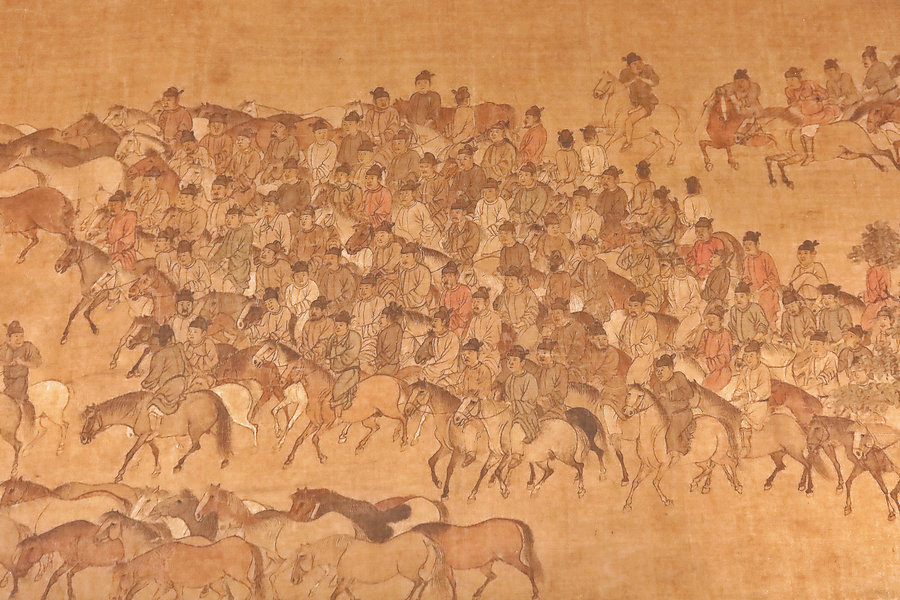
Part of the scroll on display by Song Dynasty (960-1279) painter Li Gonglin, which was created as an interpretation of an earlier work by Tang Dynasty (618-907) artist Wei Yan depicting an imperial horse pasture of the Tang era. [Photo by Jiang Dong/China Daily]
The exhibition's centerpiece is an authentic scroll painted by Song Dynasty painter Li Gonglin, created as an interpretation of an earlier work by Tang Dynasty painter Wei Yan under the auspices of Emperor Shenzong of the Song Dynasty.
"Wei was a famous horse painter in the Tang era. His authentic work was kept in the Northern Song (960-1127) court. Therefore, the emperor ordered Li, regarded as one of the greatest painters of the Song era, to re-create it," says Ma.
But such imitation was not a mere copy. While Li retained the original subject of official horse pastures containing 1,247 horses, he transformed the artistic style entirely through his own aesthetic vision.
"Unlike the powerful and imposing horses common in Tang painting, Li's horses appear restrained, elegant and introspective, qualities that reflected the Song Dynasty's artistic taste," says Ma.
"The enormous scroll balances hundreds of human and animal figures without descending into visual chaos. The composition remains orderly and harmonious despite its scale," he adds.
"The painter seemed completely immersed in the world of horses," Ma says. "Each horse and each person carries a distinct expression and personality. From the painting, it's easy to see why Li deserved the title of one of the greatest artists in Song painting, as he showed the pinnacle of horse painting in ancient China."
People view a monumental horse painting by Italian Jesuit missionary Giuseppe Castiglione, created during the Qing Dynasty (1644-1911). [Photo by Jiang Dong/China Daily]
Ma says that although Li was already famous in the Northern Song Dynasty, he was known for his quiet and introverted nature. Historical accounts describe him as spending long periods observing horses in imperial gardens, sometimes becoming so absorbed that he failed to notice people calling his name.
"That intense observation gave his horses extraordinary vitality," Ma says.
The work also reveals the scale of official horse breeding in ancient China. Historical records suggest that during the height of the Tang Dynasty, the government maintained around 700,000 horses. On average, one groom cared for about 10 animals, meaning tens of thousands of people were involved in horse rearing across the dynasty.
The exhibition also examines horses as symbols of military achievement and imperial legitimacy. Among the highlights are six paintings depicting the favorite warhorses of Tang emperor Li Shimin.
Historical records state that six horses helped save Li during the campaigns that unified the Tang Dynasty. To honor them, he commissioned stone carvings of the animals for his mausoleum in present-day Xianyang in Shaanxi province. The paintings displayed in the exhibition were produced centuries later by Jin Dynasty (1115-1234) court painter Zhao Lin and are the only surviving works attributed to him.
"The basic style of the paintings follows the carvings, but the painter introduced his own artistic interpretation by rendering the horses with softer, fuller forms that make them appear more animated and lifelike," says Ma.
"These paintings show the reverence ancient Chinese society held for horses. Because of their heroics on the battlefield, horses were memorialized in stone, celebrated in literature, and immortalized in art," he adds.
The exhibition also explores the spiritual qualities embodied by horses in ancient China and their rich cultural connotations.
For example, in classical Chinese thought, exceptional people were often compared to fine steeds. Just as a great horse requires a knowledgeable judge to recognize its value, talented individuals also depend on wise leaders who can identify and nurture ability.
Several paintings in the exhibition reflect this metaphor directly.
One portrays a neglected horse filled with frustration at never being appreciated. Another depicts a thin, exhausted horse that is nevertheless recognized by an expert as a rare and valuable steed. Also on display is a calligraphy work by Qing emperor Qianlong encouraging one of his officials to become a perceptive judge of talent and help discover capable individuals for the state.
"Over time, the relationship between the fine horse and the discerning judge became deeply embedded in Chinese culture," Ma says. "It evolved into a metaphor that encouraged rulers to remain open-minded and recognize exceptional talent."
You May Like
-
Letter from China: Ordinary luxury of "Becoming Chinese"
This month, my cousin touched down in Shanghai after a decade in Vancouver. Her first moves weren't touristy; they were practical. She booked an MRI for back ...
InKunming 2026-04-29 -
Diverse modes of business contribute to nighttime economic v...
Tourists visit the Orange Isle scenic area in Changsha, central China's Hunan Province, April 25, 2026.
InKunming 2026-04-29 -
Sealing the deal: Artisans offer visitors a signature souven...
While China is famous for its beautiful calligraphy, important documents and letters were for centuries signed not with a handwritten name, but with a carved se...
InKunming 2026-04-28 -
China Focus: Brick-and-mortar bookstores turn to digital too...
China's brick-and-mortar bookshops, once under pressure from the growth of online reading and e-commerce, are now adopting digital tools in an effort to recon...
InKunming 2026-04-28 -
Children shine at Chinese language recitation competition in...
Children gathered at the China Cultural Center in Yangon on Sunday for the final round of the 9th Chinese Language recitation competition, showcasing their lang...
InKunming 2026-04-27 -
Xinhua Headlines: China brings classics to life to attract y...
China has made nationwide reading a national strategy. To enhance institutional support, a regulation on promoting nationwide reading, which took effect in Febr...
InKunming 2026-04-27 -
Young fighters take center stage as Beijing tournament break...
The 2026 Youth Martial Arts Tournament for Beijing's Xicheng and Mentougou districts was held in Beijing over the weekend, marking a new milestone in its decade...
InKunming 2026-04-23 -
Collected works on Chinese bronze artifacts lost overseas pu...
A sixty-volume compendium documenting more than 23,000 ancient Chinese bronze artifacts lost abroad was published on Sunday by Shanghai Classics Publishing Hous...
InKunming 2026-04-21 -
From Long-Stay Living to Lifestyle Entrepreneurship: Kunming...
Stroll along the Dianchi Greenway to watch the floating bridge at Caohai open and close, and the sun set over Dianchi Lake glow like molten gold; wander around ...
InKunming 2026-04-10 -
Students embrace first spring break around Qingming Festival
On the first day of the spring break, eight-year-old Wang Siyuan could hardly contain his excitement as he ran into a science museum in the eastern Chinese city...
InKunming 2026-04-07