CATL advances dual battery tech
Source: China Daily | 2026-04-23 | Editor:Flynn
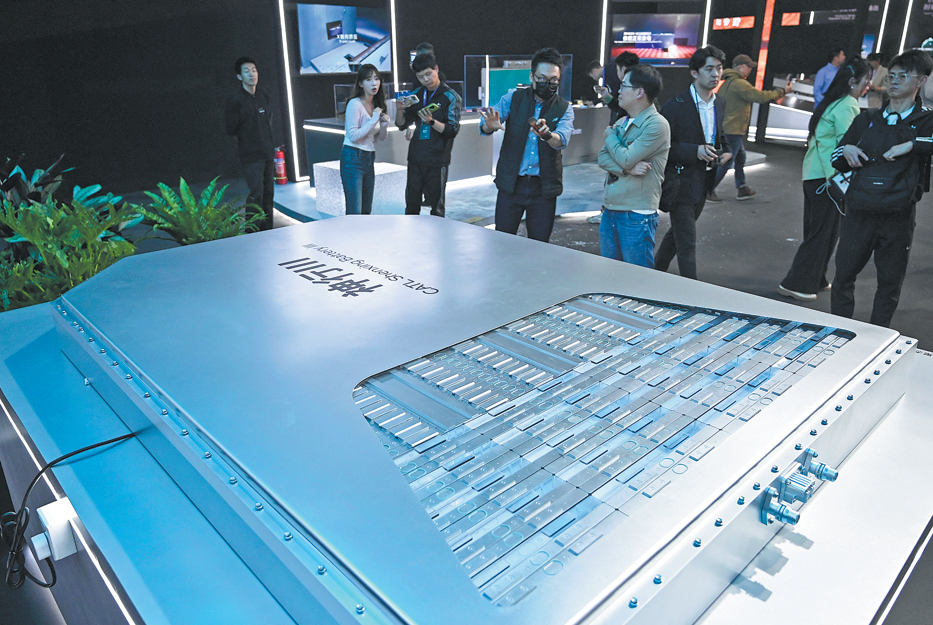
Visitors check out a battery during the CATL Tech Day event ahead of the 2026 Beijing Auto Show in Beijing on Tuesday. WANG ZHAO/AFP
Contemporary Amperex Technology Co Ltd, the world's largest electric vehicle battery maker, said on Tuesday that its sodium-ion batteries will enter large-scale production within the year, marking a potential shift in the global race to secure cheaper and more resilient energy storage.
Speaking at a company press conference, Wu Kai, CATL's chief scientist, said that key manufacturing bottlenecks of its sodium-ion batteries had been resolved, clearing the path for commercialization of a technology long viewed as a backup to lithium-ion batteries.
"Sodium-ion batteries are ready for scale," Wu said, positioning them as both a complement and, in some scenarios, an alternative to lithium-based systems.
CATL is also advancing next-generation battery technologies at the high-performance end.
Gao Huan, also a chief scientist at CATL, said the company is in talks with several Chinese premium automakers on condensed-state batteries, an emerging category related to solid-state designs. Prototype development is progressing smoothly, Gao said.
Originally unveiled in 2023 for electric aviation, CATL's condensed-state battery boasts an energy density of up to 500 watt-hours per kilogram. The technology has already completed a maiden flight in a 4-ton-class commercial aircraft and is set for further validation in larger 8-ton-class platforms.
The company now aims to adapt such aviation-grade technology for passenger vehicles. A planned Qilin condensed-state battery would deliver 350 Wh/kg at the cell level, potentially extending EV range while improving safety.
The announcement came as concerns grow over lithium supply constraints and geopolitical competition around the metal, which underpins the EV boom.
CATL's timeline signals that competition in battery chemistry is entering a new phase, as automakers and governments seek both technological edges and supply chain resilience in the transition to electrification, industry experts said.
Sodium-ion batteries use sodium, an element abundant in seawater and the Earth's crust, rather than lithium, which is comparatively scarce and concentrated in a handful of countries. Sodium-ion batteries are unlikely to displace lithium-ion systems outright in the near term, particularly in high-performance vehicles where energy density remains critical.
China has identified sodium-ion technology as a strategic priority and has singled out next-generation energy storage — including sodium-based systems — for accelerated development.
Hu Yongsheng, a researcher at the Chinese Academy of Sciences' Institute of Physics, said, "Sodium offers a more secure and scalable resource base, which is of significance as a backup solution to safeguard energy security."
It could gain traction in entry-level EVs, grid storage and cold-weather applications, where its stability and cost advantages are more pronounced, Hu said.
With production lines largely compatible between sodium-ion and lithium-ion technologies, manufacturers can switch or diversify output with limited retooling — an advantage that could accelerate adoption, Hu added.
chengyu@chinadaily.com.cn
You May Like
-
Xinhua Commentary: China's first national conference on serv...
The just-concluded national conference on the service sector in Beijing has sent a clear signal that China will promote a high-quality service sector driven by ...
InKunming 2026-04-10 -
14th Energy Storage Int'l Conference and Expo held in Beijin...
14th Energy Storage Int'l Conference and Expo held in Beijing
InKunming 2026-04-03 -
Economic Watch: Green transition a new engine for China's hi...
InKunming 2026-04-01 -
AI transforms China's conservation efforts
Artificial intelligence is reshaping China's environmental protection efforts, with pilot projects showing a 90 percent cut in labor costs for biodiversity moni...
InKunming 2026-03-31 -
Deploying AI as new engine of economic growth
During an informal media scrum outside the main hall of the two sessions, my first ever, one moment stayed with me.
InKunming 2026-03-30 -
China's technological advances critical to greater humanitar...
InKunming 2026-03-30 -
Pump pain, plug gain: Oil shock fuels demand for Chinese NEV...
The sting of expensive petroleum is doing what years of policymakers struggled to achieve: pushing drivers toward electric cars.
InKunming 2026-03-26 -
China offers enabling climate for global firms
Amid global economic uncertainty, China's combination of continuing openness, massive market scale and innovation capacity is offering multinational companies a...
InKunming 2026-03-24 -
China raises three proposals to boost energy cooperation in ...
China has put forward three proposals regarding high-quality universal energy access, artificial intelligence (AI) plus energy and coordinated energy governan...
InKunming 2026-03-20 -
Xinhua Headlines: 15th Five-Year Plan to guarantee steady, l...
China is embarking on a new journey to advance Chinese modernization as its latest grand blueprint unfolds. The outline of the 15th Five-Year Plan (2026-2030) f...
InKunming 2026-03-19