Update: China's care subsidy eases burden on disabled seniors, drives service demand
Source: Xinhua | 2026-03-25 | Editor:Doe
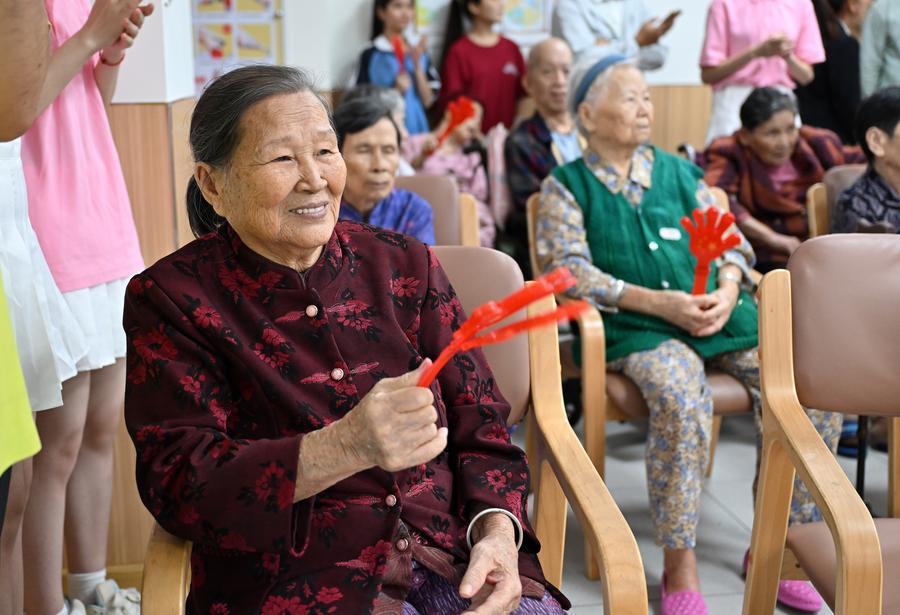
Some elderly people watch performances from volunteers at an elderly care service center in Qiongshan District of Haikou, south China's Hainan Province, Oct. 29, 2025. (Xinhua/Guo Cheng)
Inside a community elderly care center in Beijing, Mr. Wang, an older adult living with severe functional disabilities, was undergoing rehabilitation. Thanks to a nationwide subsidy program, community-based care is no longer financially burdensome for him.
"In the past, I seldom came because the cost was too high. But now with the subsidy, I attend rehabilitation every week. My health has improved a lot, and the staff here are very attentive," Wang said.
Following the implementation of the subsidy policy, there has been a marked increase in visits by seniors with limited self-care ability, according to the center's manager. "The initiative has not only alleviated the financial pressure on families, but also enabled more targeted service delivery."
The program, which has provided electronic vouchers for elderly care services to seniors with moderate to severe functional disabilities since Jan. 1, has benefited more than 1.05 million people, the Ministry of Civil Affairs has noted.
So far, it has facilitated the use of over three million vouchers in China, with a total verified value of 2.35 billion yuan (about 341 million U.S. dollars), driving an estimated 11.5 billion yuan in elderly care consumption.
The vouchers, released monthly, can be used to cover a wide range of services, such as meal assistance, bathing assistance, housekeeping assistance, mobility support, emergency aid, medical assistance, rehabilitation nursing and daytime care.
Seniors or their designated representatives can apply for the subsidy through an official app. Those assessed as eligible will receive consumption vouchers worth up to 800 yuan per month, which can be used to offset part of the cost of community and institutional elderly care services.
"Unlike previous programs that distinguished recipients based on economic status, this policy represents a large-scale welfare initiative targeting seniors with moderate to severe disabilities," said Sun Wencan, a senior official of the ministry.
The assessment, which focuses on applicants' self-care capability, mobility, mental state, perception, and social participation, must be done in accordance with national standards, the official said. "The evaluation results must be reliable and stand up to scrutiny."
Du Peng, dean of the School of Population and Health and director of the Institute of Gerontology at Renmin University of China, described the policy as an "innovative and landmark" shift in the development of the country's elderly care services.
He noted that the program focuses on three key aspects, namely the population with the most pressing needs, scenarios of elderly care consumption, and standardized third-party assessment mechanisms.
"It injects a stable stream of targeted purchasing power into the market," Du said. "This not only directly eases the burden on families but, more importantly, drives supply-side improvements and expansion via demand-side reform. It effectively incentivizes the allocation of resources toward professional elderly care services."
Indeed, this approach helps foster a healthier elderly care market, ensuring that public funds translate directly into services while preventing misappropriation of subsidies.
At a senior care center in Zhoushan, east China's Zhejiang Province, demand has risen noticeably since the introduction of these subsidies, revealed Liu Yangyang, who is head of the facility.
Liu said inquiries have increased by approximately 35 percent, with around 10 percent of newly occupied beds taken by seniors attracted thanks to the vouchers.
The program aligns with China's broader policy goals as the country adapts to its aging population. Official statistics reveal that China's population aged 60 and above had surpassed 310 million in 2024 and is forecast to exceed 400 million by 2035.
The country's development blueprint for the next five years shows that it will respond actively to population aging by rolling out insurance schemes for long-term care, improving the care system for seniors with functional impairments, and expanding rehabilitation services and hospice care.
Liu Yiying, a 63-year-old disabled senior in Yunyang County of Chongqing Municipality in southwest China, has benefited from the combined support of long-term care insurance and consumption subsidies, with her 3,600 yuan monthly care costs now reduced to only 1,000 yuan after reimbursements and subsidies.
This alignment with existing social security programs has strengthened China's multi-tiered elderly care system, making its safety net both more comprehensive and more secure, experts say.
You May Like
-
Foreign business leaders reaffirm confidence in China as sou...
Business leaders from nearly 100 multinationals around the world that gathered in Beijing for the China Development Forum (CDF) 2026 have sent a clear message...
InKunming 2026-03-24 -
Xi urges efforts to build Xiong'an New Area into innovation ...
Xi Jinping, general secretary of the Communist Party of China (CPC) Central Committee, on Monday called for efforts to build the Xiong'an New Area in north Ch...
InKunming 2026-03-24 -
Picturesque race route fuels Wuxi's economy
The city of Wuxi, Jiangsu province, was abuzz on Sunday as 35,000 runners took to the streets for its annual marathon, drawing record participation and turning ...
InKunming 2026-03-23 -
More than a movie: stepping inside a film
On an early spring afternoon in Beijing's 798 Art District, French tourist Olivier Dumont put on a virtual reality headset. Within seconds, he was "transported"...
InKunming 2026-03-23 -
Lessons for Europe from China's growth
China's 15th Five-Year Plan (2026-30) is more than an economic policy document. It is a vision of an economy that is more innovative, more technologically advan...
InKunming 2026-03-23 -
Forum highlights opening-up, innovation
Beijing has called for opening-up and technological progress to drive new market growth, in order to enable the world economy to emerge from difficulties and mo...
InKunming 2026-03-23 -
U.S. enterprises are welcome to seize development opportunit...
Enterprises from the United States are welcome to seize the development opportunities in China and deepen mutually beneficial cooperation with the country, Chin...
InKunming 2026-03-23 -
Intelligent welding device debuts at railway construction si...
A staff member operates a new energy flash butt welder for multiple scenarios at the construction site of the Hangzhou-Deqing Suburban Railway, in east China's ...
InKunming 2026-03-23 -
Chinese premier stresses opportunities, fair competition, de...
Chinese Premier Li Qiang has stressed creating new market opportunities through openness and technological progress, and upholding global market order through h...
InKunming 2026-03-23 -
China's second homegrown large cruise ship undocked in Shang...
China's second domestically built large cruise ship was undocked in Shanghai on Friday, moving a step closer to trial voyages and final delivery as the country ...
InKunming 2026-03-20