Harvesting sweetness with intelligence in south China
Source: english.news.cn | 2026-03-24 | Editor:Doe
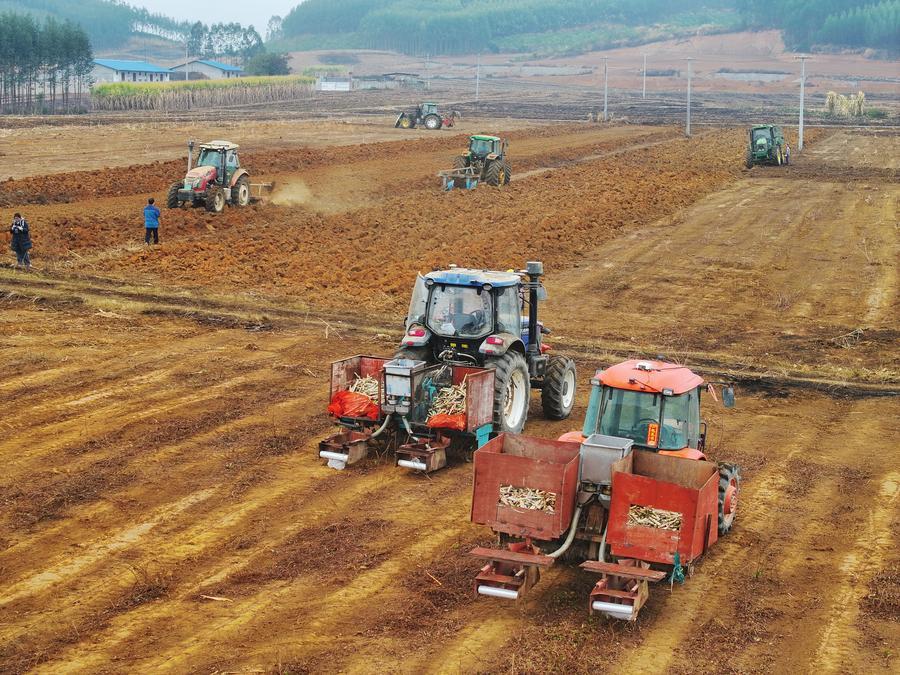
An aerial drone photo taken on Feb. 19, 2025 shows farmers operating agricultural machines at a sugarcane base in Laibin City, south China's Guangxi Zhuang Autonomous Region. (Xinhua/Zhou Hua)
A digital monitoring system is now delivering smart, timely alerts across sugarcane fields in Laibin, south China's Guangxi Zhuang Autonomous Region.
"Your sugarcane is growing well. It is recommended to stop irrigation to keep the fields moderately dry and boost sugar accumulation," said one of its automated reminders.
In addition to offering such tailored guidance, this user-friendly system can also identify pests and diseases in the sugarcane fields and assist in making data-driven production decisions.
At a national modern agricultural industrial park, sensors buried in the sugarcane fields monitor soil pH, moisture and nutrients all day long. "Through digital soil surveys, we can apply fertilizers according to real demand," said Wang Zeping, director of the digital agriculture research office at the Guangxi Academy of Agricultural Sciences.
"In some sugarcane fields, the amount of fertilizer used per mu (about 667 square meters) has been reduced by 15 percent, while the yield has increased by 200 kilograms," said Wang.
As a national key sugarcane production base, Laibin accounts for one-sixth of Guangxi's sugar output and one-tenth of China's total. The city has rolled out sweeping innovations across its entire sugar industry chain, powered by artificial intelligence (AI). These changes target longstanding bottlenecks, such as over-reliance on traditional farming experience, low efficiency in pest control, and limited processing capacity.
Laibin has now established a complete integrated industrial chain covering sugarcane sowing, field management, harvesting and post-harvest utilization.
During planting, farmers are assisted by the BeiDou Navigation Satellite System to ensure precise row spacing, down to the centimeter. When it comes to field management, meanwhile, agricultural drones can complete the spraying of pesticides over dozens of mu of sugarcane fields in just one hour.
Additionally, the integrated smart system for drip irrigation can be easily operated via a few taps on a mobile phone.
The entire sugar-making process is also visualized on large display screens. At a local sugar-making enterprise in Laibin, staff can now monitor the whole production flow in real time from the control room, with the intelligent control system precisely regulating the temperature, concentration and duration of sugar boiling.
Since the company introduced the full-process intelligent control system, the sugar recovery rate from boiling and refining has risen from 88.75 percent to 91.75 percent, significantly boosting production efficiency.
With such in-depth application of AI in the sugarcane deep processing industry chain, 13 sugar enterprises in Laibin have managed to complete equipment upgrades and technological innovations, developing over 30 types of functional sugar products, according to Mo Renzhong, deputy director of the sugar industry development bureau of Laibin.
In 2025, the output value of sugar processing and the comprehensive utilization of the entire industry chain in Laibin had exceeded 16 billion yuan (about 2.3 billion U.S. dollars), said Mo.
China's latest five-year blueprint, adopted earlier this month, emphasizes strengthening research and development in key core technologies and fostering leading enterprises in the agricultural sector.
The "No. 1 central document" for 2026, which China unveiled in February, also outlines plans to advance agricultural and rural modernization and to promote all-around rural revitalization. It pledged to expand application scenarios for advanced technologies such as drones, the Internet of Things and robots.
According to official data released in January, sci-tech advancements have contributed more than 64 percent to agricultural output in China. The total number of agricultural drones in use had surpassed 300,000 sets, while the annual operational area covered by these drones had reached 460 million mu.
"At present, rapidly developing information and AI technologies are deeply integrating with agricultural production in China," said Xia Xianfei, who is a researcher at the Nanjing Institute of Agricultural Mechanization, Ministry of Agriculture and Rural Affairs. Intelligent agricultural equipment is becoming an increasingly handy "new farming tool," Xia added.
Enterprises in Laibin are also striving for further breakthroughs in smart agriculture and agricultural machinery, including advancing the deployment of digital monitoring systems and BeiDou-powered precision agriculture, as well as developing lightweight and compact sugarcane harvesters.
This upgrading push has significantly boosted efficiency and productivity in Laibin's sugarcane industry, while also strengthening its export capacity. Laibin is now home to a mega-scale bagasse pulp tableware production and export base, with an annual capacity of 180,000 tonnes. Around 90 percent of its eco-friendly products are exported to Europe, the United States and Japan.
AI and digital technologies are reshaping how food is produced, and China is emerging as an increasingly important hub for agricultural innovation and R&D, Syngenta Group Chief Executive Officer Jeff Rowe told Xinhua in an interview on the sidelines of the World Economic Forum Annual Meeting 2026 in January.
Over the past decade, he has witnessed steadily rising productivity, improving quality of agricultural output and faster-paced innovation in China's agricultural sector. He acknowledged that agriculture is "much more of an innovative industry than most people realize," adding that China is moving quickly to adopt new technologies and build digital solutions that can benefit farmers, consumers and the environment.
You May Like
-
U.S. enterprises are welcome to seize development opportunit...
Enterprises from the United States are welcome to seize the development opportunities in China and deepen mutually beneficial cooperation with the country, Chin...
InKunming 2026-03-23 -
China tightens integrity rules for leaders of state-owned en...
China has issued revised regulations on honest and clean conduct of leaders of state-owned enterprises (SOEs), reinforcing stricter supervision to prevent corru...
InKunming 2026-03-23 -
Chinese premier stresses opportunities, fair competition, de...
Chinese Premier Li Qiang has stressed creating new market opportunities through openness and technological progress, and upholding global market order through h...
InKunming 2026-03-23 -
Xi sends congratulatory message to 10th CELAC summit
Chinese President Xi Jinping sent a congratulatory message to the 10th summit of the Community of Latin American and Caribbean States (CELAC), which opened Sa...
InKunming 2026-03-23 -
China's second homegrown large cruise ship undocked in Shang...
China's second domestically built large cruise ship was undocked in Shanghai on Friday, moving a step closer to trial voyages and final delivery as the country ...
InKunming 2026-03-20 -
China's industrial modernization drive set to spur innovatio...
China's recently unveiled development blueprint places building a modern industrial system and consolidating the foundation of the real economy at the top of na...
InKunming 2026-03-20 -
China raises three proposals to boost energy cooperation in ...
China has put forward three proposals regarding high-quality universal energy access, artificial intelligence (AI) plus energy and coordinated energy governan...
InKunming 2026-03-20 -
Chinese FM says prolonged wars have no winners
Chinese Foreign Minister Wang Yi said on Thursday that there are no winners in the prolonged wars, and a ceasefire and an end to the hostilities are the will ...
InKunming 2026-03-20 -
China issues pilot work guideline for rural land contracts e...
China on Wednesday issued a guideline outlining arrangements for pilot work to extend rural land contracts by an additional 30 years upon the expiration of the ...
InKunming 2026-03-19 -
Xinhua Headlines: 15th Five-Year Plan to guarantee steady, l...
China is embarking on a new journey to advance Chinese modernization as its latest grand blueprint unfolds. The outline of the 15th Five-Year Plan (2026-2030) f...
InKunming 2026-03-19