Lineage woven in threads
Source: China Daily | 2026-03-06 | Editor:Doe
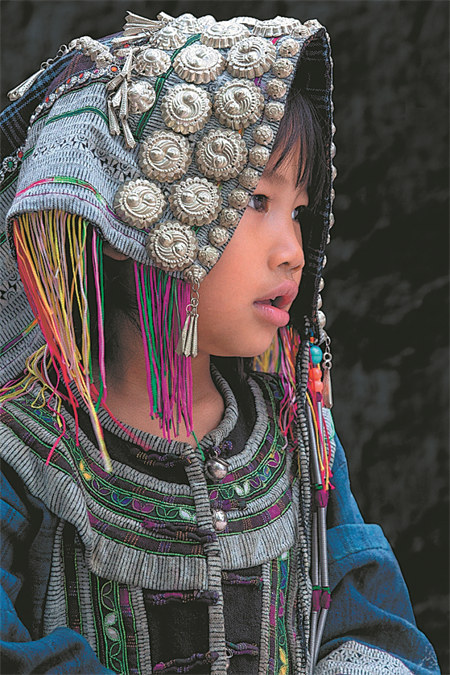
A girl from the Bailuo branch of the Yi ethnic group wears a traditional festival headdress. [Photo provided to China Daily]
More than 58 years ago, 16-year-old "educated youth" Deng Qiyao, born in Kunming, Southwest China's Yunnan province, was sent to the China-Myanmar border, a region home to many ethnic groups. It was during the "cultural revolution" (1966-76), when many people in Chinese cities dressed almost identically (mainly gray-blue, black, or army blue), in simple, military-uniform styles, with few accessories.
In Yunnan, however, Deng encountered a completely different world. Women of the Dai, Jingpo, Achang, and Derung ethnic groups wore short tops and long skirts, each with distinct styles, materials, patterns, and colors. Their garments were often close-fitting, accentuating their feminine silhouettes.
Even more surprising were the outfits worn by young women of the Hani ethnic group. They dressed in midriff-baring tops and thigh-length skirts, adorned with a dazzling variety of ornaments. Feathers, bone pins, fresh flowers and even insects could become decorations.
"They showed me that the world is not just one color, and it's simply human nature to want to make oneself look beautiful," Deng, 74-year-old anthropologist, writes in the preface of China Adorned, a book about ethnic accessories in China recently published by Yilin Press.
The decade he spent living among the many ethnic communities of Yunnan provided Deng with what he calls a folk education in anthropology — one for which he remains deeply grateful.
"The common people reminded us of basic common truths. It's simple: when you're hungry, eat; shouting slogans doesn't help. If you miss home, go to your mother. This straightforward way of living, seen in the honest lives of border communities like the Dai people, challenges the rigid and formulaic education we were used to, and brings us back to a more genuine way of life," he says.
After the "cultural revolution", Deng went to university. As one of the first university graduates after the resumption of the gaokao, or National College Entrance Examination, in 1977, Deng, a curious ruminator, chose to work at the China Academy of Social Sciences and do research on ethnic groups in Yunnan.
During a field investigation in a Miao village in central Yunnan, he once again encountered the powerful cultural significance embedded in ethnic clothing. This time, however, what struck him most was not just the visual beauty of the garments, but the profound history they carried.
He interviewed an elderly villager about the legends of the Miao ethnic group. The man pointed to a young woman's dress, saying it recorded all the deeds of their ancestors. Yet, there were no written words. Instead, the garment was covered in intricate batik and cross-stitch patterns, which Deng couldn't decipher.
The elderly man patiently explained the designs.
Some represented myths of creation that told of the origins of humans and nature. Others recounted the long migration of their ancestors from the Yellow River basin. Some depicted the origins of particular embroidery techniques. He also pointed out patterns and color combinations tied to beliefs, destiny and spiritual symbolism.
These visual narratives, combined with myths, epic songs and folklore, often corroborated each other — something Deng repeatedly observed during his fieldwork.
"Almost every ethnic group has an 'esoteric book', just as a Jingpo proverb says: 'The skirt is woven with the affairs of the world; those are the words left by the ancestors'," Deng writes in the preface.
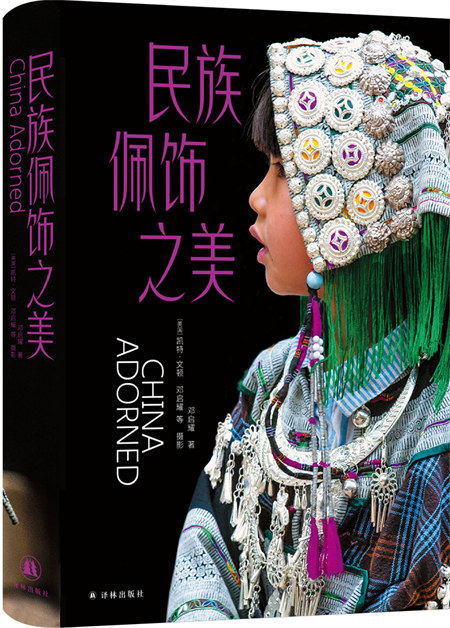
The cover of the book. [Photo provided to China Daily]
Most people are familiar with history recorded in written language and passed down through generations.
But Deng believes that another dimension of history has often been overlooked — the cultural memory recorded through images and craftsmanship rather than words. These histories may be carved in rock and wood, or woven into textiles.
"Even if many ethnic groups do not have their own written language, they preserve history through oral traditions — songs, stories and myths. Often, the stories about the patterns on their clothes align with their oral cultural history, and many elements can even be compared with what is recorded in ancient Han ethnic texts," he says.
One example, Deng explains, concerns a legendary war about 5,000 years ago between Chiyou, a tribal leader and mythical figure, and Huangdi, the Yellow Emperor. The story appears on traditional Miao clothing, as people of the Miao ethnic group regard Chiyou as their ancestor.
"Although historical records of the conflict are limited, the story lives on through ancient Chinese mythology. People of the Miao ethnic group led by Chiyou, though defeated, did not disappear but kept migrating and survived. Without a written language, their history has been preserved through oral tradition and visual imagery — both crucial areas for cultural research," he says.
In cultures without a written script, people use needles and thread to "write" myths, ancestral deeds and family histories onto their clothing. For them, garments are like unwritten books, pictorial histories and portable encyclopedias, he says.
Deng's long-standing passion for painting further deepened his fascination with ethnic clothing and visual culture. Over the decades, he has traveled extensively across Yunnan, speaking with villagers, especially elders, attending festivals, weddings and funerals, and documenting traditions through thousands of photographs.
As an anthropologist, his study also covers the spiritual life of Chinese people, including mythology, religious beliefs and ritual practices. In 2011, Deng led a major national social sciences project investigating and digitally preserving China's religious art heritage.
His research focused on folk beliefs and Buddhism, particularly religious art. For several years he visited temples across China, speaking with people ranging from ordinary believers to respected monks. The fieldwork resulted in several books documenting these cultural traditions.
In 2014, in the Anthropology Department at Sun Yat-sen University in Guangzhou, professor Deng met veteran British literary agent Toby Eady and his wife, Chinese writer Xue Xinran. The couple had been searching for an author to write a book about ethnic ornaments in China.
Eady, who had represented literary works in more than 20 languages including Chinese, passed away in 2017 at the age of 76.
In the book's postscript, Xue recalls Aug 8, 2008, when the couple was watching the opening ceremony of the Beijing Olympic Games. Eady was astonished by the vibrant and colorful appearance of the representatives from China's 56 ethnic groups, each dressed in their traditional attire. He realized that he knew very little about China's ethnic diversity and that the rest of the world likely knew even less.
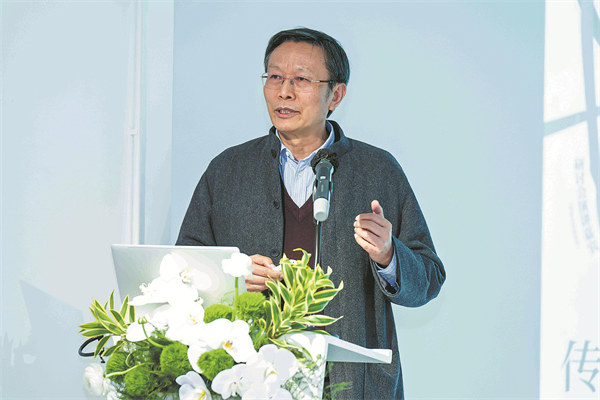
For decades, anthropologist Deng Qiyao has conducted field research on ethnic clothing in China's diverse multiethnic regions. [Photo provided to China Daily]
Eady firmly believed that literary and artistic exchange plays a vital role in promoting world peace. Folk stories and traditional customs represent some of the most vivid expressions of cultural philosophy, Xue writes. Such traditions should be documented before they disappear.
Over the next six years, the couple visited China twice annually in search of the right author — someone knowledgeable about ethnic ornaments and capable of telling their stories to a global audience.
Eventually they discovered Deng.
They learned that since the age of 23, Deng had spent three decades exploring China's southwestern border regions, documenting folk tales, clothing traditions and tribal histories. When Eady and Deng finally met, they quickly bonded over a shared fascination with ethnic culture.
Twelve years later, China Adorned has finally been published. "The hidden stories of life carried by the ornaments of China's ethnic groups will be recognized across various languages and cultures. These exquisite Chinese ornaments are poised to influence the global fashion industry, adding a vibrant chapter to the world's history of civilization and art through China's rich cultural diversity," Xue writes.
Ornaments form an essential part of traditional dress. They include a wide range of decorative items worn on the body, such as headpieces, brooches, necklaces, earrings, bracelets, belts and leg bands, Deng explains.
The 400-page book threads vivid stories by Deng about ethnic ornaments and 600 pictures with four themes — birth, coming of age, weddings, and funerals — of the ethnic groups including Tibetan, Jingpo, Yi, Yao, Jino, Mongolian, Kazak, Zhuang, Nu, Bai, Va, Derung, Gaoshan, and Naxi, inhabiting southern China and Northwest China's Qinghai province.
The photographs include more than 300 black-and-white images taken by Deng himself and more than 200 color photographs by British photographer Cat Vinton. Together, they capture the intricate details of ornaments worn during major life events — from Miao silver adornments to Tibetan agate jewelry and Dai beaded decorations.
"Ethnic clothing serves as a symbol of key life stages like birth, coming of age, marriage, and death, and represents commitments to family, clan, and society," Deng writes in the preface.
Traditional dress functions as a visual social code. It defines roles and relationships according to gender, age, ethnicity, social status and division of labor. At the same time, clothing reflects spiritual beliefs related to religion, taboos, destiny, souls and spirits.
"When you examine the patterns of these ornaments — the styles, colors, dyeing, and embroidery patterns of ethnic clothing, you'll discover a world of unique creativity and rich cultural significance. As you delve deeper, you enter an incredibly fascinating realm that bridges the ancient with the modern, connecting to their ancestors and history," he says.
"This history stretches back to mythical times and continues to the present, forming a remarkably rich cultural heritage."
However diverse, "ornaments represent just a small component of the overall outfit", he notes.
Now, Deng is working on the fifth volume of the eight-volume illustrated dictionary of Chinese ethnic costumes that he began more than a decade ago.
You May Like
-
Pink Confession of Kunming's Evening Primrose Sea
The wind in April is soft and gentle, bringing a bloom of flowers in its wake. "Evening Primrose"—Though its name holds a touch of mystery,its blossoms shine b...
InKunming 2025-04-25 -
Kunming Embraced in Paulownia's Purple Splendor
While cherry blossoms and peach blossoms flood social media after the Qingming Festival, the humble paulownia flower blooms quietly in the corners of old neighb...
InKunming 2025-04-16 -
Visionary sees village profit from tradition
Nestled in the lush mountains of Southwest China's Yunnan province, the small village of Laodabao was once connected to the outside world just by a rugged dirt ...
InKunming 2025-03-18 -
Utopia forged by women a modern model of harmony
On the shores of Lugu Lake in Yunnan province, visitors from around the globe have come to explore that question in a wooden house in Luoshui village, Lijiang.
InKunming 2025-03-18 -
Let's go to Yunnan to "chase the stars"
In this magical land of Yunnan, the pure and serene night sky is everywhere, and the stars and the Milky Way reflect each other, forming a fascinating picture s...
InKunming 2025-01-10 -
The "Alu Woluo" Festival of Achang People
carnival. The Achang people celebrate the “Alu Woluo” Festival. The "Alu Woluo" Festival originated from the Achang's hunting tradition of "Deng Woluo" (Wolu...
InKunming 2023-03-20 -
Sericulture prospers in Zhanyi, Qujing city
Yunnan’s Qujing City, sericulture and silk craftsmanship of Panjiang Town started in 1960s. After half a century of unrelenting efforts
InKunming 2021-06-19 -
Pic story: head of handicraft cooperative dedicates to promo...
In Xinsitu Village of Jinuo ethnic group, a handicraft cooperative has been set up by local women in an effort to inherit the weaving and embroidery skills of J...
InKunming 2020-12-29 -
One of Yunnan's best police dogs cloned
InKunming 2019-03-21 -
The story of peacock dancer
InKunming 2018-11-13