Xi underlines key role for economic powerhouses
Source: China Daily | 2026-03-06 | Editor:Flynn
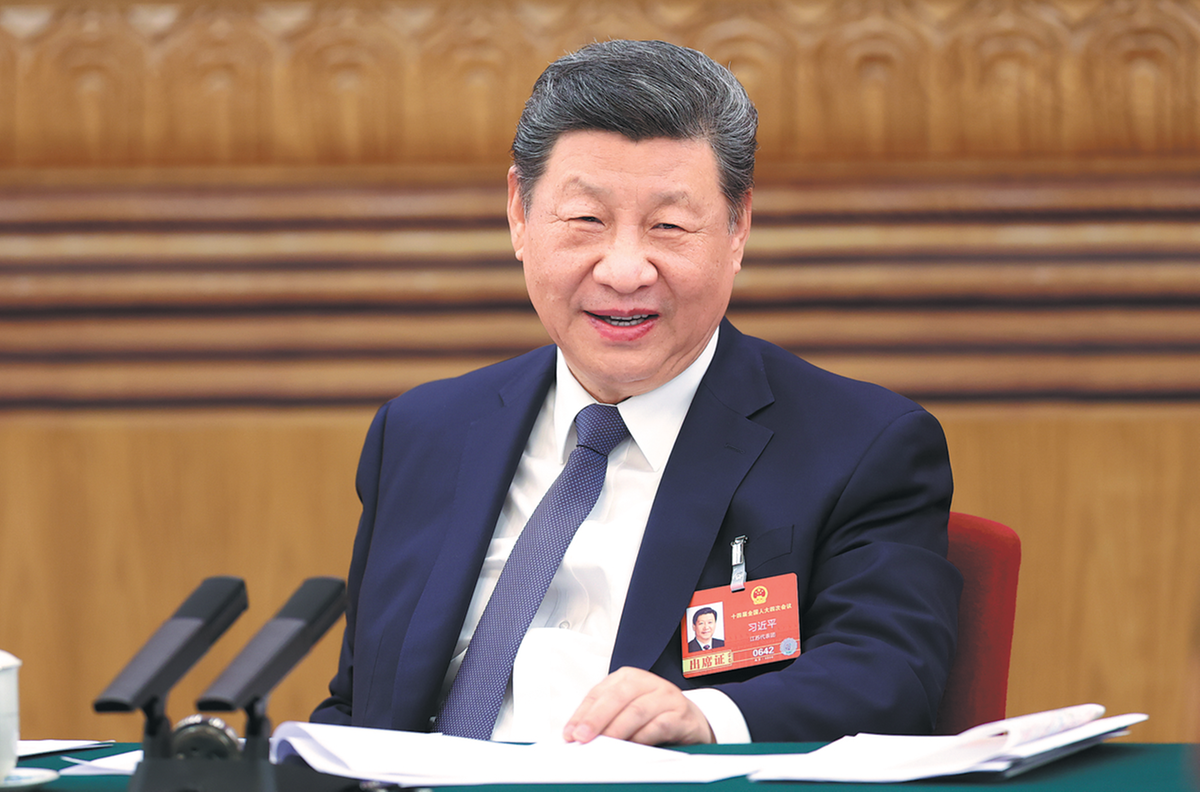
President Xi Jinping called on Thursday for provinces serving as China's economic powerhouses to pilot efforts in analyzing new circumstances and solving new problems, while stressing the need to develop new quality productive forces and promote common prosperity.
The president, who represents Jiangsu province as a deputy to the 14th National People's Congress, China's top legislature, highlighted the imperative for China to cope with an even more complex environment and solve more deep-seated issues to accomplish targets and tasks set out in the nation's 15th Five-Year Plan (2026-30).
Xi, who is also general secretary of the Communist Party of China Central Committee and chairman of the Central Military Commission, joined a deliberation with his fellow deputies from Jiangsu, the nation's second-largest provincial-level economy.
According to the government work report of the Jiangsu provincial government, the province's economy grew 5.3 percent year-on-year in 2025, with the absolute increase remaining the largest among all provincial-level regions in the country.
During Thursday's deliberation, Xi spoke after six deputies shared their insights on issues such as advancing new industrialization, promoting the integration of sci-tech innovation with industrial innovation, and accelerating breakthroughs in core technologies.
The development of new quality productive forces is instrumental in advancing high-quality growth and enhancing economic competitiveness, Xi said, adding that Jiangsu should take the lead in this regard.
He called for integrated efforts to promote education, science and technology and talent development, highlighting the need to secure new breakthroughs in strengthening original innovation, tackling key core technologies and securing the high ground in science and technology.
New approaches should be explored to promote the integration of the innovation, industrial, capital and talent chains, and to accelerate the efficient commercialization and application of sci-tech achievements, he said.
The president encouraged Jiangsu to make new progress in upgrading traditional industries, fostering and expanding emerging industries, and planning for future industries.
Xi emphasized that only when major economic powerhouses maintain a strong foundation for growth and strong resilience against external shocks can they support the stability of the world's second-largest economy as a whole.
According to data cited by Xinhua News Agency, China's top 10 provincial-level regions by gross domestic product accounted for 62.2 percent of the country's overall economic growth in 2025. These regions, including Guangdong, Jiangsu and Shandong provinces, helped boost the national growth rate by 3.1 percentage points, the data showed.
The president said that Jiangsu should continue to strengthen economic resilience by improving its internal strengths, enhancing its own capabilities, and fully integrating into the unified national market.
He called for taking steps to expand high-standard opening-up, actively explore global markets and better connect with the international economic cycle, adding that a mindset of responding to worst-case scenarios must be adopted in order to prevent various risks.
Xi pointed out that Chinese modernization is the modernization of common prosperity for all, and Jiangsu authorities should accurately grasp the new expectations of the people for a better life, as well as the evolving characteristics of work related to public well-being under the new circumstances.
The province should proactively address key issues such as ensuring high-quality and adequate employment, increasing incomes for both urban and rural residents, and further improving the level of basic public services and social security, while exploring effective pathways to promote common prosperity, he added.
Xi stressed that the more effective the Party's self-governance is, the stronger the guarantee will be for economic and social development.
He called for steps to properly carry out the Party-wide education campaign to promote a sound understanding of governance performance.
You May Like
-
China develops its first exoskeleton robot for mine emergenc...
China has successfully created its first exoskeleton robot system specifically designed for complex mine environments, marking a significant step toward "human-...
InKunming 2026-03-02 -
China releases national standard system for humanoid robotic...
China took a significant step toward regulating its rapidly growing humanoid robotics industry on Saturday, with the release of the country's first national sta...
InKunming 2026-03-02 -
China to continue supporting all efforts for peace on Ukrain...
China will continue to play a constructive role for peace in its own way and support all efforts for peace, a foreign ministry spokesperson said on Friday in ...
InKunming 2026-02-28 -
China aims to make children fit, happy via new guideline
Chinese children will spend more time outdoors, on artistic hobbies and handiwork after the country rolled out a new guideline to develop "healthy schools."
InKunming 2026-02-28 -
Explainer: Understanding common prosperity through China's n...
Over the past months, widening income gaps and strains on social security in some of the world's most developed capitalist countries have become a heated topic ...
InKunming 2026-02-28 -
HK to set up key industrial innovation site
The Hong Kong Special Administrative Region government will earmark about HK$220 million ($28.1 million) to establish the first national manufacturing innovatio...
InKunming 2026-02-27 -
Xinjiang's small-scale border trade ranks first in China in ...
Small-scale border trade in northwest China's Xinjiang Uygur Autonomous Region saw an import and export volume of 209.09 billion yuan (30.2 billion U.S. dollars...
InKunming 2026-02-27 -
New regulations for takeaway restaurants to take effect in J...
regulators seek to curb misleading practices and food safety risks. The new rules — introduced by the State Administration for Market Regulation on Thursday —...
InKunming 2026-02-27 -
China's import growth good for world trade
Chinese import growth will continue to expand, deepen and diversify in 2026, despite the US-led tariff wars.
InKunming 2026-02-27 -
China-Germany cooperation the only optimal solution to addre...
Chinese Premier Li Qiang said on Wednesday that cooperation between China and Germany is the only optimal solution to address risks, and development is the only...
InKunming 2026-02-26