China expands imports, shares growth globally
Source: China Daily | 2026-02-09 | Editor:Doe
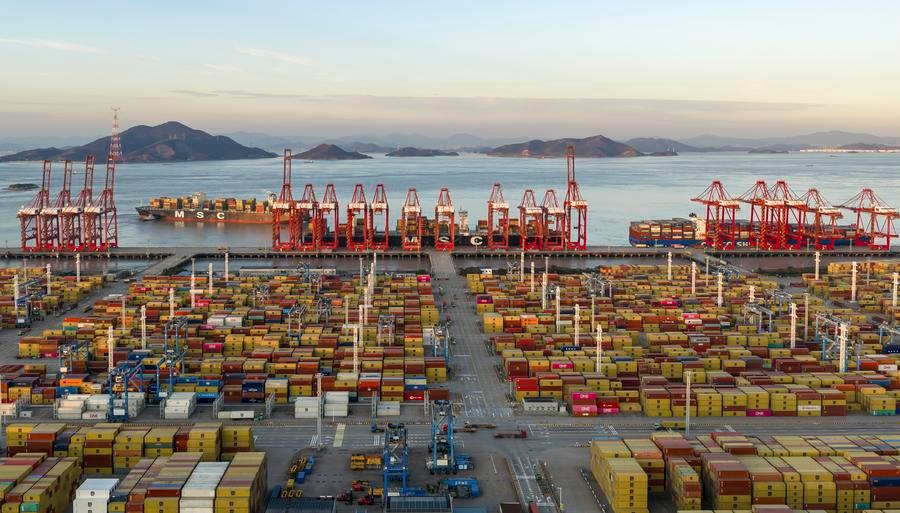
An aerial drone photo taken on Dec 4, 2025 shows a container terminal at the Chuanshan area of Ningbo-Zhoushan Port, East China's Zhejiang province. [Photo/Agencies]
China's drive to expand imports is emerging as a crucial feature of its high-level opening-up strategy, underscoring Beijing's commitment to sharing the opportunities of its vast domestic market with the rest of the world and, at a time of heightened economic uncertainty, offering predictable demand and a stable source of growth, market analysts and foreign business leaders said.
The emphasis on import expansion is consistent with President Xi Jinping's statements that China will remain committed to opening-up, and its development is not pursued in isolation, but in a way that seeks shared growth with the world.
Xi has said on multiple occasions that China will strengthen the domestic market and import more high-quality products, emphasizing that opening-up is a long-term commitment rather than a short-term policy choice.
Delivering a written speech at the APEC CEO Summit in Gyeongju, Republic of Korea, last year, Xi said that China can provide more growth opportunities for the global business community. It is now the world's second-largest market of consumption and imports, and the only developing country that hosts a national-level international import expo and continually opens its market to the world.
"The China market is huge and promising. We are continually advancing high-standard opening-up, and strive to help all sides succeed through greater openness and connectivity," said Xi.
Foreign business leaders and market analysts said the policy direction shows that China views its mega-sized market not merely as a national advantage, but as a platform for mutually beneficial engagement. Rising imports of high-quality goods, advanced technologies and services are helping align domestic demand with global supply, while enabling a wider range of economies to participate in and benefit from China's long-term growth trajectory.
The comments came as Commerce Minister Wang Wentao said the government will organize more than 100 import promotion events this year to bring together global sellers and Chinese buyers, ensuring that quality products and services not only gain access to the Chinese market, but, more important, secure solid sales.
Wang said China remains dedicated to turning its vast market into one that benefits the whole world, expanding the pie of cooperation, jointly tackling development challenges, upholding the multilateral trading system and free trade, and injecting positive momentum into the global economy.
"China welcomes all countries to capitalize on the new opportunities presented by its promotional series, aimed at making the country a preferred export destination for more countries across the world," he said.
He Yadong, a spokesman for the Ministry of Commerce, said that beyond targeted policies to improve import facilitation, refine sourcing and link imports with investment and consumption, the government will promote the "Export to China" initiative and expand imports with solid measures in the next phase.
China's goods imports reached 18.5 trillion yuan ($2.67 trillion) in 2025, making it the world's second-largest import market for the 17th consecutive year, statistics showed.
Meanwhile, China's imports from more than 130 countries and regions recorded growth, while the nation has emerged as a major export destination for nearly 80 countries.
Market watchers said China's import expansion is increasingly focused on quality upgrading rather than volume growth alone. At its core, these measures encourage a leap from quantitative satisfaction to qualitative enrichment, using consumption upgrading to drive supply-side innovation and power high-quality economic growth, said Denis Depoux, global managing director of management consultancy Roland Berger.
Wang Wei, an expert at the Development Research Center of the State Council in Beijing, echoed that view. "Given that China's imports are still heavily skewed toward commodities, it is practical to bring in more high-quality consumer goods, advanced equipment and specialized services to better match domestic demand, enrich supply and raise overall consumption quality," he said.
Mei Xinyu, a research fellow at the Chinese Academy of International Trade and Economic Cooperation in Beijing, said, "If Western countries ease their restrictive high-tech export controls on China, Chinese demand for imported products would expand significantly, creating market access and balanced, mutually beneficial trade flows."
From the perspective of trading partners, China's push to boost consumption and expand high-quality imports is translating into tangible opportunities.
Peter Wilson, the United Kingdom's ambassador to China, said that as China looks to boost domestic consumption and expand high quality imports, British businesses are well positioned to meet the needs of Chinese consumers. The UK will work actively alongside its Chinese partners to advance two-way trade, promote practical collaboration and support business growth, Wilson said, adding that this would deliver more concrete benefits for people in both countries.
European business representatives said the shift is also reshaping how foreign companies engage with the Chinese market.
Oliver Oehms, chief representative of the Delegation of German Industry and Commerce Beijing, said it is no longer just about German companies exporting more to China.
Now, it is about being here, competing in the Chinese market and matching the best international rivals, he said, adding that for German companies, China as a crucial destination for production and investment is a known fact.
You May Like
-
China Focus: Chinese scientists achieve major breakthrough i...
A research team from the University of Science and Technology of China (USTC) has achieved significant advances in the field of scalable quantum networks, bring...
InKunming 2026-02-06 -
China Focus: China's internet user base hits 1.125 billion a...
China had 1.125 billion internet users by the end of 2025, with the penetration rate climbing to 80.1 percent, according to an official industry report.
InKunming 2026-02-06 -
China strongly dissatisfied with EU probe into Chinese wind ...
China has voiced serious concerns and strong dissatisfaction over the European Commission's decision to launch an in-depth investigation into a Chinese wind pow...
InKunming 2026-02-05 -
Xi says ready to work with Trump to steer giant ship of Chin...
Chinese President Xi Jinping said on Wednesday that he hopes to work with U.S. President Donald Trump in the new year to steer the giant ship of China-U.S. rela...
InKunming 2026-02-05 -
"In-train fair" launched in NE China's Heilongjiang amid Spr...
China Railway Harbin Group Co., Ltd. has successively launched a number of themed tourist trains in recent years. At the same time, the company tries its best t...
InKunming 2026-02-05 -
Farm work in full swing across China at start of spring
A villager waters the melon seedlings at Xiayi County in Shangqiu City, central China's Henan Province, Feb. 4, 2026. Wednesday marks "Lichun," or the Beginning...
InKunming 2026-02-05 -
Economic Watch: How China is propelling agricultural moderni...
With the release of the 2026 "No. 1 central document," the first policy statement issued by China's central authorities each year, the country is set to advance...
InKunming 2026-02-05 -
Economic Watch: AI reshapes China's workforce via new profes...
The widespread rise of AI is modifying China's labor market in ways that go far beyond job replacement or creation. It has generated new professions, lowered th...
InKunming 2026-02-05 -
Shanghai sees over 320 new tech firms daily in 2025
Shanghai vigorously promoted scientific and technological innovation last year, with an average of more than 320 new tech firms established daily across this ci...
InKunming 2026-02-05 -
Xi urges breakthroughs in development of industries of the f...
Xi Jinping, general secretary of the Communist Party of China (CPC) Central Committee, has urged efforts to leverage the country's comparative advantages, pursu...
InKunming 2026-02-05