Integration of culture, tourism proves lucrative
Source: China Daily | 2024-03-01 | Editor:Ines
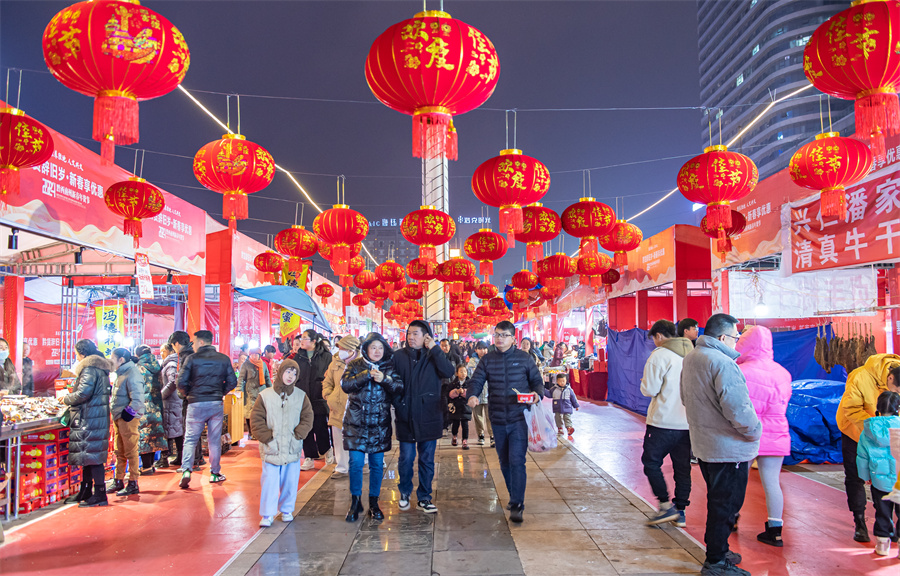
People visit a shopping festival to celebrate Chinese New Year in Xingyi city, Guizhou province, Jan 27, 2024. [Photo/Xinhua]
The integration of culture and tourism has been playing an increasingly important role in spurring the development of China's tourism sector since the country unveiled the Outline of the 14th Five-Year Plan (2021-25) for National Economic and Social Development in 2021.
Related proposals, such as those for preserving and utilizing intangible cultural heritage through tourism and using high-tech to help tourists better understand history, have been raised over the past two years at the annual meetings of China's top legislative and political advisory bodies.
Through the integration of culture and tourism, Yu Wulin, a deputy to the National People's Congress, has led efforts to build a prosperous tourism industry in his village in Yunnan province.
Yu, who is from Laomudeng, a village in the Nujiang Lisu autonomous prefecture, has set up a local ethnic cultural exhibition at his rural inn, displaying traditional farming tools.
He has also helped to arrange local cultural performances which have attracted many tourists to the village.
"I'll explore the further development of intangible cultural heritage and how it can create a more prosperous tourism sector and bring my fellow villagers a better life," Yu said.
Travelers' numbers and spending have experienced vigorous growth, as shown in many recent provincial government work reports.
"High-level recovery and high-quality development have become the most prominent features of the tourism industry this year," Du Jiang, vice-minister of culture and tourism, said at the China Tourism Industry Development Annual Conference in December.
Du attributed this to the resilience, potential and vitality of the economy, continuous reform and innovation in the industry, and the deep integration of culture and tourism.
Guizhou province in southwestern China has promoted the accelerated recovery of its tourism sector through multiple approaches, including the organization of the Rongjiang Village Super League, which became a national sensation.
At least 1 million people attended the soccer matches in person and more than 50 million watched online in three months, according to local authorities.
Videos and live broadcasts of the event went viral, having received more than 30 billion clicks.
Last year, the province saw its traveler numbers and total tourism revenue recover to 113 percent and 119 percent of the levels in 2019, before the pandemic hit.
In northern Shaanxi province, new cultural and tourism formats were created last year, including two national-level tourist leisure districts, two national immersive cultural and tourism demonstration projects, and three national tourism performances.
These initiatives have spurred the development of Shaanxi's cultural and tourism industries. The province received 109 million traveler visits last year, up 271.9 percent year-on-year.
During the recently concluded Spring Festival, the authorities in Beijing arranged diverse cultural activities, such as temple fairs and themed exhibitions, which received a positive market feedback.
The number of these events exceeded 2,100, which was 300 percent more than the figure for the Spring Festival holiday in 2019.
These played an important role in stirring up the public's travel enthusiasm during the eight-day holiday, said a senior official from the Beijing Municipal Bureau of Culture and Tourism.
The capital city received a total of 17.5 million traveler visits during the festival, up 25.7 percent over the same holiday period in 2019, with total tourism income increasing by 27.4 percent over 2019, the bureau reported.
In particular, traditional folk arts made their presence felt at the major temple fairs across Beijing, attracting a total of 5.2 million visits.
Tang Yan drew a great deal of attention with her seven-day display of delicate Beijing Juanren at the Ditan temple fair, one of the most popular of its kind.
"Visitors lay siege to our booth, making inquiries and buying our art products," Tang said, taking great pleasure in the popularity of her beloved traditional art, a silk figurine which first appeared during the Han Dynasty (206 BC-AD 220).
Li Yingqing contributed to this story.
You May Like
-
Space-themed tourism takes off in Gobi Desert
The remote and expansive Gobi Desert in northwest China is increasingly accessible to the public, thanks to the emergence of space-themed tourism, which has ope...
InKunming 2024-01-29 -
Snow and ice tourism fuels diverse sectors in China
Northwest China's Harbin City in Heilongjiang Province has become a sought-after tourist destination this winter.
InKunming 2024-01-18 -
China Focus: China's tourism consumption boosted by bustling...
China's tourism consumption has seen a surge thanks to a bustling New Year holiday travel spree to cultural events, sightseeing as well as ice and snow amusemen...
InKunming 2024-01-03 -
Heilongjiang, a popular destination for winter tourism in Ch...
Heilongjiang Province, a popular destination for winter tourism in China during the New Year holiday.
InKunming 2024-01-03 -
China's new visa-free policy to boost tourism, economic exch...
After learning about China's new visa-free entry policy, German tourist Krause Arthur Robert immediately booked a ticket for an impromptu trip to Shanghai.
InKunming 2023-12-06 -
China's cruise tourism industry sees promising revival
Boasting Mediterranean-style décor, global cuisine and boutique shopping, the cruise ship "Mediterranea" left north China's Tianjin on Sept. 30 for Sasebo and F...
InKunming 2023-10-10 -
China greets "golden week" holiday tourism spree
With this year's super-long "golden week" spanning both the Mid-Autumn Festival and the National Day holidays in full swing, Chinese people are fervently hittin...
InKunming 2023-10-07 -
Overseas tourism for holidays flying high
The upcoming Mid-Autumn Festival and National Day holiday are expected to witness a surge in the number of Chinese tourists traveling abroad, fueled by continuo...
InKunming 2023-09-07