返回顶部
返回顶部

Customers shop at a 7Fresh supermarket by JD.com in Daxing district of Beijing on Feb 19. CHINA DAILY
Fast-moving consumer goods sales in urban China grew 1.5 percent year-on-year in 2025, said Kantar Worldpanel China, a marketing research institute, signaling steady growth in the retail sector where consumption patterns are evolving.
The National Bureau of Statistics said final consumption expenditure accounted for 52 percent of the country's economic growth in 2025, up 5 percentage points from the previous year.
Retail giant Walmart China consolidated its position as a leader in the Chinese retail market last year. The company posted strong performance in the Chinese market in its latest quarterly earnings, with net sales reaching $6.1 billion in the fourth quarter of 2025, a 19.3 percent increase from the same period in 2024.
Despite a delayed Spring Festival season in February, which typically boosts retail activity, Walmart recorded a 10.7 percent growth in comparable sales, driven by strong momentum from its Sam's Club membership business and e-commerce.
Sam's Club continues to post double-digit growth in transactions. The warehouse chain, which focuses on high-end, bulk-selling products for middle-income urban families, opened 10 new stores in the past 12 months, including six in the most recent quarter. The company was operating 63 clubs as of January.
Its e-commerce business saw a 28 percent year-on-year increase in the fourth quarter, now accounting for over 50 percent of the retailer's total sales.
For fiscal year ended Jan 31, 2026, Walmart's total global revenue reached $713.2 billion, up 4.7 percent year-on-year, with adjusted operating profit increasing 5.4 percent to $31.1 billion.
It continues to focus on innovation and growth in China, and recently partnered with RedNote, a leading social media platform in the country.
The collaboration aims to co-create new products and customer shopping experiences. The two sides recently launched a co-branded product line and opened a new retail space at Walmart's Shekou location in Shenzhen, Guangdong province. This partnership signifies the company's commitment to integrating social commerce and digital engagement into its physical retail strategy.
Additionally, Walmart is accelerating the rollout of its community stores model by opening four new stores in Shenzhen in February. The move is aimed at urban middle-income consumers with fast access to high-quality products and convenience.
Meanwhile, the retailer's expansion of its private label, Marketside, also aligns with changing consumer preferences for fresh and high-quality products at competitive prices. The private label — which emphasizes simplicity, collaboration with top suppliers and a price-to-quality ratio — now includes nearly 1,000 new products in categories like fresh produce, food and beverages, Walmart said.
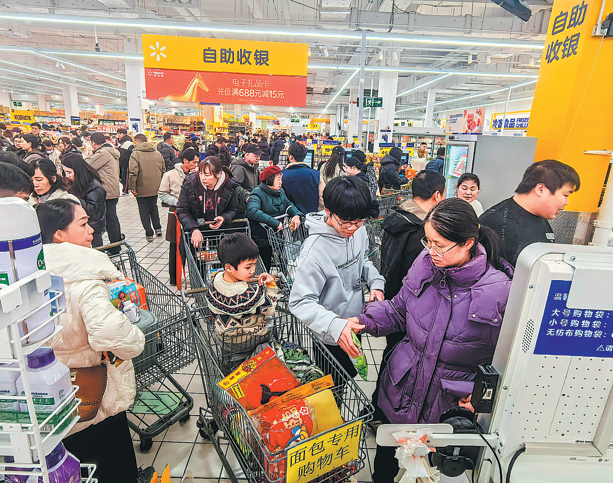
A Walmart store in Optics Valley of China in Wuhan, Hubei province, is bustling with shoppers on Feb 8. ZHU XIYONG/FOR CHINA DAILY
Retailers in China are increasingly focused on differentiation through developing private brands. In 2025, the penetration rate of private labels reached 56.8 percent, an increase of more than 11 percentage points compared to the previous year, said Worldpanel. This trend is particularly evident in smaller cities, where demand for private labels has surged, outpacing growth in larger urban markets.
Freshippo, owned by Alibaba, has been expanding aggressively with a dual-format strategy combining traditional supermarkets with the innovative Freshippo NB model. In 2025, Freshippo achieved a penetration rate of 12.9 percent, Worldpanel said.
Meanwhile, JD.com's 7Fresh supermarket chain continues to expand its footprint in North China through a hybrid model, which combines physical retail locations with the convenience of local warehouse centers. This model enabled the retailer to extend its reach and increase its market penetration by 0.7 percentage point in 2025.
Discount formats also remain a favored choice for consumers. The latest Worldpanel report said that penetration rates for bulk snack stores and discount shops increased by 4.8 and 2.9 percentage points, respectively, in 2025.
Aldi, for instance, has ramped up its expansion efforts in the Yangtze River Delta, with its penetration rate in East China increasing by 2.2 percentage points. The German retailer plans to open 100 stores in China by the end of the first quarter of 2026.
Looking ahead, it is expected that the expansion of the consumer base will serve as a critical engine for growth. Moreover, the focus on "products" has shifted from large-scale displays to demand adaptation. Retailers are building exclusive advantages by developing their private labels. On the other hand, brands need to create product portfolios tailored to specific scenarios.
"Channels are no longer merely carriers for shelf display, but have become key hubs connecting consumers and products," said Worldpanel, adding that food and beverage categories led the growth, with annual sales increasing by 3.6 percent and 3.1 percent, respectively. In 2025, the household cleaning and personal care categories both achieved growth, while dairy products faced dual pressures in terms of both sales and volume growth.
French food and beverage producer Danone posted strong momentum in China, North Asia and Oceania in the fourth quarter, with sales up 10.4 percent like-for-like. Specialized nutrition continued to grow strongly, equally driven by infant milk formula and medical nutrition. The company also had a solid performance in its water business in China last year.